
In one sentence: A bear call credit spread pays you cash upfront to bet that a stock stays below a certain price for a short window - with your maximum loss capped, no matter how far the stock rips higher.
What this strategy actually is
Think of it like collecting rent on a stock you believe has run out of steam. You promise to sell the stock at a specific price - called the "short strike" - by a specific deadline. Someone pays you cash upfront for that promise. To keep your risk from spiraling if the stock rallies hard, you also buy an insurance policy: another call at a higher strike price. That insurance caps your maximum loss.
You keep the rent you collected if the stock stays below your short strike through the expiration date. If the stock climbs above your short strike, you start giving back some of that credit - but the long call you bought puts a hard ceiling on how much you can lose. There is no scenario, no matter how far the stock spikes, where you lose more than the width between your strikes minus the credit you took in.
The bias: mildly bearish or neutral. The trade wins if the stock sells off, drifts sideways, or even grinds up a little - as long as it stays below your short strike at expiration. You do not need to be right about a crash. You just need the stock to not run away to the upside.
The payoff picture
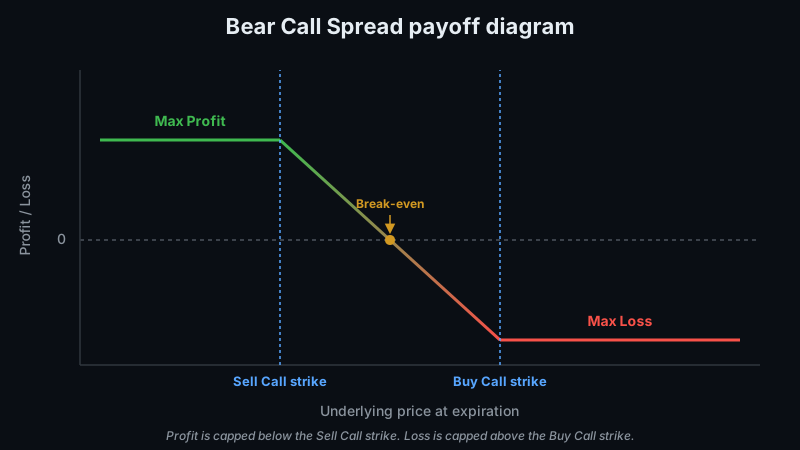
The diagram above shows exactly what happens at expiration. Read it from left to right:
- Max Profit zone (left, green): if the stock closes below your Sell Call strike, you keep the full credit. This is the outcome you are underwriting the trade for, and it is the widest zone on the chart when you pick your strikes with room to spare.
- Break-even zone (middle): between the two strikes, your profit and loss slides linearly. The higher the stock climbs past your short strike, the more of your credit gets eaten up, until you cross the break-even price and start losing money.
- Max Loss zone (right, red): if the stock closes above your Buy Call strike, you are at maximum loss. It does not get worse from there - the long call you bought is doing its job, capping the damage at a fixed, known dollar amount.
A real example: QQQ at $480
Let us put real numbers on it. Assume QQQ is trading at $480 today. You look at options expiring in about a month and pick two strikes:
- Sell (short) the $485 call for $2.30 in premium
- Buy (long) the $490 call for $1.50 in premium
- Net credit into your account:
$2.30 - $1.50 = $0.80, or $80 per spread
Max profit: $80 per contract (the credit)
Max loss: $500 - $80 = $420 per contract (if QQQ closes above $490 at expiration)
Break-even at expiration: $485 + $0.80 = $485.80
Return on the risk you took: $80 / $420 = 19 percent
Notice the strike width is $5 (from $485 to $490), so your max loss on the spread is capped at $500 minus the $80 credit, or $420 per contract. As long as QQQ finishes expiration day anywhere at or below $485, you keep the entire $80. Between $485 and $485.80 you keep a partial credit. Above $485.80, you are losing money, up to the $420 cap above $490.
When this strategy works best
Three things should line up before you open any credit spread:
- The stock is going sideways or slightly down. Bear call spreads are not a crash-prediction tool. You are not trying to time a collapse - you are betting that a stock has stalled out, is losing momentum, or is simply unlikely to make a sharp move higher before your expiration date.
- Options are "expensive." When implied volatility is elevated, the premium you collect for selling the call is fatter relative to the risk you are taking on. Selling spreads when volatility is rich is generally a better trade than selling them when volatility is already cheap and has little room to compress further.
- There is clear resistance above your short strike. A prior swing high, the 200-day moving average approached from above, or a high-volume node on the chart all give you a level that has previously turned back buyers. Placing your short strike above one of these levels gives the trade a technical reason to work, not just a hope that time decay bails you out.
The rules that keep you profitable
Close winners at 50 percent of max profit
Do not hold a bear call spread to expiration hoping to squeeze out the last few dollars. Once you have captured about half of the maximum credit, buy the spread back and move on. The last portion of premium decays slowly and is not worth the added exposure to a sudden gap higher.
Stop out if the trade doubles against you
If the spread's value grows to roughly two times the credit you collected, that is a signal the stock is pushing through your short strike with conviction. Close it. A defined-risk trade is only useful if you actually use the discipline it is designed to enforce, rather than riding it all the way to max loss out of stubbornness.
Never hold through earnings unless that IS the plan
Earnings gaps do not care about your resistance level. A stock that has been quietly stalling out for weeks can gap 8 percent higher overnight on a beat, blowing straight through both of your strikes before you get a chance to react. If you are not deliberately trading the earnings event itself, close or avoid opening spreads that straddle the report date.
Cap your daily losses
Set a hard number - in dollars or as a percentage of your account - for how much you are willing to lose in a single day across all your spreads. Credit spreads can lull you into oversizing because the win rate tends to look good over any short stretch; a hard daily cap keeps one bad session from undoing weeks of small, steady credits.
Common mistakes I see
Selling too close to the money for the extra credit
A short strike right at the current price collects more premium, but it also means a much smaller move against you turns into a loss. Give the trade some breathing room - selling further from the money means less credit per spread, but a meaningfully higher probability of actually keeping it.
Averaging down into a losing bear call spread
When a stock rips higher through your short strike and keeps climbing, the temptation is to sell another spread at a higher strike to "fix" the trade or lower your average cost. This usually just doubles your exposure to the same directional risk at the exact moment the market is proving you wrong. Take the defined loss and reassess instead of digging in deeper.
Ignoring the chart
It is tempting to sell a bear call spread purely because premiums look rich, without checking whether the stock is sitting right below a broken resistance level or in a clean uptrend. Implied volatility tells you the market's price for risk; it does not tell you which direction the stock is actually likely to go. Pair the premium with the technical picture before you place the trade.
How GenZTrade helps you find these setups
- Momentum Scanner flags stocks with confirmed technical breakdown - names losing momentum, rolling over below key moving averages, or failing to reclaim prior highs - so you are not guessing at which tickers are actually weakening.
- Options Plays auto-generates credit spread cards with strikes, credit, break-even, and probability pre-computed, so you can scan for bear call setups without building the spread by hand every time.
- High Volume Points overlays support and resistance levels on the chart, helping you confirm your short strike sits below a real resistance level rather than in open air.
Bottom line
Bear call credit spreads are boring, in the best way. You are not trying to call the exact top or predict a crash - you are collecting a defined credit for betting that a stock stays below a level that has already shown it can act as resistance. Pick your strikes with room to spare, size the trade so a max loss will not wreck your week, and let time decay do the work. Do it enough times, with enough discipline around exits, and the small, capped wins tend to add up - though as with any options strategy, no setup removes the risk of loss, and past results never guarantee future ones.
Comments (0)