
In one sentence: the best options strategy for a small account is whichever one matches your actual capital, not whichever one performed best on someone else's screenshot.
Why most options content ignores small accounts
Open most options trading guides and they quietly assume you're working with $25,000 (the pattern day trader minimum) or $50,000+. The default playbook that comes with that assumption - selling naked puts, holding 100 shares of a $150 stock for covered calls, running iron condors across multiple expirations - simply doesn't fit into a $500-2,000 account. It's not that these strategies are bad. It's that they were never built for the account size a lot of GenZTrade readers are actually starting with.
A smaller account needs a different ranking system: not "what's the most sophisticated strategy" but "what actually fits inside my buying power, in order of how much capital it really requires." Below are four strategies that scale down to a $500-2,000 account, roughly ordered by capital needed, plus what to avoid and how to size in from here. Small accounts also mean less room for error - a single oversized loss is a much bigger percentage hit than it would be in a larger account, so capital efficiency and position sizing matter more here, not less.
Ranked by capital required
Cash-secured puts on lower-priced stocks
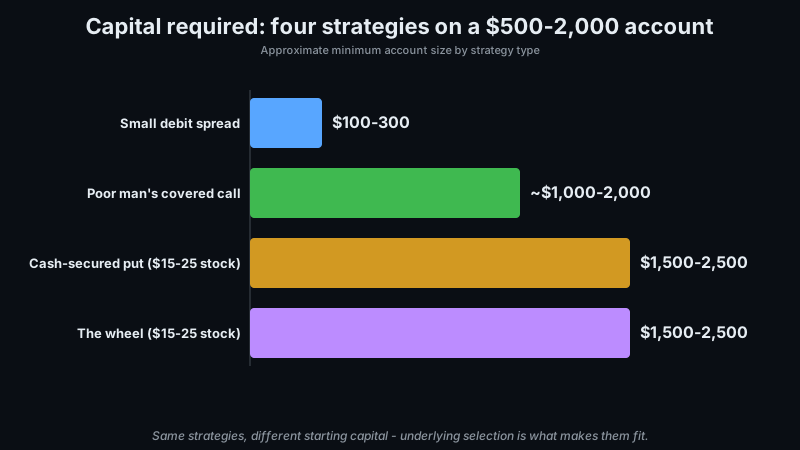
Capital required for a cash-secured put (CSP) is simply the strike price x 100 shares. That math is what locks most small accounts out of CSPs on expensive names - a $400 stock needs $40,000 in cash to secure one contract. But the strategy itself scales down cleanly: pick a $15-25 stock instead, and the same CSP now needs $1,500-2,500. This is the core advantage of CSPs for a small account - you're not locked out of the strategy, you just have to pick underlyings that fit your account rather than the ones getting attention that week.
- $400 stock, $400 strike: $40,000 required
- $20 stock, $20 strike: $2,000 required
Small debit spreads (bull call spreads / bear put spreads)
A debit spread caps your max loss at exactly what you pay for it - often $100-300 per spread depending on strike width and how far out of the money you go. That defined, known-in-advance risk makes position sizing genuinely controllable in a small account: you know your worst case before you enter, and it's a fixed dollar amount rather than a percentage of a stock price that can move against you overnight. The tradeoff is symmetrical - your profit is capped too, at the width of the spread minus what you paid. For a small account, that predictability is often worth more than the uncapped upside you're giving up.
Poor man's covered calls (PMCC)
A PMCC swaps the 100 shares in a traditional covered call for a deep in-the-money long call (LEAPS), then sells shorter-dated calls against it. The capital required is roughly 20-30 percent of owning the shares outright - see our dedicated PMCC guide for the full strike selection and math - which means a small account can run a covered-call-style income strategy on a $100-200 stock that would otherwise require $10,000-20,000 in shares. It's the strategy on this list that unlocks the widest range of underlyings for the least capital, but it also carries more moving parts (two option legs, time decay on both sides) than a straightforward CSP or debit spread.
The wheel strategy on lower-priced names
The wheel starts with a cash-secured put and, if assigned, rolls into selling covered calls on the shares you now own. Because the entry leg is a CSP, the capital math is identical: strike price x 100. That means the wheel scales the same way a standalone CSP does - a $10-20 stock lets a small account run the full cycle, while a $400 stock would eat an entire $1,000-2,000 account in a single cash-secured put and leave nothing for anything else. The wheel is really a sequencing strategy layered on top of CSP capital requirements, so the underlying selection matters just as much here as it does above.
What to avoid in a small account
A few things are worth avoiding regardless of which strategy you pick:
- Naked positions that need a margin buffer. Many brokers won't even approve a small account for naked selling without significantly more capital and a higher options approval tier - and even where it's technically allowed, the open-ended risk is genuinely harder to manage with less cushion behind it.
- Oversizing a trade because "it's a small account anyway." This is backwards. Position sizing rules matter more, not less, when the account is small - one bad trade in a $1,000 account that's sized at 40-50 percent of capital is a far bigger hit than the same mistake in a $50,000 account.
- Chasing high-premium, low-priced speculative stocks purely because the premium looks big relative to account size. A fat premium on a thinly traded $8 stock often comes with wide bid-ask spreads that quietly eat the edge you thought you had. Liquidity and spread quality matter just as much on a $1,000 account as they do on a $100,000 one.
A realistic path forward
Start with one strategy and one position, sized so a full loss doesn't meaningfully damage the account. A common rule of thumb small-account traders use is capping any single position's max loss at 5-10 percent of total account value - on a $1,500 account, that's roughly $75-150 per trade. Add position count and size gradually as the account actually grows, rather than trying to run CSPs, spreads, and a PMCC simultaneously from week one. Concentration risk is inherently higher in a small account, since fewer positions means each one carries more weight - so the growth path is width and size increasing over time, not complexity increasing on day one.
How GenZTrade helps you find these setups
Finding candidates that actually fit a small account is the harder part in practice - most screeners aren't built to filter for it. Options Plays surfaces capital-efficient candidates like debit spreads and cash-secured puts sized to what a smaller account can actually support, so you're not manually checking whether a $400 stock's CSP fits your buying power before you've even looked at the setup. Portfolio tracks your account size and position sizing alongside your open trades, which makes it easier to see in real time whether a new position keeps you inside the sizing rules you set for yourself, rather than finding out after the fact.
Bottom line
None of these strategies are guaranteed to make money, and a small account doesn't change that math - it just changes which strategies are realistically available to you. The honest starting point is picking one strategy whose capital requirement actually fits what you have, sizing each position so a loss doesn't wreck the account, and letting the number of strategies and positions you run grow alongside the account itself rather than the other way around.
Comments (0)