
In one sentence: a stock screener is only as good as the criteria you plug into it, and most people either use way too few filters (and drown in noise) or way too many (and get zero results, ever).
There are roughly 8,000 publicly traded stocks in the U.S. alone. You are not going to look at all of them, and you shouldn't try. The entire point of a screener is to take that number down to something you can actually think clearly about — 10, 20, maybe 30 names a day — by rejecting everything that doesn't fit a setup you actually trade. This isn't about finding "the best stock." There is no such thing on a given morning. It's about building a filter that reliably throws out the stocks that would waste your time and money, so what's left is worth a closer look.
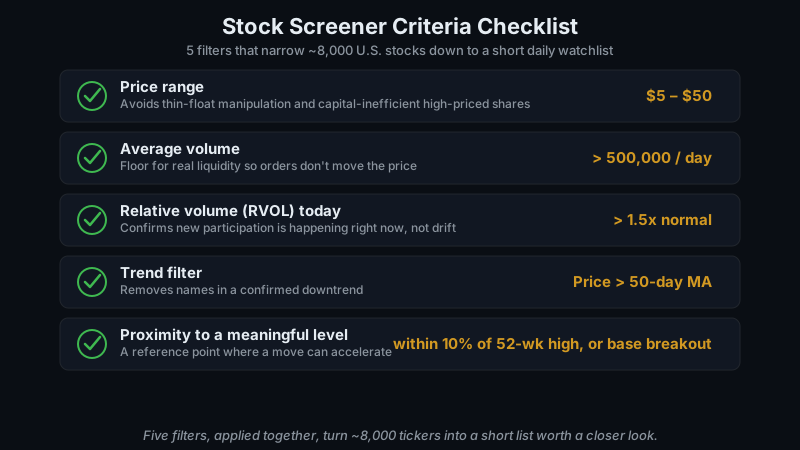
Below is a checklist of five criteria that do most of the work. You don't need more than this to start, and honestly, most traders would improve their results by using fewer, better-chosen filters instead of stacking on more.
The core filter checklist
Price range: $5 to $50. This isn't a moral judgment about "quality" — it's about risk mechanics. Below $5, you're in a zone where thin float, low institutional interest, and outright manipulation are far more common; the stock can be pushed around by a handful of large orders with no real news behind it. Above $50, share price starts working against a small account: you either can't buy a meaningful position size, or you're forced into fractional shares or options just to get exposure, which adds complexity you didn't ask for. The $5-$50 band filters out both the manipulation-prone bottom and the capital-inefficient top.
Average volume: over 500,000 shares per day. This one is about liquidity, not popularity. A stock trading 50,000 shares a day might look fine on a chart, but the bid-ask spread will eat into your entry and exit, and you may not be able to get out at the price you see when you actually need to. Half a million shares of average daily volume is a rough floor for "there's enough real trading activity here that my order won't move the price by itself." Anything below that gets filtered out regardless of how good the chart looks.
Relative volume today: above 1.5x normal. Average volume tells you a stock is generally liquid. Relative volume (RVOL) tells you something is happening right now. A stock trading at 1.5x or higher its normal volume today is seeing real participation — new money is showing up, not just the usual drift of existing holders shuffling shares. This filters out stocks that technically pass every other screen but are just sitting there on a quiet day. Low RVOL is often the fastest way to spot a setup that looks good on paper but has no actual interest behind it today.
Trend filter: trading above the 50-day moving average. This is a blunt instrument, and that's the point. Requiring the stock to be above its 50-day average filters out names in a confirmed downtrend — the ones where every bounce has been sold and every rally has failed. It won't catch every bad setup, and it will occasionally exclude a stock that's about to turn around. But as a first pass, "is this thing even in an uptrend" is a cheap, effective way to remove a big chunk of stocks that simply aren't in the right regime for a breakout-style trade.
Proximity to a meaningful level: within 10% of a 52-week high, or breaking out of a defined base. This is the readiness filter. A stock can be liquid, in an uptrend, and seeing high relative volume, and still be in the middle of nowhere on the chart — no level nearby, no reason for buyers or sellers to act. Being close to a 52-week high, or breaking out of a base that's been building for weeks, means there's an actual reference point where a move can accelerate: breakout buyers stepping in, short sellers covering, resistance flipping to support. This filters out stocks that are merely "cheap" or "moving" with nothing structurally interesting about their position on the chart.
The tradeoff: don't over-filter
Here's the failure mode nobody warns you about: stacking every strict version of every criterion until your screener returns zero results on most days. Price $10-$20 only, volume over 2 million, RVOL above 3x, within 3% of the 52-week high, above the 20-day and 50-day and 200-day moving averages — technically each filter makes sense in isolation, but combined they're so narrow that you're effectively asking the market to hand you a guaranteed winner. It won't.
If your screener comes back empty for several days in a row, that's not proof the market has nothing going on. It's a signal that one of your thresholds is too tight for current conditions. Maybe RVOL of 1.5x is unrealistic in a low-volatility week and you loosen it to 1.3x. Maybe the 10% proximity-to-high filter is too strict in a choppy market and 15% is more realistic. The goal is a screener that consistently returns a small, workable list — not one that returns nothing, and not one that returns 200 names either. Both extremes mean your filters aren't calibrated to what the market is actually doing right now.
How GenZTrade helps you find these setups
You don't have to rebuild this checklist from scratch every morning. GenZTrade's Momentum Scanner runs this exact kind of filter set automatically, scanning for stocks that combine price range, trend, and proximity to key levels so you're not manually cross-referencing five different screens before the market opens.
For the volume and liquidity side specifically — average volume and relative volume — High Volume Points is built to surface exactly where unusual volume is showing up in real time, which is the fastest way to confirm that a stock passing your other filters actually has real participation behind it today, not just a chart pattern that looks fine in isolation.
Bottom line
A screener finds candidates. It does not find certainties. Every name that clears all five filters above still needs its own individual read — what's the news, what's the sector doing, where's the actual entry, where does the trade become wrong. The screener's job is to narrow 8,000 stocks down to a short list worth your attention. Your job is everything that happens after that list lands in front of you. Skipping that second step because a stock "passed the screen" is how good filters end up producing bad trades.
Comments (0)