
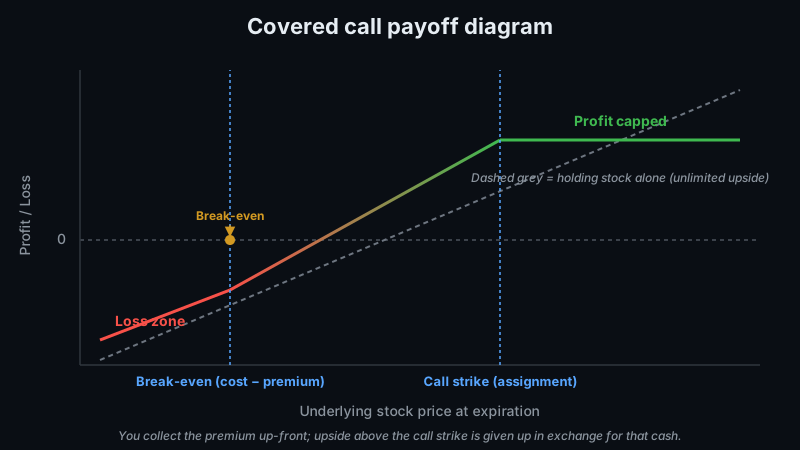
In one sentence: The strike and expiration on a covered call matter less than most traders think - the timing of when you sell it is what actually determines whether you collected real premium or left money on the table.
Most covered call guides talk about mechanics: pick a strike, pick an expiration, collect premium, repeat. What they skip is that the exact same trade - same stock, same strike, same expiration - can pay you wildly different amounts depending on when you pull the trigger. This article is only about that timing question.
Why IV rank matters more than raw IV
A stock's implied volatility (IV) on any given day means very little on its own. What matters is where that IV sits relative to the stock's own recent history - that's IV rank (or IV percentile). A stock with "high" IV of 35% might actually be at the low end of its normal range if it usually trades at 45-50% IV. Selling calls there is selling cheap premium and calling it expensive.
IV rank tells you whether option premium is rich or cheap for that specific stock, right now. When IV rank is elevated - say above 50 - option sellers are being paid more than usual for taking on the same risk. That's the environment where covered call premium is worth collecting. When IV rank is low, you're getting paid a below-average rate for tying up your shares, and the trade isn't worth the opportunity cost.
Rule of thumb: Don't ask "is IV high?" Ask "is IV high for this stock, relative to where it usually sits?"
Why it matters: A 30% IV reading can be rich for a sleepy utility stock and cheap for a volatile growth name.
What to check: IV rank or IV percentile over the past 6-12 months, not just the current IV number.
The 30-45 day sweet spot
Days to expiration (DTE) is the second timing lever, and 30-45 days is the range most experienced covered call sellers default to. Here's why the edges of that range are worse:
- Weeklies (7-10 days): Theta decay is fast, but you're making a new timing decision every week - more chances to sell into a bad IV rank window, more whipsaw from earnings dates and news catching you mid-cycle, and more transaction friction.
- 60+ days out: Premium is higher in dollar terms, but theta decay is slow at the start of an option's life, so your capital (in the form of shares that can't be sold or repositioned without unwinding the call) sits mostly idle for weeks before decay accelerates.
- 30-45 days: This is roughly where theta decay starts accelerating meaningfully while still giving you a wide enough window to avoid constant re-entry decisions.
This isn't a hard rule - some traders run 21-30 DTE, others prefer 45-60 - but 30-45 is the range where the tradeoff between decision frequency and decay speed tends to work best for most covered call sellers.
Timing around earnings
Earnings dates are where covered call timing gets genuinely tricky, because they cut both ways.
Selling right before earnings
Implied volatility rises heading into an earnings report because the market is pricing in the uncertainty of the outcome. Sell a call while that IV is elevated and you collect a richer premium than you would in a quiet period - this is the IV crush effect working in your favor as a seller, since IV typically collapses right after the report regardless of which way the stock moves. The catch: you're still holding the shares and the short call through the actual event, so a big gap - up or down - happens before you've had any chance to react.
Selling right after earnings
Once the report is out, IV crushes immediately. Now you're selling calls into a market that just deflated the very premium you wanted to capture. This is close to the worst timing window for a covered call seller - all the uncertainty (and the reward for selling into it) is gone, but the stock could still be volatile in its aftermath without any premium cushion to show for it.
Worked example: same trade, two different timing outcomes
Say you own 100 shares of Apple, bought at $170. Apple has since climbed to $180. In both scenarios you sell the same $185 call, 35 days to expiration - the only thing that changes is when you sell it.
Scenario A - good timing: Earnings are 10 days away, IV rank is 65 (elevated relative to Apple's own recent history). The $185 call prices at $2.50, or $250 per contract.
Scenario B - bad timing: No catalyst, quiet drift, IV rank is 18 (low). The same $185 call, same 35 DTE, prices at only $1.10, or $110 per contract.
Difference: $250 - $110 = $140 extra premium per contract, purely from timing the IV rank, not from picking a different strike or expiration.
That $140 is real and it's repeatable - it's not luck, it's the market paying you more to sell volatility when volatility is priced richer relative to its own normal range. But Scenario A isn't a free upgrade. Selling into that 10-day earnings window means the short call and your shares are exposed to the report itself. If Apple gaps up hard past $185 on the news, your shares get called away below where the stock is trading and you cap your upside earlier than you'd like. If Apple gaps down hard, you're sitting on a paper loss on the shares that the $250 premium only partially offsets. Scenario B avoids that gap risk entirely by selling into a quiet period, but it pays for that safety with a thinner premium. This is a genuine risk/reward tradeoff, not a way to get extra money for free.
Timing after a big move vs. a quiet drift
The Apple example above also illustrates a separate timing wrinkle: the stock had already run from $170 to $180 before either call was sold. Selling a covered call right after a sharp up-move captures rich premium (volatility tends to be elevated after a big move too), but the strike needs to account for the fact that the move has already happened - a strike that looked comfortably out-of-the-money last month may now be uncomfortably close.
Selling into a quiet, rangebound stock is the opposite problem: premiums are thin because there's been no move to price in, so getting a worthwhile premium usually means selecting a strike closer to the current price - which in turn means giving up less upside room before your shares get called away. Neither environment is automatically better; they just require different strike discipline.
How GenZTrade helps you find these setups
Timing a covered call well means checking several things at once, which is exactly what GenZTrade's tools are built to speed up. The Intel Panel surfaces options flow, news sentiment, and upcoming earnings dates in one place, so you can see at a glance whether a stock is heading into a catalyst window before you sell a call against it. The Momentum Scanner flags stocks that have already made a significant move, which is useful context for the strike-selection question above. And Options Plays auto-generates covered call cards with the strike, premium, delta, break-even, and annualized yield already computed, so you can compare a 30-day setup against a 45-day setup, or a pre-earnings entry against a post-earnings one, without building the math yourself.
Bottom line
Covered call timing isn't about finding a secret formula - it's about checking IV rank relative to the stock's own history, staying in the 30-45 DTE range more often than not, and being deliberate about whether you're selling into an earnings catalyst or away from one. The $140 difference in the Apple example above is a real edge, but it comes bundled with real gap risk, not a guarantee. No covered call strategy, no matter how well-timed, removes the risk of loss - you can still see your shares called away below a post-move price, or sit through a gap down that a premium check doesn't fully cushion. Timing well shifts the odds in your favor; it doesn't eliminate the downside.
Comments (0)