
In one sentence: Buy and hold wins on structure before it even wins on returns — it has fewer taxable events, fewer transaction costs, and fewer moments where you can talk yourself into a bad decision, which means active trading has to clear a real math hurdle just to break even with it.
What "buy and hold" actually means
Buy and hold doesn't mean picking a stock and never looking at it again. It means you take a position based on a thesis — a company, an index, a sector you believe in over years, not days — and you hold through the interim noise instead of reacting to every red candle. The thesis is the anchor. Price movement on any given Tuesday isn't new information about whether the thesis is still true, so it doesn't automatically trigger a decision. You still sell, but you sell because something about the original thesis changed, not because the chart moved.
This is a strategy, not passivity. It requires you to actually have a thesis in the first place, know what would invalidate it, and be disciplined enough to sit through drawdowns that would make a shorter-term trader nervous.
What "active trading" actually means
Active trading means frequent entries and exits aimed at capturing shorter-term price moves — days, weeks, sometimes hours. Instead of one decision (buy, and eventually sell when the thesis breaks), you're making dozens or hundreds of decisions a year: when to enter, where to place a stop, when to take profit, when to cut a loser. Each of those decisions is a chance to be right. It's also a chance to be wrong, and unlike buy and hold, you don't get to average out a bad decision over a multi-year horizon — the outcome locks in fast.
Neither approach is inherently smarter. Active trading can work for people with a tested process and the temperament to follow it. But it carries three structural costs that buy and hold mostly avoids, and those costs matter regardless of how good your stock-picking is.
Cost one: taxes are not neutral to your holding period
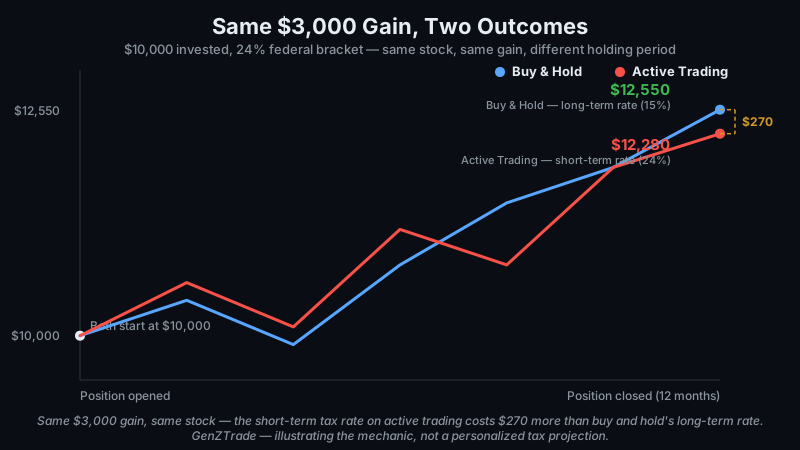
This is the part most new traders underestimate, because it has nothing to do with skill — it's just the calendar. In the US, a gain on a position held under one year is a short-term capital gain, taxed as ordinary income. A gain on a position held over one year is a long-term capital gain, taxed at a lower federal rate. Same profit, same stock, different tax bill, purely because of how long you held it.
Same $3,000 gain, two different holding periods:
Held under a year (short-term): taxed as ordinary income. For someone in the 24% federal bracket, that's 24% of $3,000 = $720 in tax.
Held over a year (long-term): taxed at the long-term capital gains rate. For that same bracket, the rate is 15%, so 15% of $3,000 = $450 in tax.
Difference: $720 − $450 = $270 — lost to the same gain, on the same stock, for the same investor, purely because of how long the position was held.
$270 on one trade isn't what breaks anyone. What matters is that active trading, by design, generates far more of these short-term taxable events in a single year than buy and hold does. Every one of them gets taxed at the higher ordinary-income rate instead of the lower long-term rate. That gap compounds across dozens of trades in a way a single example understates — and it applies before you've asked whether the trades were even profitable enough to justify making them. (Tax brackets and rates vary by income and can change; this is illustrating the mechanic, not giving you a personalized number. Talk to a tax professional about your own situation.)
Cost two: transaction costs and slippage add up quietly
Even with commission-free trading at most brokers now, trading isn't free. There's the bid-ask spread you cross on every entry and exit. There's slippage — the difference between the price you expected and the price you actually got, especially on less liquid names or fast-moving markets. Individually, each of these looks negligible. A few cents here, a fraction of a percent there. But active trading means paying that toll far more often than buy and hold does, and small recurring costs compound the same way small recurring gains do — just in the wrong direction for your account.
Buy and hold pays this toll once, maybe twice a year per position. Active trading can pay it dozens of times a month. The strategy doesn't have to be bad for the drag to matter — it just has to trade often enough for the toll to add up.
Cost three: more decisions means more chances to break your own plan
This is the honest, uncomfortable one. Every trade you place is a decision point, and every decision point is a moment where stress, fear, or excitement can override whatever plan you had going in. Buy and hold gives you very few of these moments — you set a thesis and mostly leave it alone. Active trading gives you constant ones: a dip that tempts you to panic-sell before your stop is even hit, a spike that tempts you to FOMO-buy after most of the move already happened.
This isn't a guarantee that active traders make these mistakes or that buy-and-hold investors never do — plenty of people abandon a long-term thesis at the worst possible moment too. But the structure of active trading puts you in front of that decision far more often, and more repetitions of a high-stress decision is more chances for it to go wrong, especially before you've built the experience to recognize what stress-driven trading feels like in the moment.
How GenZTrade helps you find these setups
If you're leaning toward the long-term side of this, Spotlight and Long Growth are built to help you find companies worth building a real thesis around — not a hot tip for tomorrow, but a position you could actually explain and defend a year from now. That's the foundation buy and hold depends on.
If you're going to trade actively anyway, do it with your eyes open. Cockpit helps you track your real costs — not just the price you paid, but what your trading frequency is actually costing you over time — and keep your plan visible so a bad day doesn't quietly turn into a pattern of decisions you didn't sign up for. Knowing your numbers is the minimum bar for active trading to make sense at all.
Bottom line
Neither approach is inherently right. Some people have the process and temperament to trade actively and do it well. But it's worth being honest about the math: active trading starts with a structurally higher bar to clear than buy and hold — more short-term taxable events at higher rates, more transaction costs paid more often, and more individual decision points where stress can knock you off your plan. Buy and hold isn't guaranteed to outperform. It just doesn't have to overcome those three drags before it even gets started. That's arithmetic, not a verdict on whether trading itself is worth doing.
Comments (0)