
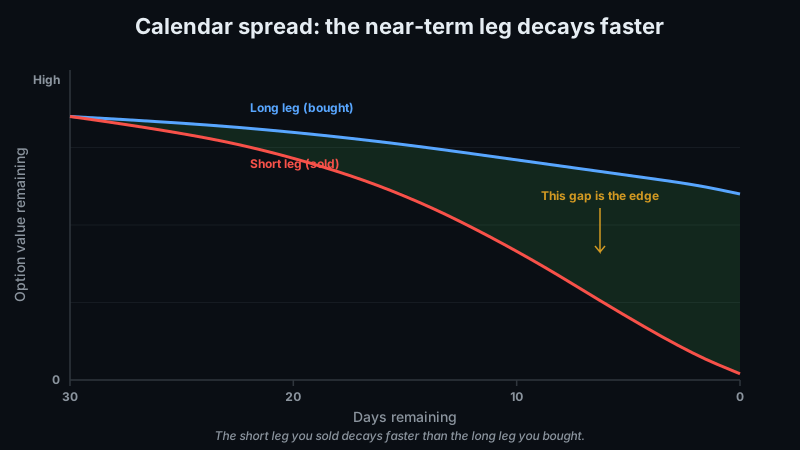
In one sentence: A calendar spread sells a near-term option and buys a longer-dated option at the same strike, betting that time decay eats the short option faster than it eats the long one.
What a calendar spread actually is
A calendar spread - also called a time spread or horizontal spread - is built from two options of the same type (both calls or both puts) on the same underlying stock, at the exact same strike price, but with two different expiration dates. You sell the near-term option and buy the longer-dated option.
Because a longer-dated option always carries more time value than a shorter-dated one at the same strike, this trade is a net debit. You pay more for the long leg than you collect for the short leg, and that net debit is your maximum possible loss on the position.
The core bet is not really about direction. It's about the stock staying close to the strike price through the near-term expiration. If it does, the option you sold decays quickly and expires cheap or worthless, while the option you bought - which still has weeks or months of life left - holds onto most of its value.
Why it works: decay rates aren't equal
Theta, the rate at which an option loses value purely from the passage of time, is not constant. It accelerates as expiration approaches. A 30-day option loses value day to day noticeably faster than a 90-day option sitting at the same strike, even though both are decaying every single day.
A calendar spread is a direct attempt to harvest that gap in decay speed. You're short the option with the faster daily decay and long the option with the slower daily decay. As long as both options stay roughly at the money, the near-term leg bleeds value faster than the longer-dated leg, and that difference becomes your profit.
A worked example
Suppose a stock is trading at $100. You sell the near-term $100 call, expiring in 30 days, for $2.50, collecting $250. At the same time, you buy the longer-term $100 call, expiring in 90 days, for $5.50, paying $550.
Premium collected (30-day short call): $250
Premium paid (90-day long call): $550
Net debit paid: $550 - $250 = $300
Maximum loss on the trade: $300
That $300 net debit is also the most you can lose, assuming you close both legs together as intended rather than leaving the long call open indefinitely.
Now fast-forward 30 days to the first expiration. Say the stock is sitting exactly at $100. The near-term $100 call you sold expires worthless, so you keep the full $250. The longer-term call you bought is no longer a 90-day option - it now has 60 days left - and because it still carries meaningful time value, suppose it's worth roughly $4.30, or $430.
Value remaining (60-day call, stock at $100): $430
Original capital risked: $300
Profit if closed here: $430 - $300 = $130
Return on capital risked: $130 / $300 = roughly 43%
That 43% figure is illustrative, not a promise. It depends on implied volatility holding roughly steady between now and the near-term expiration. If volatility drops, or the stock drifts away from $100, the outcome looks different - sometimes much worse.
The ideal outcome vs. the risk
The best-case scenario for a calendar spread is the stock pinning close to the strike price all the way through the near-term expiration. That's when you extract the most value from the decay differential between the two legs.
The risk sits on both sides of that pin. If the stock moves sharply away from the strike - up or down - before the near-term expiration, both options become less relevant to where the stock actually is, and the spread's value can shrink back toward zero, closer to the full $300 max loss. A calendar spread's profit zone is narrower than it might look at first glance; it's built around a specific price staying in a specific place.
There's a second, less obvious risk: vega. The long-dated option you bought is more sensitive to changes in implied volatility than the short-dated one. If implied volatility drops sharply on the longer leg - even if the stock hasn't moved at all - the value of your long call can fall enough to hurt the position. A calendar spread isn't just a bet on price and time; it's also a bet that volatility on the far leg doesn't collapse.
No options strategy removes the risk of loss, and calendar spreads are no exception - the defined max loss caps the downside, but that loss is still real money if the setup doesn't play out.
When to use a calendar spread
Calendar spreads are best suited to a stock you expect to stay range-bound or drift only slightly, not one you have a strong directional view on. The setup gets more attractive when near-term implied volatility is elevated relative to the longer-dated option's implied volatility - a bigger IV gap between the two legs means more relative decay benefit built into the trade from the start.
As a general rule, calendar spreads aren't recommended straight through an earnings report that falls inside the near-term leg's window, unless that IV differential around earnings is the entire point of the trade. Trading a calendar specifically to capture the volatility crush after an earnings announcement is a real, well-known variant - sometimes called an earnings calendar - but it carries its own separate risk profile involving gap risk and volatility behavior that's worth understanding on its own before attempting it. For a standard calendar spread, avoiding known volatility events inside the near-term window keeps the trade closer to a pure time-decay bet.
How GenZTrade helps you find these setups
Calendar spreads are a more advanced, less common strategy than something like a credit spread or a covered call, and GenZTrade doesn't currently generate an automatic setup card for them the way it does for those bread-and-butter trades. What the platform can help with is groundwork: the Intel Panel lets you check a stock's IV term structure across expirations and see upcoming catalysts like earnings dates, which is exactly the kind of information you'd want before deciding whether a calendar spread makes sense on a given name. From there, you'll want to build and verify the exact strikes, expirations, and pricing directly in your own broker's option chain before placing the trade.
Bottom line
A calendar spread is one of the more mechanical ways to trade time itself rather than direction - you're profiting from the fact that a 30-day option decays faster than a 90-day option at the same strike. The trade has a defined, capped max loss equal to the net debit paid, which makes the risk easy to quantify going in. But it's not a low-risk trade just because the loss is capped: a sharp move away from the strike or a drop in implied volatility on the long leg can both erode the position quickly. Like every options strategy, it comes with real risk of loss, and it rewards patience and a clear read on where a stock is likely to sit over the next few weeks, not a quick directional guess.
Comments (0)