
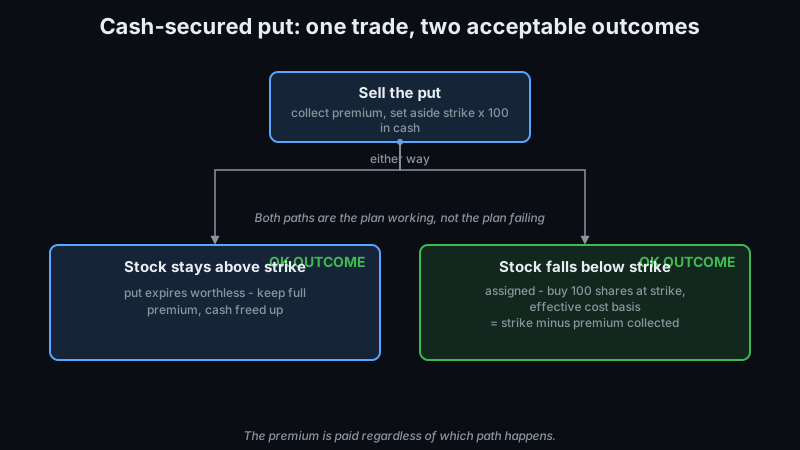
In one sentence: A cash-secured put means you set aside the cash to buy 100 shares at a strike price you choose, and get paid a premium for that promise - it is basically getting paid to place a limit buy order.
What this strategy actually is
When you sell a put option, you are making a promise: if the stock falls to or below your chosen strike price by expiration, you agree to buy 100 shares at that strike. In exchange for taking on that obligation, the option buyer pays you a premium, in cash, the moment you sell the contract.
The "cash-secured" part is what separates this from a much riskier version of the same trade. When you sell a cash-secured put, you set aside strike price times 100 in cash in your account as collateral - enough to actually buy the shares if you are assigned. A "naked" put, by contrast, is sold without that cash sitting there, which means your broker is extending you margin and your downside math gets a lot messier. This guide is only about the cash-secured version.
Once the trade is on, there are two ways it can play out at expiration:
- Stock stays above the strike: the put expires worthless, you are not assigned, and you keep the full premium. Your cash is freed up and you can sell another put if you want.
- Stock falls below the strike: you get assigned, meaning you buy 100 shares at the strike price. Your effective cost basis on those shares is the strike minus the premium you already collected - so you own the stock cheaper than the strike price alone would suggest.
A real example
Say a stock is trading at $45 today. You like the company and would be happy to own it at a lower price. You look at options expiring in about four to five weeks and sell the $40 put, which has roughly a 30 delta, for $1.10 in premium.
- Cash required to secure the trade:
$40 strike x 100 shares = $4,000 - Premium collected upfront:
$1.10 x 100 = $110
If the stock stays above $40 at expiration: the put expires worthless and you keep the full $110. On the $4,000 you had set aside, that is a 2.75 percent return in about five weeks (110 / 4,000).
If the stock falls below $40 and you get assigned: you buy 100 shares at $40, but your effective cost basis is $40 - $1.10 = $38.90 per share - a real discount to the $45 price the stock was trading at when you opened the trade.
Either outcome has something going for it. You get paid for waiting, or you get the stock you wanted at a lower net price than if you had just bought it outright today.
Why traders use this instead of just buying the stock
If you already want to own a stock, a cash-secured put gives you two ways to win instead of one. Buy the stock outright and you are only right if it goes up. Sell a cash-secured put on it instead, and you either collect premium while you wait for a better entry, or you get assigned at a price below where the stock was trading when you sold the put.
This is also why the "cash-secured" distinction matters so much. A naked put collects the same premium but without the cash set aside to back it up - your broker treats it as a margin position, and the amount of margin required can move around with the stock price and volatility. If the stock drops hard, a naked put seller can be forced to buy back the position, add funds, or get liquidated at the worst possible time. A cash-secured put has none of that drama: the worst case is fully known upfront, because the cash to buy the shares is already sitting in your account. That is a big part of why this strategy is considered approachable for people newer to options - the risk is defined and it is risk you already agreed to.
Picking the strike and expiration
Delta is a useful shortcut here. It is not a guarantee, but it is a rough proxy for the probability the option finishes in the money - meaning, roughly, the probability you get assigned. A 30 delta put has roughly a 30 percent chance of being in the money at expiration, all else equal. That makes something in the 20-30 delta range a common starting point for traders who want a real shot at collecting premium, but also want a reasonable chance of picking up the stock if it dips.
Expiration length matters too, and it is a genuine tradeoff, not a "shorter is always better" situation:
- Weekly or very short-dated puts decay faster on a relative basis day to day, which sounds appealing. But you are also tying up your cash more often - closing and reopening positions every week or two means more decisions, more commissions, and more chances to get whipsawed by a short-term move that would have resolved fine over a longer window.
- Long-dated puts (60+ days out) decay slowly for most of their life, which means your cash sits secured for a long stretch while earning comparatively little premium per day. That is capital inefficiency - the same cash could be working in a shorter-dated put, or another position entirely, in that time.
The four-to-five-week window used in the example above is a common middle ground: enough premium to make the trade worth doing, without capital sitting idle for months.
What "assignment risk" really means
New options traders often talk about assignment like it is the bad outcome to avoid. If you are only selling puts on stocks you would genuinely want to own at the strike price, assignment is not a risk - it is the strategy working as intended. You said, in effect, "I will buy this stock at this price," and the market took you up on it.
The actual risk shows up when traders sell puts purely to collect premium on stocks they have not actually thought about owning. That works fine until the stock drops, assignment happens, and suddenly the trader is holding 100 shares of something they never wanted, sized at whatever the strike happened to be, and reacting emotionally instead of according to a plan. The premium was never the point if you would not have wanted the stock underneath it.
The fix is simple to state, if not always easy to follow: treat the strike price as a real buy order, not just a number that generates income. If you would not be comfortable owning 100 shares at that strike, do not sell that put.
Rules that keep this strategy safe
- Only sell puts on stocks you are fine owning at the strike. This is the single most important rule. Every other rule is secondary to this one.
- Keep it actually cash-secured. Do not lean on margin to sell more puts than your real cash can back. The whole appeal of this strategy is a known, bounded worst case - do not undo that for extra size.
- Be deliberate around earnings. Selling a put right before an earnings report means collecting a fatter premium in exchange for a much wider range of outcomes overnight. That can be a reasonable, intentional trade - just do not stumble into it without noticing the date.
- Roll down and out instead of panic-buying back a loser. If the stock drops and the put moves deep in the money, you can often roll the position to a lower strike and a later expiration for an additional credit, giving the trade more room and more time rather than locking in a loss out of anxiety.
How GenZTrade helps you find these setups
Finding good candidates by hand - the right stock, the right strike, the right expiration - takes time. GenZTrade is built to shortcut that process:
- Momentum Scanner surfaces stocks with confirmed technical structure, giving you a starting list of names worth a closer look rather than a random universe of tickers.
- Options Plays then builds out put-selling candidates for those stocks automatically, with strikes, premium collected, cash required, and probability of assignment already computed, so you can compare setups side by side instead of pulling an options chain apart manually.
Bottom line
A cash-secured put is a way to get paid while you wait for a stock you actually want to hit a price you actually like. Set aside the cash, pick a strike you would be comfortable owning, choose an expiration that balances premium against how long you want your cash tied up, and let the trade resolve one of two ways - both of which you were fine with before you clicked the button. Skip stocks you have not thought through owning, keep the position genuinely secured with cash rather than margin, and treat assignment as the plan working, not the plan failing.
Comments (0)