
In one sentence: day trading is a full-attention, small-edge, high-repetition skill that a small percentage of people manage to do profitably, and if you're going in expecting a laptop-lifestyle montage instead of a job, you're going to fund somebody else's account with your losses.
It's a job, not a background app
The version of day trading you see clipped on TikTok skips the boring part, which is also the entire job: sitting at a screen, alert, during market hours, watching price action in real time. Most of the actual opportunity in day trading — the volatility, the volume, the clean setups — shows up in the first hour or two after the open and sometimes again near the close. That's not a window you can check on a lunch break between classes or during a break at work.
Day trading also isn't passive the way a long-term stock position can be. You're making decisions in seconds: entering, sizing, setting a stop, watching it get hit or not, deciding whether to cut a loser early or let a winner run. You're doing that on a compressed timeline, repeatedly, for as long as the session gives you setups. If you can't give it your full attention during market hours, you're not day trading — you're guessing with extra steps.
Realistic position sizing for a small account
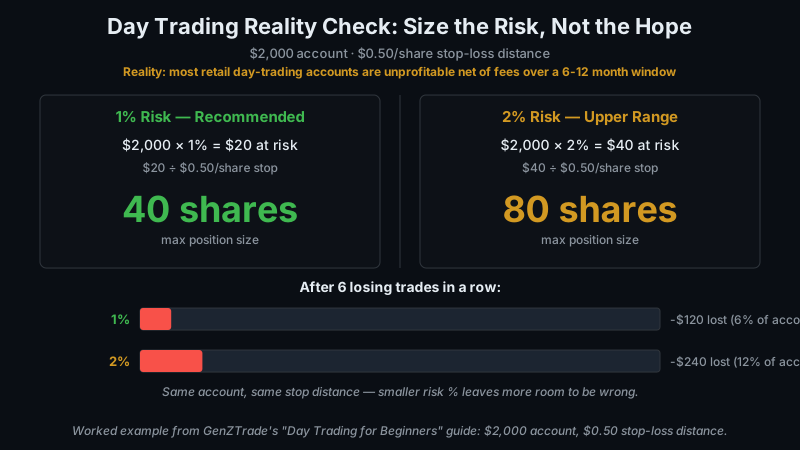
The other thing the hype version skips is math. "All in" is not a strategy, it's how a $2,000 account becomes a $200 account in a week. Professional and semi-professional traders size positions around a fixed percentage of account risk per trade, usually somewhere in the 1-2% range, not because it's a rule someone made up to sound responsible, but because it's the difference between surviving a losing streak and not.
Say you're trading a $2,000 account and you cap your risk at 1% per trade. That's $2,000 x 1% = $20 you're willing to lose on any single trade, no exceptions. If the stock you're watching has a stop-loss distance of $0.50 per share (meaning you'll exit if it drops $0.50 from your entry), your max position size is $20 / $0.50 = 40 shares. If you bumped risk up to 2%, that's $40 of risk, giving you 80 shares at the same stop distance. Notice what didn't change: your stop distance and your discipline about honoring it. What changed is how much you're allowed to lose if you're wrong — and on a $2,000 account, that number should be small enough that a string of five or six losing trades in a row doesn't wipe you out.
Do that math before every trade, not after. If a setup only "works" with a position size that risks more than you've decided you can afford to lose, the answer isn't to size up — it's to skip the trade or find a tighter stop.
The honest statistical reality
Here's the part most content built to get you to sign up for something conveniently leaves out: most published research on retail day trading finds that a majority of active accounts are unprofitable net of fees, commissions, and slippage over a six-to-twelve-month window. That's not a scare tactic, it's the baseline you should assume applies to you until you have your own track record proving otherwise. Day trading has a real, if smaller, population of people who do it consistently and profitably — but they got there through screen time, losses, and refinement, not a course that promised a system.
None of that means it's impossible. It means the starting assumption should be "the odds are against me until I prove they aren't," not "I'll figure it out as I go with real money." That distinction is what separates people who treat their first few months as tuition versus people who treat their first few months as a payday.
What separates survivors from account blowups
Watching enough accounts go to zero (and enough stick around for years) turns up a pretty consistent pattern in what actually matters:
- Position sizing discipline. The traders who last size every single trade off their risk percentage, not off conviction, a hot tip, or "this one feels right." The math from the example above isn't optional homework — it's the thing standing between a bad week and a blown account.
- A defined edge, not a vibe. Survivors trade a specific setup they can describe in a sentence — a volume breakout above a level, a pullback to a moving average, a specific pattern with specific confirmation — and they only take trades that match it. If you can't explain why you're in a trade beyond "it's moving," you don't have an edge, you have a guess with money attached.
- Treating losses as a cost of doing business. Every trader, including profitable ones, loses on a large share of individual trades. The people who survive plan for that and size accordingly. The people who blow up treat a loss as an insult that needs to be avenged with a bigger, angrier trade — which is how a $20 planned loss turns into a $600 unplanned one.
How GenZTrade helps you find these setups
None of the above is about finding a magic tool — it's about behavior. But behavior is easier to hold onto when the tools around you support it instead of tempting you off the plan. GenZTrade's Momentum Scanner is built for the "defined edge" part of this: instead of scrolling social media hoping a ticker gets mentioned, you're screening for stocks actually showing unusual volume and momentum in real time, so the setups you're looking at have some real confirmation behind them instead of a stranger's hunch.
The Cockpit is built for the discipline part. It's where you track open positions, see your risk in real time, and get a clear view of whether a trade is behaving the way you expected — which makes it a lot harder to quietly ignore a stop you set an hour ago because you don't want to admit you were wrong. Neither tool trades for you or promises a win rate. What they do is remove some of the friction and guesswork from finding setups and managing risk, so the decisions you make are based on data you can see rather than a feed you scrolled past.
Bottom line
Day trading is a real skill with real capital and behavioral requirements — screen time during market hours, position sizing you actually stick to, and a defined setup instead of a guess. Most people who try it without a plan lose money, and that's not a niche opinion, it's what the research on retail day trading consistently shows. If you go in treating it like a job you have to learn, sizing your risk like the $2,000 example above, and holding yourself to a defined edge, you give yourself a real shot at being in the minority that sticks around. No scanner, no dashboard, and no tool — GenZTrade's included — removes the risk of loss. What they can do is make sure that when you lose, it's because the market did something unexpected, not because you skipped the math.
Comments (0)