
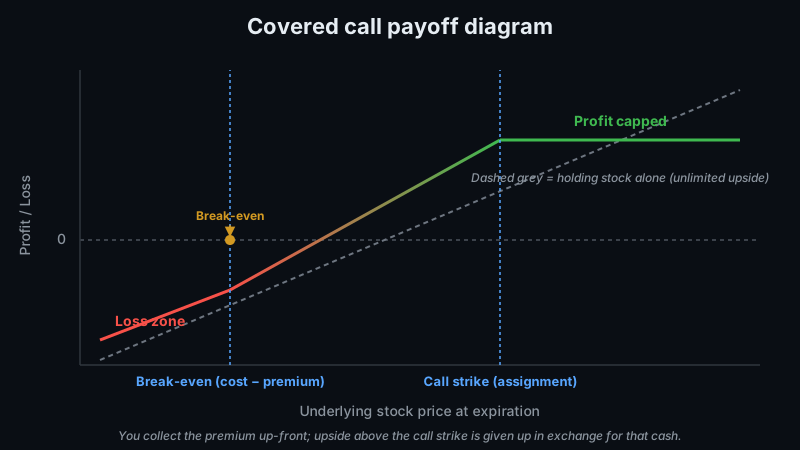
In one sentence: Delta 30 tends to be the strike where covered call sellers collect meaningfully more premium than a far-out-of-the-money call while keeping the odds of losing their shares well below a coin flip.
What delta actually tells you
Delta measures how much an option's price moves for a $1 move in the underlying stock, but traders also use it as a rough, unofficial stand-in for the probability that the option finishes in the money. A 0.50 delta call is often read as "roughly 50% chance of expiring in the money," a 0.30 delta call as "roughly 30% chance," and a 0.15 delta call as "roughly 15% chance." This is an approximation, not a guarantee - actual outcomes depend on how the stock moves between now and expiration, and delta itself shifts as the stock price and time to expiration change. But as a quick filter for comparing strikes, it is the number most covered call sellers lean on.
For a covered call seller, that probability cuts both ways. A higher delta strike sits closer to the current stock price, which means a bigger premium check today, but also a higher chance the stock gets called away and you lose the shares (and any further upside) at expiration. A lower delta strike is further out of the money, so it pays less premium, but leaves you more room to keep the stock if it runs.
The classic setup: three strikes on the same stock
Here is the trade-off in practice. You own 100 shares of Apple, bought at $170. Apple has since climbed to $180, and you are deciding which call to sell against those shares, all expiring in about 35 days.
$180 strike (at-the-money): delta ~0.50, premium $4.00 ($400 total) - the richest premium, but close to a coin-flip chance the shares get called away.
$185 strike: delta ~0.30, premium $2.50 ($250 total) - the delta-30 pick, and the middle ground between the other two.
$190 strike: delta ~0.15, premium $1.20 ($120 total) - the smallest premium, but the shares are unlikely to be called away.
Laid out as a straight comparison, the three strikes look like this:
- $180 strike / 0.50 delta: $400 premium, ~50% assignment odds, $0 of headroom before the stock passes the strike (it's already there).
- $185 strike / 0.30 delta: $250 premium, ~30% assignment odds, $5 of headroom (Apple can rise from $180 to $185 before the call is at risk of being exercised).
- $190 strike / 0.15 delta: $120 premium, ~15% assignment odds, $10 of headroom.
Why 30 delta tends to win the trade-off
Line the three up against each other and the delta-30 strike is doing something the other two are not: it is giving up relatively little premium while buying back a lot of safety, and it is also giving up relatively little safety while buying back a lot of premium. Both directions of the trade-off look favorable at the same time.
Compared to the $190 strike, the $185 strike collects $250 versus $120 - a $130 difference, or roughly double the income - for only an incremental increase in assignment risk (30% versus 15%). Compared to the $180 strike, the $185 strike cuts the odds of losing the shares roughly in half (30% versus ~50%) while still collecting almost two-thirds of the at-the-money premium. It also keeps $5 of headroom for the stock to appreciate before the shares are at real risk of being called away, versus zero headroom at the $180 strike, where any move up puts the shares in play immediately.
That combination - a real premium check, materially better odds of keeping the stock, and room for the position to still work in your favor - is why 30 delta became the default reference point for covered call strike selection rather than a hard rule. It is a reasonable center of the trade-off curve, not a strike that is mathematically optimal in every situation.
When to break the rule
1. You are genuinely bullish on the stock over the next month
If you think Apple is setting up for a real move higher over the next 35 days, capping the upside at $185 may cost you more in missed gains than the extra premium is worth. Dropping to a 15-20 delta strike, like the $190 call, trades some premium income for more room to let the stock run before the shares are at risk of being called away. You are paying for that room with a smaller premium check, but that is the point - you are optimizing for keeping the stock, not for maximizing this month's income.
2. You are flat-to-mildly-bearish, or you would not mind losing the shares
If your read on the stock is neutral to slightly negative, or you would be fine seeing the shares called away at a profit, there is less reason to protect upside room you do not expect to use. Moving to a 40-50 delta strike, like the $180 call, maximizes premium collected since you are less attached to holding the position through expiration. This is effectively a bet that the extra income is worth more to you than the shares themselves right now.
3. Implied volatility is very low
Delta is only half the picture - the other half is how much premium a given delta actually pays, and that depends heavily on implied volatility. In a low-IV stretch, even a 30-delta strike can pay a premium that is not worth the trade once you account for the risk of losing the shares. In that environment, the right move is sometimes to skip the covered call for that cycle entirely rather than force a strike selection into a market that is not paying you enough to take the trade.
How GenZTrade helps you find these setups
Comparing strikes by hand means pulling up an option chain, checking delta on each row, calculating premium as a percentage of share price, and estimating break-even and annualized yield for every candidate - for every stock, every cycle. GenZTrade's Options Plays feature auto-generates covered call cards with the strike, delta, premium, break-even, and annualized yield already pre-computed, so comparing a 15-delta, 30-delta, and 50-delta strike side by side is a quick lookup instead of a chain-by-hand exercise. That makes it easier to apply the trade-offs above consistently, cycle after cycle, instead of re-deriving them from scratch each time.
Bottom line
Delta 30 earns its reputation as the covered call default because it sits at a genuinely favorable point on the premium-versus-assignment-risk curve, not because it is a magic number. The Apple example makes the case clearly: $250 in premium and a 30% assignment probability beats $120 at 15% and loses relatively little ground to $400 at ~50%. But your view on the stock and the volatility environment should still move you off that default when the situation calls for it - more bullish conviction argues for a lower delta, more willingness to part with the shares argues for a higher one, and a quiet volatility environment might argue for skipping the trade altogether. No covered call strike, at any delta, removes the risk of losing money on the position or having the shares called away - it only shifts where that risk sits.
Comments (0)