
In one sentence: dollar-cost averaging (DCA) means investing a fixed dollar amount on a fixed schedule no matter what the price is doing, and while it doesn't guarantee you a better return than dumping all your cash in on day one, it's the closest thing investing has to a cure for decision paralysis.
What dollar-cost averaging actually is
DCA investing is not a stock-picking strategy. It's a scheduling strategy. You decide on an amount — say $500 — and a cadence — say monthly — and you buy the same dollar amount of the same asset every single period, regardless of whether the price went up, down, or sideways since last time.
The mechanical effect is that your fixed dollar amount buys more shares when the price is low and fewer shares when the price is high. You're not trying to identify the low; the math does that weighting for you automatically, just by virtue of spending the same dollars every time. That's the entire mechanism. No signal-reading, no chart-watching, no guessing whether this week is "the dip."
People usually reach for DCA for one of two reasons: either they're investing out of a paycheck and simply don't have a lump sum sitting around, or they have the lump sum but are too anxious about buying at a local top to actually pull the trigger. Both are legitimate. But it's worth being precise about what DCA does and doesn't do for you, because a lot of finance content treats it like a guaranteed edge, and it isn't one.
The worked example: DCA vs. lump sum, with real numbers
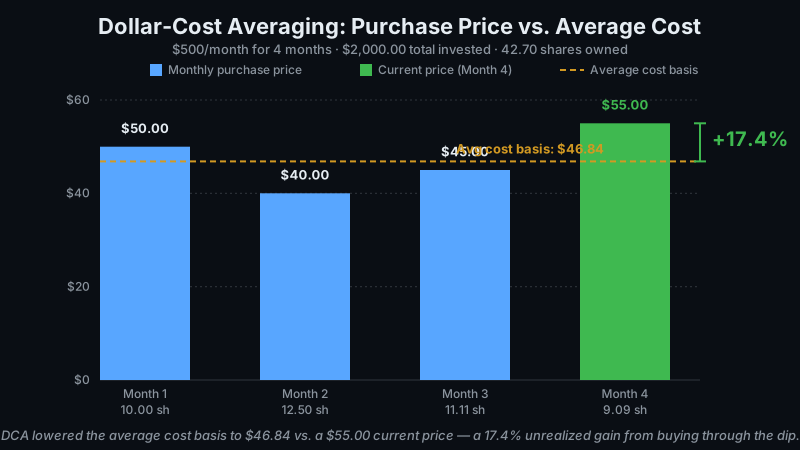
Say you're investing $500 a month into a stock for four months, and the price happens to dip in the middle of the run before recovering. Here's exactly how the math shakes out.
Month 1: $500.00 ÷ $50.00 = 10.00 shares
Month 2: $500.00 ÷ $40.00 = 12.50 shares
Month 3: $500.00 ÷ $45.00 = 11.11 shares
Month 4: $500.00 ÷ $55.00 = 9.09 shares
Total invested: $2,000.00
Total shares owned: 10.00 + 12.50 + 11.11 + 9.09 = 42.70 shares
Average cost per share: $2,000.00 ÷ 42.70 = $46.84
Current price: $55.00
Unrealized gain: ($55.00 − $46.84) ÷ $46.84 = $8.16 ÷ $46.84 = 17.4%
Now compare that to putting the entire $2,000 into the stock in month one, as a lump sum, at $50.00 a share.
Lump sum shares: $2,000.00 ÷ $50.00 = 40.00 shares
Current price: $55.00
Unrealized gain: ($55.00 − $50.00) ÷ $50.00 = $5.00 ÷ $50.00 = 10.0%
In this scenario, DCA wins by a wide margin — 17.4% versus 10.0%. But you need to understand exactly why it won, because it's not because DCA is inherently smarter money management. It won because the price dipped to $40 and $45 in months two and three, and the DCA strategy was still buying through that dip, picking up extra shares (12.50 and 11.11) at a discount. Averaging in a lower cost basis than the lump sum's flat $50.00 entry is what did the work here.
Does DCA vs. lump sum actually favor DCA? Be honest about it.
Here's the part most explainers skip: run the exact same $500-a-month schedule against a stock that just goes up every single month — say $50, then $52, then $54, then $55 — and DCA loses to lump sum every time. If the price never dips, every dollar you hold back from month one to "average in" later is a dollar that missed out on the run. Lump sum investing the full $2,000 immediately, at the lowest price the stock will ever trade at again, would have outperformed spreading it out.
That's not a hypothetical edge case, it's the base rate. Historically, markets go up more often than they go down, which means a lump sum invested immediately has beaten a phased-in DCA schedule into the same asset more often than not, on average, over long stretches. DCA is not a strategy that mathematically beats lump-sum investing. It's a strategy that reduces the damage if you happen to invest right before a drawdown, in exchange for giving up some upside if the asset just runs.
So what's the actual case for dollar-cost averaging? It's behavioral, not mathematical. Most people with a lump sum sitting in cash never actually invest it all at once — they hesitate, they wait for "a better entry," the price moves, they wait some more, and months later they still haven't deployed the capital because there's always a reason it looks like a bad moment to buy. DCA removes that decision entirely. You're not trying to find the perfect entry point because there isn't a decision to make — the schedule makes it for you. For most people investing out of a regular paycheck rather than a windfall, that's also just how the cash shows up in the first place, so DCA isn't really optional, it's the default.
How GenZTrade helps you find these setups
DCA works best when it's aimed at something you actually want to own for years, not something you're trying to flip in a week. That's where Spotlight comes in — it's built to surface names with real underlying momentum and fundamentals worth researching, instead of whatever's trending on social media that hour, so you're not automating your way into a position you'll regret holding.
Once you've found a name worth building a position in over time, that's exactly the kind of setup our Long Growth tools are designed around: a systematic, scheduled approach to accumulating shares over months or years rather than trying to nail a single entry. Pairing a Spotlight-vetted name with a recurring, scheduled buy is DCA investing done with intention — you're still not timing the market, but you're at least not dollar-cost averaging into something you haven't actually looked at.
Bottom line
Dollar-cost averaging explained honestly: it's a discipline tool, not a performance guarantee. In our worked example it beat lump sum by 7.4 percentage points because of a mid-run dip, and it will keep winning in any scenario where the price dips before it recovers. But flip the price path to a steady climb and lump sum wins instead — that's just how the math works when you're paying an average price across a range of entries instead of one specific price. If you already have the cash and the conviction, and you know you'd actually deploy a lump sum rather than sit on it out of nerves, the math tilts toward lump sum on average. If the honest answer is that you'd freeze, second-guess yourself, and still be "waiting for a dip" six months from now, DCA is the strategy that actually gets you invested — and getting invested consistently beats a theoretically optimal entry you never end up making.
Comments (0)