
In one sentence: you sell a stock when the reason you bought it stops being true, not when a certain number of days have passed — the calendar only matters as a secondary factor, mostly around taxes.
Holding periods aren't the decision — the thesis is
Ask around and you'll get confident-sounding answers to "how long should I hold a stock?" Some people say a year, because that's the tax cutoff. Some say "forever," quoting an investor who was talking about a specific handful of businesses, not a general rule for every ticker. Some say a few weeks, because that's how long their patience lasts. None of these are actually frameworks. They're arbitrary numbers dressed up as wisdom.
The real framework is simpler and has nothing to do with dates: you bought the stock for specific, nameable reasons. Maybe it was accelerating revenue growth, a product launch you thought would land, a valuation that looked cheap relative to earnings, or a turnaround story you believed in. Whatever it was, that reason is the only thing that should decide when you sell. If the reason is still true, the holding period is irrelevant — three weeks in or three years in, you hold. If the reason stops being true, the holding period is also irrelevant — you sell, whether you've held it for eleven days or eleven years.
This is harder than it sounds, mainly because it requires you to have written down a real reason in the first place. "It looked like it was about to move" is not a thesis — there's nothing in it that can later become false, so you have no way to know when to get out. "Revenue is growing 40% a year and margins are expanding" is a thesis. You can check it every quarter. When it stops holding up, that's your signal, completely independent of how long you've owned the stock.
The one place the calendar actually matters: taxes
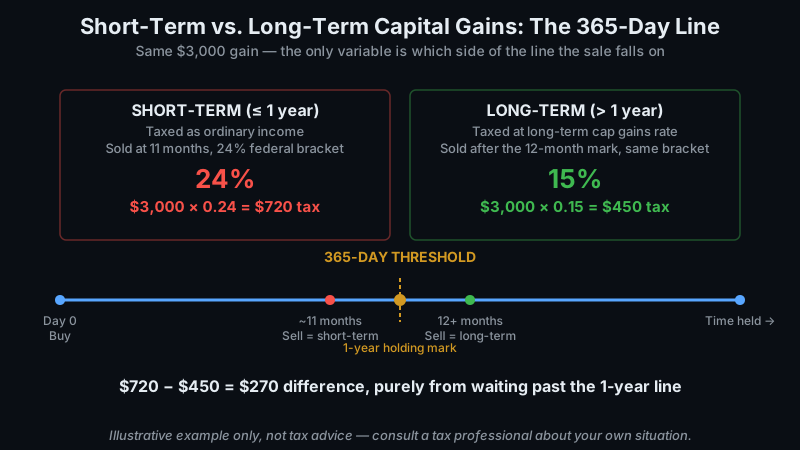
There's exactly one place where the number of days you've held a stock changes the math in a real, quantifiable way, and that's taxes. In the U.S., a gain on a stock held for one year or less is a short-term capital gain, taxed at your ordinary income tax rate. A gain on a stock held for more than one year is a long-term capital gain, taxed at the lower long-term capital gains rate. Same stock, same gain, different tax bill, purely based on which side of the 365-day line the sale falls on.
Here's what that looks like with real numbers.
Scenario: $3,000 gain, sold at 11 months (short-term)
Taxed as ordinary income, 24% federal bracket
$3,000 x 0.24 = $720 in tax
Same $3,000 gain, sold after the 12-month mark (long-term)
Taxed at the long-term capital gains rate, 15% for that same bracket
$3,000 x 0.15 = $450 in tax
Difference, purely from waiting past the 1-year line
$720 - $450 = $270
Same trade. Same gain. $270 different in tax owed, and the only variable that changed is which side of one specific date the sale landed on. That's not a rounding error on a $3,000 gain — it's real money, and it scales up with the size of the gain.
This is worth being aware of specifically when you're near the 1-year mark and a sale is already a close call — when your thesis has softened somewhat but you're not fully convinced it's broken, and you're sitting a few weeks from the long-term threshold. In that narrow situation, knowing the tax gap exists is a legitimate input into your timing. It is not, however, a reason to hold a stock you've already concluded you no longer believe in. A broken thesis costs you more in downside risk and opportunity cost than $270 saves you in tax. Don't let a tax calculation talk you into holding a bag you already know you don't want.
The two signals that should actually make you sell
Strip away the noise and there are really only two clean reasons to sell a stock. First, the thesis broke — the specific thing you believed when you bought it is no longer true. Growth decelerated in a way that changes the story, the competitive position eroded, guidance came down, the balance sheet got worse, or new information surfaced that contradicts your original case. Second, you found a meaningfully better use for the capital — not a slightly shinier stock, but a genuinely better risk-adjusted opportunity where moving your money produces a real improvement in your expected outcome, not just a lateral move dressed up as an upgrade.
Everything else is noise pretending to be a signal. Boredom isn't a reason — a stock that isn't doing anything exciting isn't automatically a stock that's gone bad. A scary-looking dip that has nothing to do with your original thesis isn't a reason either — price moving against you for a day or a week doesn't mean the underlying business changed, and reacting to volatility instead of information is how you turn a good long-term hold into a bad short-term trade. And wanting to "lock in" a gain purely out of nervousness — because it's up and you're scared of giving it back — isn't a thesis-based reason to sell either. If nothing about the case that got you into the position has changed, nervousness about volatility is a you problem, not a stock problem, and selling to soothe it usually just means re-buying something similar later, at a worse price, with a transaction cost and a tax bill added on top.
How GenZTrade helps you find these setups
The hard part of this framework isn't understanding it — it's actually tracking your original thesis over time instead of letting it quietly drift or get forgotten. Spotlight and the Long Growth feature are built around the idea that a stock worth buying should be worth re-checking against the same criteria that got it flagged in the first place, so you're not relying on memory or vibes to know whether the case still holds. Cockpit handles the other half of this: it surfaces when a position is approaching its 1-year holding mark, so the tax factor is visible exactly when it's relevant to a real decision — not buried in a brokerage statement you only look at once a year. Neither tool decides for you whether a thesis is broken. That's still your job. They just make sure you have the information in front of you when the decision actually needs to be made.
Bottom line
The calendar is a secondary input, not the main one. The 1-year tax line is real and worth $270 on a $3,000 gain in the example above — worth knowing, worth factoring in when a sale is genuinely a close call near that date. But a bad thesis doesn't become a good reason to hold just because you're two months away from crossing the long-term threshold, and a good thesis doesn't become a bad one just because you crossed it eleven months ago. Sell when the reason you bought breaks, or when you've found somewhere meaningfully better for the money. Everything else — including the date on the calendar — is a detail to manage around that decision, not a substitute for it. And to be clear: none of this is tax advice, just an explanation of how the mechanics work. Talk to an actual tax professional about your own situation before making decisions based on bracket math.
Comments (0)