
In one sentence: a good watchlist isn't a list of every stock you find interesting — it's a funnel that starts with thousands of tickers and ends with the 10 to 15 you actually watch closely enough to act on.
Why an unfiltered watchlist fails
The instinct when you start trading is to add everything. You see a ticker mentioned somewhere, you add it. A stock pops 12% on some headline, you add it. Within a few weeks you've got a watchlist with 200 names on it, and here's the problem: you don't actually watch 200 stocks. Nobody does. What happens instead is you glance at the list, your eyes catch whatever moved the most that morning, and the other 190 names sit there doing nothing for your process except taking up space.
A watchlist with 200 tickers on it isn't more coverage — it's less attention per name, spread so thin it stops functioning as a watchlist at all. The entire point of building one is focus. You're trying to get to a small enough set of names that you actually know their normal range, their typical volume, where support and resistance sit, and what a real setup looks like on that specific chart. That kind of familiarity is only possible with a short list. Add too many names and you trade the way most beginners trade: reacting to whatever's flashing red or green at 9:35 AM instead of working from a plan you set up in advance.
The filtering approach: treat it like a funnel
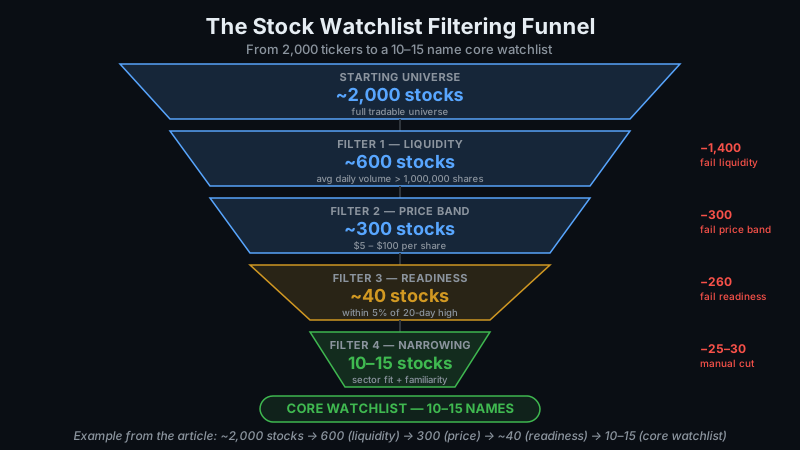
The fix isn't "add fewer stocks and hope you pick well." It's running every stock through a sequence of filters, in order, so that what survives at the end has actually earned its spot instead of getting there because you saw it on a forum. Each filter should answer one specific question, and each one should shrink the list. Here's what that looks like end to end.
Starting universe: ~2,000 stocks — roughly the full set of names with enough size and history to be worth considering at all.
Filter 1 — Liquidity: average daily volume over 1,000,000 shares. This cuts out names you can't get in and out of without moving the price yourself. Result: ~600 names survive.
Filter 2 — Price band: price between $5 and $100. Under $5 you're in penny-stock territory, where manipulation risk and unreliable price action go up; over $100 your per-share cost eats into position sizing and makes small accounts less flexible. Result: ~300 names survive.
Filter 3 — Readiness: within 5% of a 20-day high, or sitting at some other defined technical level you actually use — a breakout level, a moving average, a base. This filters for stocks that are near a decision point right now, not stocks that were interesting three weeks ago. Result: ~40 names survive.
Filter 4 — Manual narrowing: from those ~40, you cut down to a working list of 10–15 names based on sector diversification (you don't want twelve semiconductor names moving on the same catalyst) and personal familiarity (names you've actually traded before and understand the behavior of).
Notice what each step is doing. The first two filters are mechanical and objective — volume and price either clear the bar or they don't, no judgment required. The third filter is still rule-based but starts asking whether the stock is actually near something worth reacting to. Only the last step involves real discretion, and by the time you get there you're choosing among 40 names that already cleared three objective bars, not choosing among 2,000 names based on vibes.
Maintaining the list matters as much as building it
A watchlist built once and never touched again is worse than useless, because it gives you false confidence that you're "tracking" names you haven't actually re-evaluated in months. Volume dries up. Price bands shift. A stock that was near a breakout level in March can be 20% below it by June with no real setup left. If you don't revisit the filters, you end up watching stale names purely out of habit — you're used to seeing the ticker, so it stays, even though it wouldn't survive the funnel if you ran it fresh today.
The fix is to actually rerun the filters on a schedule, not just eyeball the list and assume it's still good. Names should rotate off when they stop meeting the criteria that got them on in the first place — not when you get bored of them, and not never. A stock earning its way off the list is exactly as important as a stock earning its way on.
Core list vs. scan list
It helps to split your watchlist into two tiers instead of treating it as one flat list. A core watchlist is the small set of names — the 10 to 15 from the funnel above — that you track every single day regardless of what they're doing, because you know them well enough to spot when something's off. A scan list is different: it's the daily output of running your filters fresh, the candidates that clear the bar today but haven't been around long enough to earn a permanent spot. Some scan-list names will show up for one day and disappear. A few will keep showing up often enough that you eventually promote them into the core list. Keeping these separate stops you from either overloading your core list with one-off movers or ignoring genuinely new setups because you're only looking at names you already know.
How GenZTrade helps you find these setups
Running this funnel by hand every morning — checking volume, checking price bands, checking who's near a 20-day high across a couple thousand tickers — isn't something anyone actually wants to do before the open. GenZTrade's Momentum Scanner automates the parts of this process that don't require judgment, applying volume, price, and technical-proximity filters continuously so you're looking at a pre-filtered scan list instead of rebuilding one from scratch every session. For the liquidity layer specifically — the first and most important filter, since it's the one that protects you from getting stuck in a position — High Volume Points surfaces names clearing real volume thresholds in real time, which is exactly the kind of check that should happen before a stock is even allowed into your funnel. Neither tool replaces the manual narrowing step at the end; that part still depends on your own sector awareness and familiarity with the names. What they do is take the repetitive, mechanical filtering off your plate so you spend your limited attention on the 10 to 15 names that made it through, not on rebuilding the funnel from 2,000 tickers every day.
Bottom line
A good watchlist doesn't guarantee good trades. Nothing about narrowing 2,000 stocks down to 15 makes any one of those 15 a winner — the funnel filters for liquidity, price, and readiness, not for outcome. What it does is make sure your limited attention is pointed at names that meet a real, repeatable bar instead of being spread thin across everything you've ever heard of. That's the actual value: not prediction, just focus. Build the funnel, run it consistently, let names earn their spot and lose it when they stop qualifying, and you'll spend your trading time watching stocks worth watching instead of scrolling a list of 200 tickers you never really knew in the first place.
Comments (0)