
In one sentence: rolling a losing put spread means closing the old one and opening a new one further out in time and at lower strikes, and it only helps if the new strike sits on a real support level - not just further away from the current price.
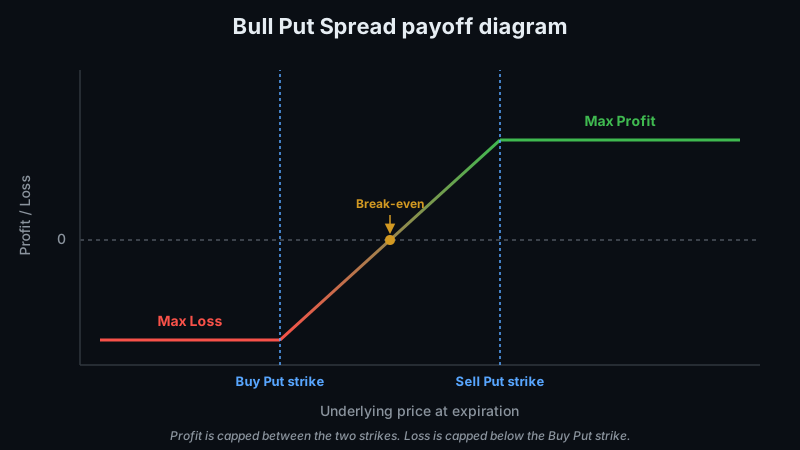
In our bull put spread guide, we walked through a basic risk-management example: SPY at $500, sell the $495 put for $2.10, buy the $490 put for $1.30, for a net credit of $0.80 ($80 per contract), a max loss of $420, and a break-even of $494.20. Let's pick that trade back up and walk through what happens when it starts to go against you - and what "rolling" actually looks like in dollars and cents.
Step 1: know your close-now number
Two weeks later, SPY has dropped to $493, with 15 days left to expiration. The spread is now trading at $1.90 to buy back - it costs $190 to close. Before you touch anything else, calculate the baseline: what happens if you just close it right now?
Credit collected originally: +$80
Cost to buy back the spread now: -$190
Net P&L if you close now: -$110
That $110 loss is your reference point. Every roll decision should be measured against it. If a roll doesn't give you a realistic shot at beating -$110, it's not worth doing.
Step 2: the roll - same idea, more room
Instead of closing, you roll: buy back the $495/$490 spread for $190, and in the same transaction, open a new spread further out in time (30 more days) and at lower strikes - sell the $488 put for $2.20, buy the $483 put for $1.40, for a new credit of $0.80, or $80.
Walk the ledger step by step:
Original credit received: +$80
Buy back old spread: -$190 (running total: -$110)
Open new spread, credit received: +$80 (running total: -$30)
So immediately after the roll, you're down $30 on paper instead of $110 - an $80 improvement - and you've bought 30 more days for SPY to recover above the new $488 strike, instead of needing to hold above the original $495. That's the entire mechanism of a roll: you're not erasing the loss, you're trading a chunk of it for more time and more room.
Step 3: how the roll can resolve
The roll isn't a free option - it's a new trade with its own two outcomes.
Outcome A: SPY finishes above $488
At the new expiration, the new spread expires worthless and there are no further cash flows. Final result: a $30 loss overall, versus the $110 loss you'd have locked in by just closing. Rolling saved $80 in this outcome.
Outcome B: SPY keeps falling and finishes below $483
If SPY is below $483 - the new long put strike - at the new expiration, the new spread hits its own max loss. The new spread's max loss, net of its $80 credit, is $500 - $80 = $420. That $80 credit is already counted in the running ledger above, so the additional cash impact is a $500 payout, taking the running total from -$30 to -$530.
Running total before final expiration: -$30
New spread hits max loss, additional payout: -$500
Final result: -$530
Say this plainly: rolling here made things meaningfully worse than just closing at -$110 - $420 worse - because now there are two rounds of risk stacked on top of each other. This is the part traders skip past when they roll out of hope rather than analysis.
Step 4: the actual decision rule
Roll only when the reason you opened the original trade still holds - meaning there's still a real support level near or below your new strike, and nothing has fundamentally changed about the setup. Rolling purely to "give it more time," with no technical reason the new strike should hold, is how a $110 loss quietly turns into a $530 loss.
If the chart broke down hard - lost a major level, a high-volume down day, a change in the broader trend - take the defined loss and move on instead of rolling into more risk. The whole point of a credit spread is that your loss is capped and known in advance. Rolling without a real thesis for the new strike undoes that discipline and turns a bounded loss into an open-ended one, one roll at a time.
It's also worth separating two things that get conflated: rolling out in time and rolling down in strike. Rolling out in time only helps if you're also rolling to a strike with a real reason to hold. Rolling to the same strike, just further out in expiration, doesn't fix anything - it just delays the same problem and gives the underlying more time to keep drifting against you while you pay the same premium for less protection.
Mechanics: executing a roll as one order
You don't have to close the old spread and open the new one as two separate trades, hoping the price doesn't move against you in between. Most brokers support a combined "roll" order that closes the existing spread and opens the new one simultaneously, priced as a single net transaction. This matters because credit spreads can be thinly traded, and trying to leg out of one position and into another manually exposes you to slippage on both sides. A single combined order locks in the net credit or debit of the whole roll at once, which is what let us calculate the -$30 running total cleanly in the example above - in practice, always confirm the net price of the combined order before submitting rather than assuming the individual leg prices will hold.
How GenZTrade helps you find these setups
Rolling well is mostly a pricing and location problem, and that's where GenZTrade's tools fit in. Before you commit to a roll, Options Plays can price a new spread's strikes, credit, and break-even instantly, so you can see the real economics - like the $80 credit and new $488/$483 strikes in this example - before you place the order, instead of estimating and hoping the fill matches.
Cockpit tracks the position after you're in it and flags when a stop or adjustment trigger hits, so you're not relying on memory or a spreadsheet to catch the moment SPY approaches your break-even or a predefined danger zone.
And since the entire decision in Step 4 comes down to whether the new strike sits on real support, High Volume Points helps you pick that new, lower strike based on where actual volume has clustered in the past - rather than picking $488 just because it's "five dollars lower" with no structural reason behind it.
Bottom line
Rolling a losing put spread isn't a rescue button - it's a second trade wearing the first trade's clothes. In this example, rolling turned a known $110 loss into a coin flip between a $30 loss and a $530 loss, and the only thing that should tip that coin in your favor is whether the new strike sits on real support. If it does, rolling can be a reasonable way to buy time. If it doesn't, you're not managing risk, you're doubling down on hope with extra steps. No options strategy, including rolling, removes the risk of loss - it only changes its shape and timing. Know your close-now number, know your worst case after the roll, and only roll when the chart still gives you a real reason to believe the new strike holds.
Comments (0)