
In one sentence: holding a stock through earnings turns a normal position into an overnight bet on a single headline, and the only real lever you have to manage that bet is trimming your size before the report drops.
Earnings risk is not the same risk you signed up for
Most of the time, trading a stock is a slow-moving process. The price drifts, you set a stop-loss, and if things go wrong, your stop gets you out somewhere close to where you planned. You have a rough sense of your downside because the market is open and continuously pricing the stock while you hold it.
Earnings breaks that assumption completely. A company reports after the closing bell or before the opening bell, and the stock can gap 5%, 10%, 20% or more between one day's close and the next day's open, based entirely on numbers and guidance that came out while the market was shut. There is no trading in between for you to react to.
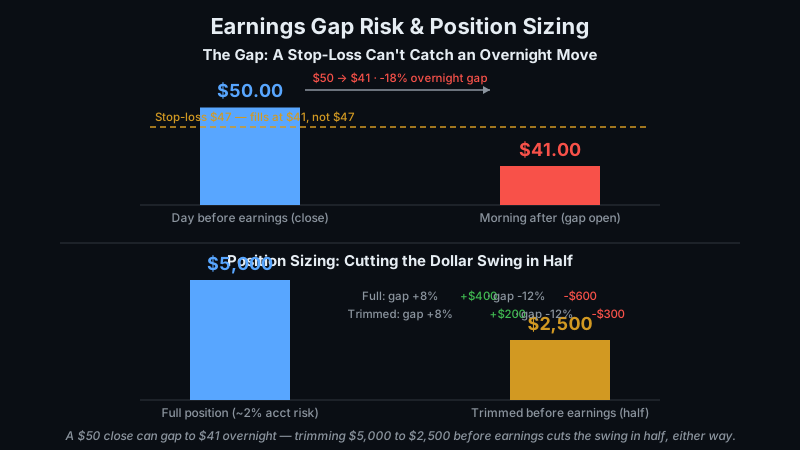
This matters because of one detail traders new to earnings season consistently miss: a stop-loss order does not protect you from a gap. Your stop only triggers once the market reopens and shares actually start trading again. If a stock closes at $50, you're stopped out at $47, and the company reports a bad quarter overnight, the stock can open at $41 the next morning. Your "stop" doesn't fire at $47. It fires at $41, because that's the first price available when trading resumes. The order was never broken — the market simply moved past it while it was closed.
Why position size is the only lever that actually works here
You can't out-analyze an earnings report. You don't know what management is going to say, what guidance will look like, or how the market will interpret it — and neither does anyone else with certainty, including people who are extremely good at reading a business. What you can control is how much money is riding on the outcome when the headline hits. Sizing down before the report doesn't predict the outcome any better. It just makes both possible outcomes smaller in dollar terms, which is the only kind of control you actually have over an event you can't see coming.
The setup: You're holding a $5,000 position, sized at roughly 1-2% account risk under normal conditions. Earnings are in two days.
The move: Ahead of the report, you trim the position to half size — selling down to $2,500 — specifically because you don't want the full position exposed to an overnight gap you can't control or exit during.
Outcome A — stock gaps up 8% on the report:
Full $5,000 position would have gained: $400
Trimmed $2,500 position actually gains: $200
You left $200 of upside on the table. That's the cost of trimming.
Outcome B — stock gaps down 12% on the report:
Full $5,000 position would have lost: $600
Trimmed $2,500 position actually loses: $300
You avoided $300 of loss you would otherwise have taken with no way to exit before it happened. That's the point of trimming.
Notice what actually happened in both scenarios: the trimmed position captured exactly half the move, in either direction, every time. That's not an accident — it's the entire mechanism. You are not making a prediction about which way the stock gaps. You're deliberately taking on half the binary risk in exchange for giving up half the binary reward, before you know which one you're going to get.
That's the honest way to think about it: this is a tradeoff, not a free lunch. You are not finding a way to keep the full upside while cutting the downside — that setup doesn't exist for a plain stock position. You're choosing to make the swing smaller in both directions because you'd rather not have a single overnight headline move your account by a full 1-2% chunk in an instant.
The other two honest choices
Trimming to half size is a middle path, and it's not the only reasonable one. Two other approaches are just as legitimate, depending on how you feel about the stock and the report:
Exit entirely before earnings. If you don't want any gap exposure at all — maybe you don't have strong conviction on the quarter, or the position is already a bigger chunk of your account than you're comfortable with — there's nothing wrong with selling out completely before the report and deciding whether to get back in afterward, once the market has actually priced in the news. You give up the chance of a favorable gap, but you also give up the chance of an unfavorable one. Some traders treat this as the default and only hold through earnings when they have a specific reason not to.
Hold full size, deliberately. If you have real conviction in the business and you've genuinely thought through what an 8-12% move against you would do to your account — and you can actually stomach that outcome, not just say you can — holding the full position through earnings is a legitimate choice too. The problem isn't holding full size. The problem is holding full size by default, without ever running the numbers on what a bad print would actually cost you.
What ties all three approaches together is that the decision gets made before the report, on purpose, with the dollar amounts written down. The bad outcome isn't losing money on a gap — that's a normal risk of holding stocks through news events. The bad outcome is not realizing earnings were even coming up.
How GenZTrade helps you find these setups
The most common way traders get blindsided by earnings isn't bad judgment — it's simply not knowing the date. Edge includes an Earnings Radar that flags upcoming earnings dates for the positions you're actually holding, so a report landing overnight shows up on your radar days in advance instead of as a surprise gap in your account the next morning.
Once you know the date, Cockpit is built to make the actual adjustment easy — trimming a position down to a smaller size ahead of a known event takes a couple of clicks, not a spreadsheet and a manual calculation of what half your shares are worth. The goal isn't to automate the decision for you. It's to remove the friction so that when you decide to trim, you actually do it, instead of telling yourself you'll get to it and then forgetting until the report has already happened.
Bottom line
There is no version of holding a stock through earnings that eliminates gap risk. If you want zero exposure to an overnight surprise, the only real way to get it is to not hold the position when the report comes out. Trimming your size doesn't remove the risk — it just shrinks the dollar swing on both sides, up and down, in proportion to how much you cut. That's a real and useful tool, but it's a tradeoff, not a hedge.
What matters most isn't which of the three choices you make — trim, exit, or hold full size. It's that you make the choice on purpose, with the earnings date in front of you and the dollar amounts worked out ahead of time, instead of finding out you were exposed the hard way when you check your account the morning after.
Comments (0)