
In one sentence: when a company's own executives spend their own outside cash to buy more stock on the open market, that's one of the more honest signals available to you — but only if you know how to separate it from routine noise.
Legal insider trading is not what you think it is
The phrase "insider trading" gets used almost exclusively to describe a crime, so it's worth stopping to untangle it before going further. There are two completely different things hiding under that phrase.
Illegal insider trading is trading on material non-public information — knowing something about a company that the rest of the market doesn't know yet, and using that knowledge to trade before the news comes out. That's the version that ends in headlines and, sometimes, handcuffs.
Legal insider trading is something else entirely, and it happens constantly, in the open, with paperwork. Executives, directors, and large shareholders of a public company are legally required to report any trade they make in their own company's stock. Under SEC rules, that means filing a Form 4 within two business days of the transaction. The filing is public. Anyone can look it up. There's no secret information changing hands — these are people buying or selling shares of the company they already run or sit on the board of, and telling the public about it almost in real time.
So when this article talks about "insider buying," it means the legal, disclosed, everyday version: a Form 4 filing showing an executive bought shares with their own money. Keep that distinction in your head, because it changes how you should read the rest of this.
Why insider selling usually tells you less than you'd think
It's tempting to treat every insider sale as a red flag — "the CEO is selling, get out." Most of the time that reaction is wrong, because most insider selling has nothing to do with what the executive thinks about the stock right now.
A large share of insider sales happen through what's called a 10b5-1 plan. This is a pre-scheduled trading plan an executive sets up months in advance, often specifying exact dates or price triggers for future sales, precisely so they can diversify a concentrated position or cover a tax bill without ever being accused of trading on information they know today. The plan is disclosed as such. By design, it's disconnected from the executive's current opinion of the company — it was set in motion before this quarter's numbers even existed.
Executives also accumulate huge amounts of stock simply by being compensated in stock. Selling some of it to pay a mortgage, fund a kid's tuition, or just not have your entire net worth tied to one employer is normal financial hygiene, not a vote of no confidence. None of this means insider selling is always meaningless — a sudden, large, non-scheduled sale by someone who's never sold before can still be worth noting — but as a category, selling is a much noisier signal than buying.
Why insider buying tends to matter more
Buying doesn't have this problem, and the reason is simple: executives don't get open-market purchases as part of their pay. Stock grants, options, and bonuses hand them shares automatically. Nobody automatically hands them more shares bought with their own after-tax cash. If an executive is buying on the open market, it's because they chose to, out of their own pocket, with money that could have gone anywhere else.
That's what makes it a discretionary bet rather than routine plumbing. It doesn't require them to be right — plenty of insider purchases turn out to be poorly timed — but it does require them to be willing to put personal capital behind a public, dated, disclosed statement that they think the stock is worth owning more of. That's a different kind of information than a scheduled sale that was set up before anyone knew what this quarter would look like.
Illustrative example (not a real company):
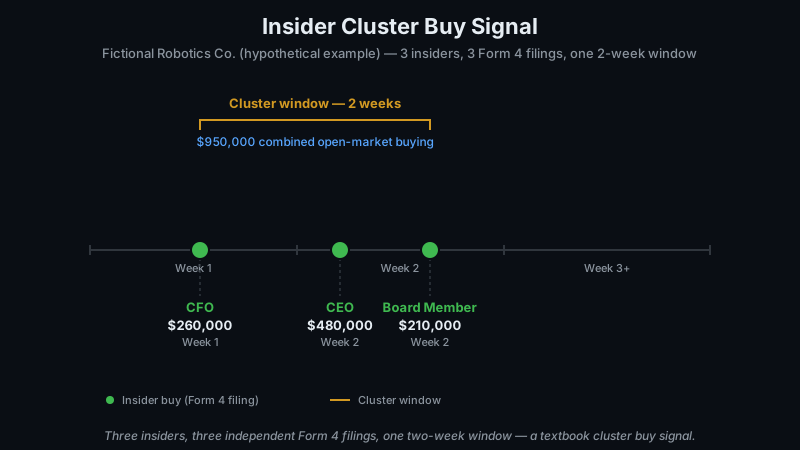
Say a mid-cap company called, hypothetically, "Fictional Robotics Co." has had a rough six months and the stock is down sharply from its highs.
Week 1: The CFO files a Form 4 showing an open-market purchase of roughly $260,000 in shares.
Week 2: The CEO separately files a Form 4 for an open-market purchase of about $480,000.
Week 2: A board member, unconnected to either of them, files a Form 4 for around $210,000 in open-market shares.
Why this matters more than any one purchase alone: three people with different jobs, different information access, and different personal financial situations independently decided, within the same two-week window, to spend real personal money buying more stock in a company that had just gotten cheaper. That's called cluster buying, and it's a meaningfully stronger signal than a single insider's transaction — especially a routine, pre-scheduled one. One executive buying could be a one-off. Three, acting independently and around the same time, is much harder to wave off as coincidence.
What insider buying does not tell you
Even a clean cluster-buying signal has real limits, and it's worth being blunt about them. Executives are not oracles — they run the company, but they don't have a crystal ball on the stock price, and plenty of well-intentioned insider purchases have been followed by the stock falling further anyway. A CEO can be genuinely convinced their company is undervalued and still be wrong.
Position size matters too. A $250,000 purchase sounds significant in isolation, but for an executive whose annual compensation runs into the millions, it may be a fairly small, low-conviction bet rather than a "betting the house" statement. Always weigh the purchase against what you know about that person's overall financial picture, not just the dollar figure on the filing.
Treat insider buying as a reason to look closer, not a reason to click buy. It's a filter for where to spend your research time, not a substitute for doing the research.
How GenZTrade helps you find these setups
The problem with insider buying as a signal has never been that it doesn't work — it's that finding it requires digging through SEC filings by hand, company by company, hoping you notice a pattern before it's stale. GenZTrade's Edge tools include an Insider view built specifically to remove that friction: it surfaces Form 4 filings as they're disclosed and flags cluster-buying patterns — multiple insiders at the same company buying in a tight window — automatically, instead of leaving you to piece it together from raw filings. It won't tell you whether the buying is right. It just makes sure you see it while it's still useful, instead of finding out about it three weeks later in a recap article.
Bottom line
Insider buying, especially cluster buying from multiple people acting independently, is one of the more honest signals available in public markets, precisely because it's disclosed, dated, and voluntary. But it's one input, not a verdict. Executives can be wrong, the dollar amounts can be smaller than they look, and following any signal blindly — without forming your own view of the business — is still a guess. It's just a better-informed one than ignoring the filings entirely.
Comments (0)