
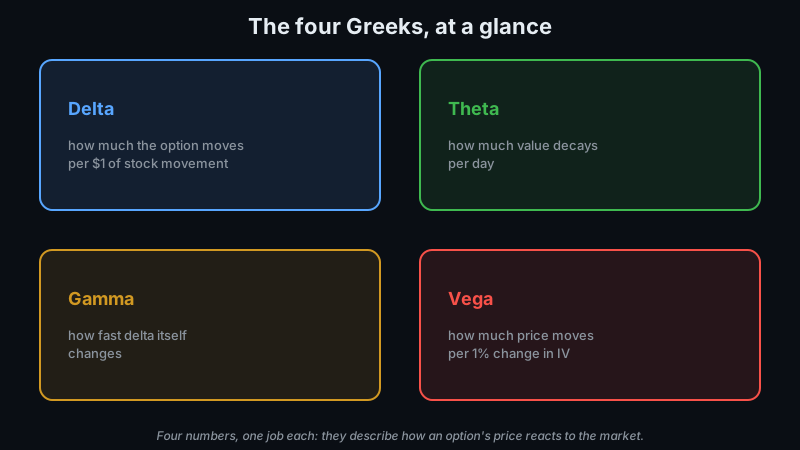
In one sentence: The Greeks - delta, theta, gamma, and vega - are just a shorthand for how an option's price reacts to the stock moving, time passing, and volatility shifting.
Why the Greeks matter
Every options strategy article on this site mentions delta, theta, gamma, or vega, usually without pausing to explain them, because doing so in every post would get repetitive fast. This page is the definition you can always come back to. The Greeks are not a separate math discipline bolted onto options trading - they're just labels for four things that are already happening to every option position: the stock price moves, time passes, the stock's volatility expectation changes, and an option's own sensitivity to price moves shifts as things change. You don't need calculus to use them. You need the plain-English version of what each number is telling you, and that's what this article gives you.
Delta: how much the option moves when the stock moves
Delta measures how much an option's price changes for every $1.00 move in the underlying stock. It's expressed as a decimal between 0 and 1 for calls (and between 0 and -1 for puts), and it also doubles as a rough, informal estimate of the probability that the option finishes in the money at expiration.
0.30 delta call: gains about $0.30 per share if the stock rises $1 - roughly $30 on a standard 100-share contract
Rough odds: roughly a 30 percent chance of finishing in the money at expiration
0.50 delta call: moves about half as much per dollar of stock movement - roughly a coin flip on finishing in the money
0.90 delta call: moves almost dollar for dollar with the stock, behaving like a stock substitute
The higher the delta, the more the option behaves like owning the stock outright, and the less time value it's carrying relative to its price. Low-delta options are cheaper and more leveraged, but they need a real move to pay off. This tradeoff is the first thing to check on any strategy card - it tells you how directional a position actually is before you look at anything else.
Theta: how much value the option loses every day
Theta measures how many dollars an option's price decays per day purely from time passing, assuming the stock price and volatility stay flat. Every option is a wasting asset - it has an expiration date, and part of its price is just the value of time remaining, which shrinks every single day whether the stock moves or not.
Theta of -0.05: the option loses about $0.05 per share per day
Per contract: about $5 per day per 100-share contract, all else equal
Theta isn't constant - it accelerates as expiration approaches. An option loses time value faster in its final two weeks than it did three months out, because there's simply less time left for the trade to work in the buyer's favor. This is exactly why premium sellers - covered calls, credit spreads, and similar income strategies - tend to favor the 30-45 day expiration window. There's enough daily theta decay to make the trade worthwhile, without getting so close to expiration that gamma risk (see below) starts to dominate the position's behavior.
Gamma: how fast delta itself is changing
Gamma measures the rate of change of delta itself - it tells you how much delta will shift for a $1 move in the stock. If delta tells you how fast the option is moving right now, gamma tells you how fast that speed is changing.
Starting point: a call with delta 0.30 and gamma 0.05
After a $1 stock rise: delta becomes roughly 0.35 (0.30 + 0.05)
After another $1 rise: delta climbs again, and keeps accelerating toward 1.00 as the option moves deeper in the money
Gamma is highest for at-the-money options that are close to expiration. That's the mechanical reason 0DTE (zero days to expiration) and other near-expiration options can swing in value so violently on small stock moves - a modest price change causes an outsized shift in delta, and since delta drives the option's price, the option's price shifts outsized too. High gamma cuts both ways: it can turn a small move into a big win, or a big loss, faster than most beginners expect.
Vega: how much the option's price moves per 1 percent change in implied volatility
Vega measures how many dollars an option's price changes for each 1 percentage point change in implied volatility (IV) - the market's expectation of how much the stock will move going forward, independent of which direction.
Vega of 0.10: the option gains about $0.10 per share ($10 per contract) if IV rises 1 percentage point
Same option: loses about $0.10 per share if IV falls 1 percentage point
Vega is the Greek that trips up the most beginners around earnings. Implied volatility is typically priced up heading into an earnings report, because the market knows a big move is coming and doesn't know which direction. Once the report is out, that uncertainty resolves and IV often collapses immediately - a phenomenon widely called "IV crush." That means an option can lose value even when the trader's directional call on the stock was correct, purely because vega worked against the position harder than delta worked for it. Understanding vega is what separates "I was right about the stock" from "I made money on the trade."
Putting them together
These four Greeks aren't separate events - they're all acting on a position at the same time. Take a 30-delta, 35-day call with theta of -0.04 and vega of 0.12. On any given day, that option gains value if the stock rises (delta), quietly loses a little value just from another day passing (theta), and moves up or down depending on whether the market's expectation of future volatility rises or falls (vega) - and if the stock makes a sharp move, delta itself shifts because of gamma. All of this happens simultaneously, every day the position is open. That's why judging an option trade purely on "did the stock go the right direction" misses part of the picture - a correct directional call can still lose money to theta or an IV crush, and an incorrect one can occasionally still profit from a volatility spike.
How GenZTrade helps you find these setups
You don't need to run these calculations by hand to use them. On GenZTrade's Options Plays, every strategy card already shows delta, break-even price, and probability pre-computed alongside the setup, so you can see where a trade sits on the risk spectrum without pulling up a separate options chain calculator. It's a starting point for reading a position's risk profile at a glance, not a substitute for understanding what delta, theta, gamma, and vega actually measure - which is why this page exists as the reference every other strategy article on the site links back to.
Bottom line
The Greeks are not a barrier to entry - they're a vocabulary. Delta tells you how much an option moves with the stock, theta tells you what time is costing you, gamma tells you how fast delta itself is shifting, and vega tells you how sensitive the position is to changes in volatility expectations. None of them predict outcomes or guarantee returns, and no combination of Greeks removes the risk of losing money on an options trade. What they do is turn "the option went up" or "the option went down" into a reason why, which is the difference between trading and guessing.
Comments (0)