
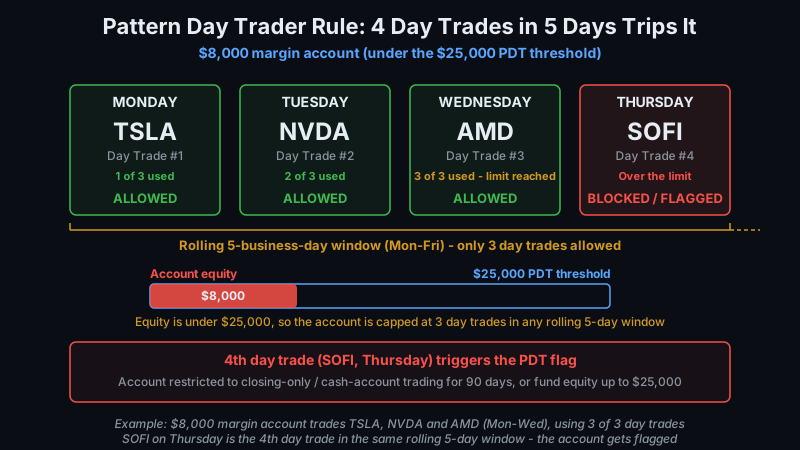
In one sentence: If your margin account holds less than $25,000, FINRA lets you make exactly 3 day trades in any rolling 5-business-day window before your account gets flagged and restricted.
What the PDT rule actually says
Pattern Day Trader is a FINRA rule, not a broker gimmick, and it applies to margin accounts specifically. The moment a margin account's equity drops below $25,000, the account is capped at 3 day trades within any rolling 5-business-day period. Not 3 per week on a Monday-to-Friday reset — a rolling window, so Wednesday's trades are still counted when you check Monday's.
Make a 4th day trade while under that limit and two things can happen. Your broker flags the account as a Pattern Day Trader account, and it either gets locked to closing-only trades until you deposit enough to hit $25,000, or it gets restricted to cash-account-style trading for 90 days. The exact mechanics vary slightly by broker, but the outcome is the same: you lose the ability to freely day trade until you either wait out the 90 days or bring in more capital.
This is the part almost nobody explains in trading content online. Most "day trading" videos and threads show entries and exits with zero mention that a $3,000 or $5,000 account legally cannot do this more than 3 times a week without tripping a restriction. It's not a secret, it's just rarely the fun part of the story.
What actually counts as a "day trade"
A day trade is buying and selling the same security on the same calendar day — or short selling and then buying to cover on the same day. That's it. The security has to match and the open-and-close has to happen within the same session.
Two things trip people up here. First, it's per security, not per trade — buying and selling AAPL twice in one day is 2 day trades, not 1. Second, holding overnight breaks the chain entirely. Buy today, sell tomorrow, and it isn't a day trade at all — it's just a trade, with no PDT consequence whatsoever. That single distinction is the entire foundation of how smaller accounts stay active without getting flagged.
A worked example: how the count actually plays out
Monday: Trader has $8,000 in a margin account. Buys and sells TSLA same day. Day trade #1.
Tuesday: Buys and sells NVDA same day. Day trade #2.
Wednesday: Buys and sells AMD same day. Day trade #3. The account has now used all 3 day trades allowed in the rolling 5-business-day window that started Monday.
Thursday: Trader buys SOFI in the morning and sells it that afternoon. This would be day trade #4 within the same rolling window.
Result: The broker's system catches it, either blocking the closing trade in real time or executing it and immediately flagging the account afterward. Either way, the account gets marked as a Pattern Day Trader account. Because equity is $8,000 — well under $25,000 — the account is restricted: closing-only or cash-account-only trading for 90 days, unless the trader deposits enough to bring equity up to $25,000.
What resets it: Nothing resets the flag itself once it's tripped. The trader either waits out the 90-day restriction or funds the account to $25K. The 5-day trade count itself would have started clearing on the following Monday, but that's irrelevant once the PDT flag is already set.
Two real ways to trade actively under $25K
Neither of these is a loophole. They're the two legitimate structures traders under $25K actually use.
Cash account. A cash account has no day-trade-count limit at all — the PDT rule only applies to margin accounts. The tradeoff is settlement. When you sell a stock, the cash from that sale isn't available to trade with again until it settles, which for most U.S. equities is T+1 (one business day after the trade). Sell on Monday, and that cash is usable again Tuesday. Try to use unsettled funds to buy again the same day and you risk a "good faith violation," which is its own separate problem with brokers. A cash account trades active, but it's active on a delay, not instantly recyclable capital.
Swing trading. The simplest fix is to stop day trading. Hold positions overnight — even just one day — and the trade never counts against the PDT limit in the first place, because it was never a day trade. This is less about avoiding a rule and more about matching your trading style to your account size. A lot of the setups that actually work for smaller accounts (breakouts, pullbacks to support, multi-day momentum) were never built to be closed same-day anyway.
How GenZTrade helps you find these setups
If you're under $25K and don't want to burn your 3 day trades on mediocre setups, the Swing Watchlist is built for exactly this. It surfaces stocks showing multi-day setups worth holding overnight, which is the whole point when day trades are a scarce resource and overnight holds aren't restricted at all.
For the day trades you do have — the 3 you're allowed in a rolling 5-day window — the Momentum Scanner helps you make sure each one is spent on a real setup instead of a random impulse trade. When you only get 3 shots, wasting one on a low-conviction entry is expensive in a way it isn't for a funded account. Use the scanner to filter for actual volume and momentum confirmation before you spend a day trade you can't get back until the window rolls forward.
Bottom line
PDT isn't FINRA punishing small accounts — it exists because frequent day trading on thin capital and margin is genuinely risky, and regulators decided under-$25K accounts needed a guardrail. Whether you agree with that reasoning or not, it's the rule you're trading under, and planning around it — cash account, swing trading, or just being deliberate with your 3 day trades — beats getting flagged and locked out for 90 days by accident. None of these workarounds change the actual risk of the trades themselves. A cash account, a swing position, a scanner-confirmed setup — all of it can still lose money. Staying compliant with PDT keeps your account open. It doesn't make any individual trade safe.
Comments (0)