
In one sentence: A poor man's covered call replaces 100 shares of stock with a single deep in-the-money long-dated call, letting you run the same monthly income strategy for roughly a fifth of the capital.
What a poor man's covered call actually is
A regular covered call has two pieces: you own 100 shares of stock, and you sell a call option against those shares to collect premium. The stock is what makes it "covered" - if the short call gets assigned, you already have the shares to deliver.
A poor man's covered call (PMCC) swaps out the stock for a stand-in. Instead of buying 100 shares, you buy one long-dated, deep in-the-money call option - typically a LEAPS (Long-term Equity AnticiPation Security) expiring 6 to 12 months or more out. Because that call is deep in the money, its delta sits close to 1.00, meaning it moves almost dollar-for-dollar with the underlying stock. It behaves enough like owning shares that you can sell short-dated calls against it every month, exactly like a regular covered call. That's why it's also called a diagonal call spread - a long option and a short option at different strikes and different expirations, stacked on the same underlying.
Worked example
Say a stock is trading at $180.
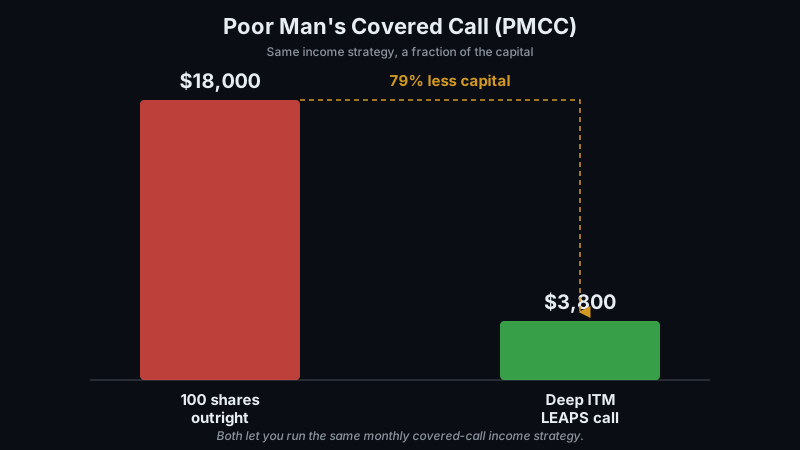
Buying 100 shares outright: $180 x 100 = $18,000
Buying one $150 LEAPS call, 12 months out, instead: $38.00 x 100 = $3,800
Capital used vs. buying shares: $3,800 / $18,000 = 21% of the capital
Capital saved: roughly 79% less than buying shares outright
Long call delta: approximately 0.80 (moves about $0.80 for every $1.00 the stock moves)
That 0.80 delta is the key number. It means the $150 LEAPS call is a reasonable stand-in for 100 shares of stock - not a perfect one, but close enough that the position will track most of the stock's up-and-down movement.
Now you sell a near-term call against that LEAPS, same as you would against real shares:
Sell the $190 call, 30 days out: $2.50 x 100 = $250 collected
If the stock stays below $190 at expiration: the short call expires worthless, you keep the $250, and you can sell another short call the following month
If the stock rises above $190: the short call is at risk of assignment
That last line is where a PMCC diverges from a real covered call in a way worth understanding before you put one on. In a normal covered call, assignment just means your broker sells your existing 100 shares - clean and automatic. In a PMCC, you don't own actual shares to deliver. If your short call is assigned, you'd typically need to exercise your long LEAPS call to generate the shares to deliver, or your broker may close out both legs for you. Either way, there can be a cash timing gap between when the short call is assigned and when the long call's exercise settles, and exercising a LEAPS early gives up any remaining time value it still had. Most traders avoid this altogether by closing (buying back) the short call before expiration if it's deep in the money, rather than letting assignment happen. It's a real mechanical wrinkle, not a hypothetical one, and it's the main reason PMCCs take more active management than plain covered calls.
The tradeoffs versus a real covered call
What you gain
- Far less capital required. In the example above, $3,800 versus $18,000 - about 79% less - lets you run the same monthly premium-selling strategy on a much smaller account, or spread that capital across several names instead of concentrating it in one 100-share position.
What you give up
- The long call expires. Shares of stock never expire. Your LEAPS does, and eventually you'll need to roll it to a new expiration or close the whole position out.
- Time decay, even if slow. A deep in-the-money, long-dated call still loses a small amount of extrinsic value each day. It's much slower than an at-the-money option, but it's not zero - unlike stock, which has no decay at all.
- Imperfect tracking. A 0.80 delta is not a 1.00 delta. The position will lag the stock somewhat on the way up and cushion less on the way down than actual shares would, and that gap widens the further out-of-the-money and the shorter-dated the long call is.
- More involved assignment mechanics. As covered above, a PMCC doesn't hand off shares automatically the way a real covered call does.
Picking the long call (the stock substitute)
The long leg needs to act like stock, not like a fast-moving option, so you're generally looking for:
- Deep in the money: delta in roughly the 0.75-0.85 range is a common starting point.
- Far dated: 6-12 months minimum, often longer, so the option's own time decay stays slow and you're not constantly rolling it.
The tradeoff inside this leg itself: a higher delta (deeper ITM) tracks the stock more precisely but costs more; a lower delta costs less but drifts further from real share-like behavior.
Picking the short call (the income leg)
This part uses the same logic as a regular covered call: roughly 30 delta and 30-45 days to expiration is a common starting range, balancing premium collected against the odds of the stock finishing above the strike. The one PMCC-specific check is to make sure your short strike sits comfortably above your long call's strike - that spread between the two strikes is your maximum profit if the short call is ever assigned, so you want it wide enough to be worth the trade.
How GenZTrade helps you find these setups
GenZTrade's Options Plays surfaces covered-call-style candidates with strikes, deltas, and premium already computed. Those cards are built assuming you own the shares, so they won't build the long LEAPS leg of a PMCC for you - but the strike and delta logic behind the short-call side is exactly the same whether you're selling against 100 real shares or a deep ITM long call. You can use those short-call candidates as your starting point for the income leg and apply the delta and days-to-expiration ranges above to your own long call separately. Once you've built the position, Portfolio tracks it so you can see both legs, your net cost basis, and how the diagonal is performing as expiration approaches.
Bottom line
A poor man's covered call isn't a shortcut around risk - it's a way to run a familiar income strategy with a fraction of the capital a real covered call requires, at the cost of added complexity: an expiring long leg, imperfect delta tracking, and messier assignment mechanics if your short call goes in the money. For traders priced out of buying 100 shares of a higher-priced stock, it's worth understanding in detail before using it. No options strategy, including this one, removes the risk of loss, and a PMCC can lose money on both legs if the stock moves against you. Size it, understand the mechanics, and manage it as actively as its two moving parts demand.
Comments (0)