
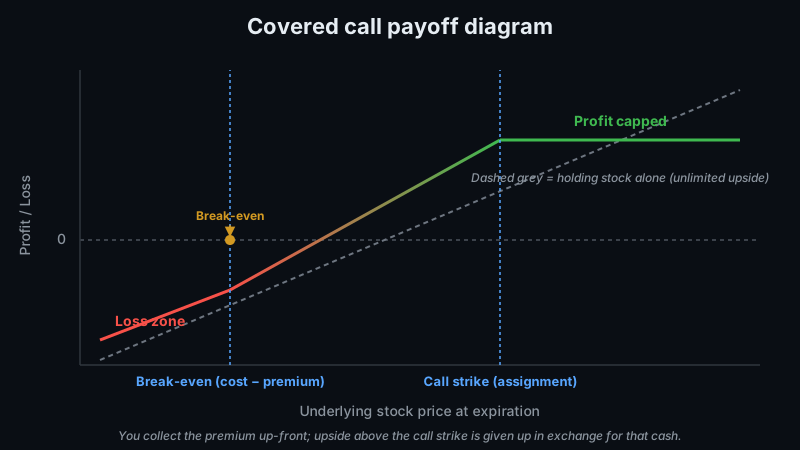
In one sentence: when your covered call is about to get exercised, you can let it happen, roll it up and out for more room and more premium, or take the assignment on purpose - and the right call comes down to simple arithmetic, not nerves.
Pick up where the last article left off. You own 100 shares of Apple, cost basis $170. A few weeks ago you sold the $185 call, about a month out, for $2.50, collecting $250. Now there are only a few days left before expiration, and Apple has climbed to $184.50 - close enough to the $185 strike that assignment is a real possibility. This is the exact moment a covered call seller has to make a decision, and there are three legitimate ways to handle it.
The three choices when a call is threatened
First, you can do nothing and let it play out. If Apple stays below $185 at expiration, the call expires worthless and you keep the $250 plus your shares, free to sell another call next cycle. If Apple finishes above $185, your shares get called away at $185, and you keep the $250 premium plus the stock gain from your $170 cost basis to the $185 strike - $15 per share, or $1,500 - for a total of $1,750. That's a fine outcome, but you'd miss anything Apple does above $185.
Second, you can roll up and out - buy back the current $185 call and simultaneously sell a new call at a higher strike and a later expiration. This is the adjustment most active covered call sellers reach for when they still like the stock and want to stay in the trade.
Third, you can just take the assignment on purpose. If you're comfortable selling at $185 anyway - it's still a solid gain over your $170 cost basis - and you don't want to keep managing the position, letting assignment happen is a legitimate, simple choice. It is not a failure. Plenty of good covered call trades end exactly this way.
The math on rolling up and out
With a few days left and Apple at $184.50, assume buying back the $185 call now costs $1.80, or $180. At the same time, you sell the $190 call, 30 days out, for $2.60, collecting $260.
Cost to buy back the $185 call: $180
Premium collected on new $190 call: $260
Net credit from the roll itself: $260 - $180 = $80
Original premium collected at trade open: $250
Total premium collected so far: $250 + $80 = $330
New upside room created by the roll: $185 to $190 = $5/share, or $500
The roll did two things at once: it put an extra $80 in your pocket, and it moved the ceiling on your shares from $185 to $190, meaning you'd now also capture Apple's move from $185 to $190 if it keeps climbing before the new expiration.
Now compare the two outcomes at the new $190 strike. If Apple stays below $190 at the new expiration, you keep the $330 total premium plus your shares, ready to sell another call. If Apple finishes above $190, shares get called away at $190: you collect the $330 in premium plus the stock gain from $170 to $190 - $20 per share, or $2,000 - for a total of $2,330.
Total if called away at $190 after the roll: $330 + $2,000 = $2,330
Total if called away at $185 with no roll: $1,750
Difference: $2,330 - $1,750 = $580
Rolling up and out in this example was worth $580 more than simply letting the original $185 call get exercised - and it cost nothing to do, since the roll itself was collected as a credit rather than paid for.
When rolling makes sense versus when it doesn't
Rolling up and out is worth doing when the new credit is positive or roughly breakeven, as in the example above, where the roll itself was a net credit of $80, not a cost - and when you still want to hold the stock longer.
It stops making sense in two situations. The first is when the roll would require paying a net debit just to buy more room - meaning the market is pricing the higher strike option too cheaply relative to what it costs to close the current one. That's usually a sign the stock has moved too fast for the roll to pay for itself, and you'd be spending real money just to delay a decision. The second is when you've already hit your target gain on the stock and would be perfectly happy exiting via assignment anyway. In that case, rolling just keeps you in a position you were already fine leaving.
A practical rule
Only roll if the transaction is credit-neutral or better, like the $80 credit in the example above. Rolling for a net debit just to avoid assignment is usually an emotional decision, not a mathematical one - a reluctance to "give up" the shares rather than a clear-eyed read of the trade. It's often better to just accept the assignment, take the gain, and start a fresh position elsewhere than to pay up to stay in a stock that's already done what you wanted it to do.
How GenZTrade helps you find these setups
This decision only works if you can see both sides of it quickly, with a few days left on the clock and the stock sitting right at your strike. Options Plays prices a new, higher strike and later expiration instantly, so comparing "roll" versus "let it get called away" - like the $185-to-$190 roll above - is a quick lookup instead of a manual spread calculation. And because the moment to act is narrow, Cockpit tracks the sold call intraday and pings you when the stock threatens the strike, which is exactly the trigger for this decision. You don't have to watch the ticker all week to catch the window where rolling still makes sense.
Bottom line
Rolling a covered call up and out isn't a rescue move - it's just another version of the same trade, sold at a better strike, for more premium, with more time. Do the arithmetic each time: if the roll is a credit and you still want the stock, roll it. If it would cost you money or you're already happy with the gain, let the shares go. Either way, remember that a covered call still leaves you exposed to the stock falling below your cost basis, and no options strategy - rolled, adjusted, or otherwise - removes the risk of loss.
Comments (0)