
In one sentence: SPY 0DTE options expire the same day you trade them, which means extreme time decay and extreme gamma work for you or against you within minutes - so the strategy only works with strict rules, small size, and a defined-risk structure, not with buying naked calls and hoping.
What 0DTE actually means
0DTE stands for "zero days to expiration." Because SPY options list new contracts every trading day, there is always a chain expiring at the close of the current session. When you trade 0DTE, you are buying or selling an option with hours - sometimes minutes - left before it settles.
That single fact changes everything about how the option behaves. A normal 30-day option has a cushion of time value built into its price. If the stock moves against you, that time value gives the position room to recover before expiration. A 0DTE option has almost none of that cushion. Nearly all of its price is intrinsic value or pure gamble on a same-day move.
Two forces dominate 0DTE pricing:
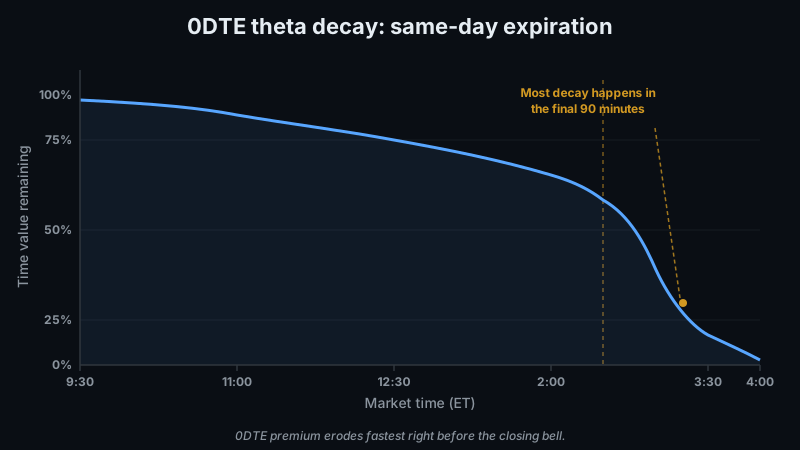
- Theta (time decay) accelerates non-linearly as expiration approaches. An option that loses a few cents an hour in the morning can lose that same amount every ten minutes by early afternoon. The decay curve is steep and it gets steeper the closer you get to the close.
- Gamma (rate of change of delta) is at its highest possible level on expiration day. A small move in SPY can flip an option from nearly worthless to deep in the money, or the reverse, in a matter of points. This is what makes 0DTE both attractive and dangerous - the payoff swings are large relative to the premium paid.
The takeaway: 0DTE is not a smaller, cheaper version of a normal options trade. It is a structurally different instrument where time and gamma dominate price far more than the underlying trend does.
The honest risk picture first
Multiple studies of retail 0DTE flow, including research published by the Cboe and academic reviews of SPX 0DTE volume, point to the same pattern: the majority of retail traders buying naked 0DTE calls and puts lose money on those positions over time. This is not a secret, and GenZTrade is not going to pretend otherwise.
The mechanism is straightforward. When you buy a naked 0DTE call or put, you need two things to go right in a narrow window: direction and magnitude, within a few hours, before theta erases your premium. Theta decay on a 0DTE contract does not move in a straight line down to zero - it compounds hardest in the final one to two hours of the session, which is often exactly when a retail trader is watching the position bleed and hoping for a bounce that theta will not wait for.
Layer gamma on top of that. High gamma means the option's delta - and therefore its price - reacts violently to small moves in SPY. That cuts both ways. A half-percent move in your favor can double the option's value. The same half-percent move against you can cut it in half just as fast. Traders who buy 0DTE options as a directional lottery ticket are making a bet where the house edge (decay) is stacked against a payout structure (gamma) that is genuinely unpredictable minute to minute. That combination is why undisciplined 0DTE buying behaves less like trading and more like a slot machine with a countdown timer.
None of this means 0DTE cannot be traded responsibly. It means the naked directional lottery-ticket approach is the wrong way to do it.
Two ways to actually trade this (not gamble)
There are two structures that keep 0DTE inside the bounds of a real strategy instead of a gamble.
1. Directional 0DTE calls or puts, bought on a confirmed intraday setup
This means buying a call or put only after price has already given you a real signal - not at the open on a hunch. Examples include a VWAP reclaim with volume confirmation, or a break of the opening range with follow-through. The position is sized small on purpose (more on that below), and the trader defines an exit before entering: a stop if the setup fails, and a target or trailing exit if it works. This is a short, tactical bet on a confirmed move, not a hold-and-hope position.
2. 0DTE credit spreads and iron condors, sold for defined-risk income on elevated same-day IV
Instead of buying decay, you sell it. Same-day implied volatility on SPY is frequently elevated relative to where the stock actually ends up moving, which is what makes selling premium on 0DTE structurally interesting - you collect a credit that reflects a wider expected range than what typically plays out. A credit spread caps your risk at the width between strikes minus the credit received, so there is no open-ended exposure even though gamma is high.
Here is a real example using a SPY put credit spread, sold same-day.
SPY is trading at $560. With a few hours left before the close, you sell a put credit spread below the current price:
- Sell (short) the $555 put for $1.40 in premium
- Buy (long) the $550 put for $0.85 in premium
- Net credit into your account:
$1.40 - $0.85 = $0.55, or $55 per spread (one contract controls 100 shares)
Max profit: $55 per contract (the credit)
Max loss: $500 - $55 = $445 per contract (if SPY closes below $550 at expiration)
Break-even at expiration: $555 - $0.55 = $554.45
Return on the risk you took: $55 / $445 = approximately 12 percent
The trade profits if SPY closes anywhere above $554.45 at the end of the session - including flat, or even down slightly. The tradeoff for that wider window is a max loss more than eight times the max gain, which is the honest math of any credit spread. On 0DTE specifically, that loss can arrive fast because there is no next session to wait out a bad move - the position settles today, at the closing price, full stop.
Position sizing rules specific to 0DTE
Gamma risk on 0DTE is not something you manage with a wider stop. It is something you manage with smaller size, before you ever place the trade.
- Size well below your normal swing-trade allocation. If you would normally risk 2-3 percent of your account on a multi-week options position, cut that down meaningfully for 0DTE. The compressed timeframe means you have far less room to recover from being wrong.
- Set a hard cap per trade. Many disciplined 0DTE traders cap a single position at 1 percent of account value or less, specifically because a single adverse gamma swing can move the position further, faster, than a similar swing would on a longer-dated contract.
- Never add to a losing 0DTE position. Averaging down on a decaying, high-gamma contract compounds two problems at once - you are adding size into an accelerating theta curve and into a position that has already proven the setup was wrong. There is no next session to "wait it out."
- Decide your exit before you enter. Because there is no time to deliberate mid-session while gamma is moving the position by the minute, the stop level, profit target, and time-based exit (for example, "close by 2:00 pm regardless of P/L if the setup hasn't worked") should all be set before you click buy.
When NOT to trade 0DTE
There are specific conditions where 0DTE, especially undefined-risk directional buying, stops being a strategy and starts being a coin flip with extra steps.
- CPI, FOMC, and other major macro release days. These sessions can produce outsized, fast, two-directional moves as the market reprices in real time. If you are trading the volatility itself with a defined-risk structure and you understand exactly what you are exposed to, that is a deliberate choice. Buying naked directional 0DTE calls or puts into that kind of event, hoping to catch the initial spike, is a different thing entirely and is where a lot of retail 0DTE losses concentrate.
- Low-volume, directionless chop. If SPY is grinding sideways on thin volume with no clear intraday structure, there is no confirmed setup to trade and no elevated IV worth selling into. Sitting out is a position.
- Any day your size discipline has already broken down. If you have already taken a loss and are tempted to "make it back" with a bigger 0DTE position before the close, that is the exact moment to stop for the day. The math of 0DTE does not offer forgiveness for revenge trades - decay and gamma do not care about your P/L so far today.
How GenZTrade helps you find these setups
0DTE trading lives or dies on having real intraday structure to react to, not guesswork. Here is where the platform fits in:
- Momentum Scanner surfaces intraday signals like a VWAP reclaim or an opening range breakout (ORB) as they confirm, which gives the directional 0DTE approach an actual trigger instead of a guess at the open.
- High Volume Points overlays intraday support and resistance levels on the chart, so you can see where meaningful volume has traded before picking your short strike on a credit spread or your stop level on a directional play - rather than placing strikes at round numbers with no structure behind them.
Bottom line
SPY 0DTE options are not inherently reckless, but the way most retail traders use them - buying naked calls and puts as a same-day lottery ticket - is exactly the behavior that shows up losing money in the data. Theta decay compounds hardest right when you can least afford it, and gamma amplifies every move, in both directions, more than any other timeframe in options trading. Treated as a defined-risk, small-size, rules-based approach - whether that is a confirmed intraday directional trade or a credit spread sold into elevated same-day IV - 0DTE can be one tool in a broader strategy. Treated as a way to turn a few hundred dollars into a few thousand by the close, it is closer to gambling than trading, and the odds are not in your favor.
Comments (0)