
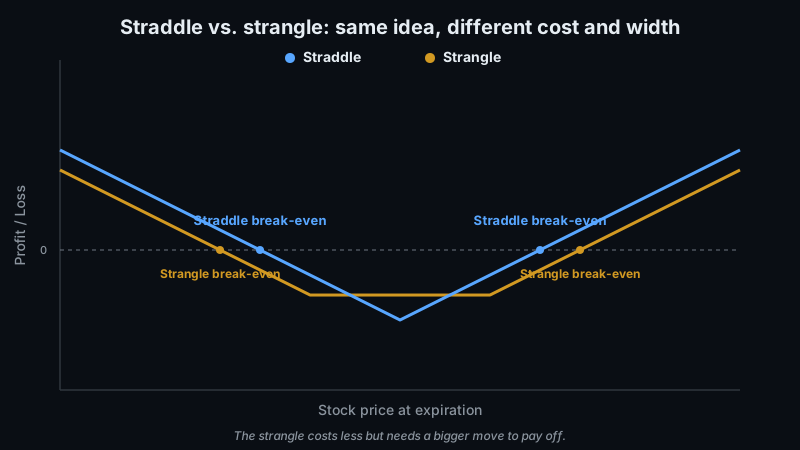
In one sentence: A straddle and a strangle both bet on a big move without picking a direction - the difference is how much you pay upfront and how far the stock has to travel before you're right.
If you've ever wanted to trade an earnings report without guessing beat or miss, these are the two strategies that come up first. They sound similar, and traders mix them up constantly, but the cost structure and break-even math are different enough to matter. Here's how they actually compare, with real numbers.
What both strategies have in common
Both a straddle and a strangle are long-premium, non-directional trades. You're not betting the stock goes up or down - you're betting it moves far enough, in either direction, to cover what you paid for the options. Both involve buying a call and buying a put on the same underlying stock with the same expiration date, and both are commonly used around a known catalyst - earnings, an FDA decision, a court ruling - where you expect volatility but don't have a strong directional read.
Because you're buying options rather than selling them, time decay and volatility work against you in both trades, not for you. That's the tradeoff for not having to pick a direction, and it's worth sitting with before you look at either one as a "safe" way to play an event.
Long straddle: same strike, both sides
A long straddle means buying a call and a put at the same strike price, same expiration - typically the strike closest to the current stock price. Your maximum possible loss is capped at the combined premium you paid for both legs, and that's also your entry cost. You profit if the stock moves far enough in either direction to clear the combined premium on one side of the trade.
Because both legs start at or near the money, a straddle is the more expensive of the two setups to put on. In exchange, you get the tightest break-even width - the stock doesn't have to move as far before one leg is in profit.
Long strangle: different strikes, cheaper entry
A long strangle means buying a call struck above the current price and a put struck below it - both out of the money, same expiration. Because neither leg starts with any intrinsic value, the combined premium is lower than a straddle on the same stock. The catch is that the stock now has to move further before either leg is worth more than you paid for it, since it has to cross the strike before it can even start building intrinsic value.
Side-by-side example: a $100 stock ahead of earnings
Say a stock is trading at $100 heading into an earnings report, and you're deciding between the two setups.
Long straddle: buy the $100 call for $4.00 and the $100 put for $3.80
Total cost: $4.00 + $3.80 = $7.80, or $780 per pair of contracts
Upper break-even: $100 + $7.80 = $107.80
Lower break-even: $100 - $7.80 = $92.20
Total break-even width: $107.80 - $92.20 = $15.60
Long strangle: buy the $105 call for $2.20 and the $95 put for $2.00
Total cost: $2.20 + $2.00 = $4.20, or $420 per pair of contracts
Upper break-even: $105 + $4.20 = $109.20
Lower break-even: $95 - $4.20 = $90.80
Total break-even width: $109.20 - $90.80 = $18.40
The tradeoff is plain once you put the two side by side. The strangle costs $360 less per pair ($780 - $420 = $360, roughly 46 percent cheaper), but it needs a wider total move to break even - $18.40 wide versus $15.60 wide - because both legs start out of the money and need the stock to travel further before they're worth anything.
Which one fits which situation
A straddle tends to make more sense when you expect a very large, high-conviction move - the kind of binary-outcome event where you genuinely think the stock could gap double digits in either direction - and you want the tightest break-even width the structure allows, even though it costs more upfront.
A strangle tends to make more sense when you want a cheaper way to play a possible big move, you're comfortable needing a bigger swing before you're profitable, or you want to size smaller per trade while still getting exposure to a volatility event. Some traders also use strangles simply because the lower dollar cost lets them spread risk across more names instead of concentrating it in one straddle.
The risk both share
The single biggest risk to both strategies is the same: implied volatility crush right after the event. Options are priced with elevated IV heading into a known catalyst, and once the news is out, that IV premium tends to collapse fast - regardless of which way the stock moved. That means even if you called the direction right, you can still lose money if the stock doesn't move enough, or if IV drops faster than the stock's move can offset it.
This is the flip side of being a premium buyer instead of a premium seller. As a buyer, time decay and volatility decay work against you, not for you - every day that passes and every point IV falls chips away at what your options are worth, independent of where the stock trades. Most single-event straddles and strangles lose money, not because the direction call was wrong, but because the move wasn't big enough to outrun that decay. There's no guaranteed return here - you're paying for a chance at a big move, and the odds of that move being large enough to clear break-even are the whole game.
How GenZTrade helps you find these setups
GenZTrade doesn't auto-generate straddle or strangle trades the way it does with defined-risk credit spreads - this is a strategy you build and size yourself. What the platform can do is help you spot when a setup might be worth considering: the Intel Panel shows upcoming earnings dates alongside IV context for a stock, so you can see at a glance whether a name has an event on the calendar and whether options are already pricing in elevated volatility ahead of it. That's useful for narrowing down which names are worth pricing out a straddle or strangle on, and for getting a sense of how expensive the volatility already is before you commit premium to either leg.
Bottom line
A straddle and a strangle are both ways to bet on movement instead of direction, but they're not interchangeable. The straddle costs more and gives you a tighter break-even range; the strangle costs less and asks the stock to move further before it pays off. Neither one is free money around an event - IV crush and time decay are real costs that work against you as the buyer, and plenty of correctly-directed trades still lose because the move wasn't big enough to clear the premium paid. If you're going to run either strategy, know your break-even numbers cold before you place the trade, not after.
Comments (0)