
In one sentence: a good stop loss isn't a feeling or a round number, it's a distance derived from how much a specific stock normally moves, placed just past the price level that would actually prove your trade idea wrong.
The two ways people get stop placement wrong
Almost every blown-up stop falls into one of two categories, and they're opposite mistakes.
The first is a stop that's too tight. You place it a few cents below your entry, or right at a round number, because it "feels safer" to risk less. The problem is that stocks wiggle. A stock can dip 1-2% intraday for no reason at all — a big seller hitting the bid, a sympathy move with a sector peer, plain noise — and be back above your entry an hour later. If your stop sits inside that normal noise band, you get stopped out of a trade that was never actually wrong. You didn't lose because your thesis failed. You lost because you gave the trade no room to breathe.
The second is a stop that's too loose. You place it far away because you don't want to get "shaken out," which sounds disciplined but usually just means you haven't decided what would actually invalidate the trade. The issue here isn't emotional, it's mathematical: a wide stop means a large dollar loss if it hits, which means either you're risking way more than you should per trade, or you have to buy a tiny position to compensate — and if you didn't do that math, you're just exposed. One bad trade with a stop that's too wide can do more damage to your account than five small, well-sized losses combined.
Both mistakes come from the same root cause: picking a stop distance based on vibes instead of the stock's actual behavior.
What ATR actually measures
Average True Range (ATR) is not complicated, even though the name sounds like it belongs in a textbook. It measures the typical high-to-low range a stock has covered per day over some recent window — usually 14 days. That's it. It's a direct read on "how much does this specific stock normally move around in a single session, independent of direction."
Why does that matter for stops? Because noise is not the same across stocks. A slow-moving, high-priced blue chip might have a 14-day ATR of $1.20 on a $150 stock — under 1% of price. A small-cap that's been running might have an ATR of $3 on a $20 stock — 15% of price. If you used the same fixed-dollar or fixed-percent stop on both, you'd be way too tight on the volatile name and way too loose on the calm one. ATR lets the stock tell you how much room it needs, instead of you guessing.
The practical use: once you know a stock's ATR, you can place your stop a fraction of that ATR beyond the structural level that actually matters — usually a recent swing low (for a long trade) — instead of placing it exactly at that level or at some arbitrary round number.
A full worked example
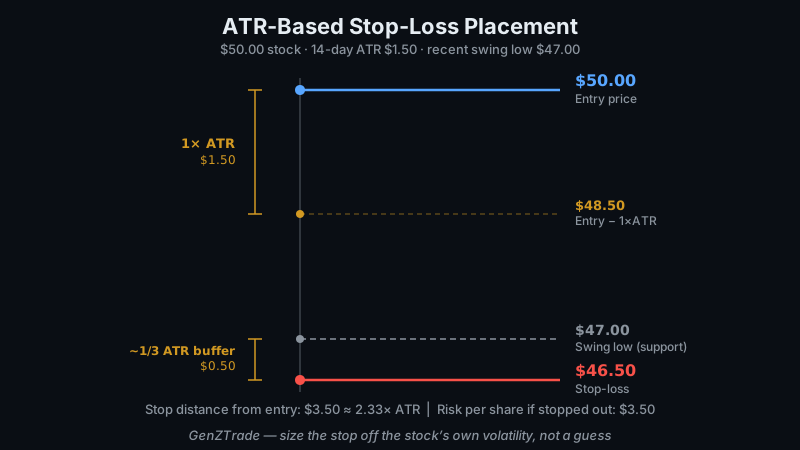
Setup: A stock is trading at $50.00.
Recent swing low: $47.00.
14-day ATR: $1.50.
The mistake to avoid: Placing the stop exactly at $47.00, right on the swing low. That level is real support, but ordinary noise on this stock (remember, ATR is $1.50/day) can easily poke a few dimes below a support level without actually invalidating it. A stop parked exactly on the line gets clipped by the first random flush.
The fix: Place the stop at $46.50 — 50 cents below the swing low, which is roughly a third of one ATR. That's enough room to absorb normal daily noise without giving the trade so much slack that a genuine breakdown goes unpunished. If price trades down to $46.50, the level has actually failed, not just wobbled.
Risk per share: $50.00 entry − $46.50 stop = $3.50 of risk per share.
Position sizing: Account size is $2,000. Risking 1% per trade caps the loss at $20 if the stop hits. Position size = $20 ÷ $3.50 ≈ 5 shares (5.7 rounds down to 5, since you can't risk more than your cap by rounding up).
Check: 5 shares × $3.50 risk = $17.50 actual dollar risk if stopped out — under the $20 cap, as it should be.
Five shares. On a $50 stock, that's a $250 position out of a $2,000 account — 12.5% of the account's capital, and a max loss of well under 1% if it's wrong. If that number looks small to you, sit with why. The position isn't small because something went wrong with the math. It's small because the stock's honest volatility ($1.50/day) and the account's honest risk budget ($20/trade) only support five shares. Sizing up from there means either accepting a bigger loss than your rule allows, or tightening the stop until it no longer reflects how the stock actually moves — which just reintroduces the first mistake.
A small account with disciplined position sizing produces small positions. That's not a flaw in the method. That's the method working.
How GenZTrade helps you find these setups
The math above only works if you're starting from a real level, not a guess. GenZTrade's Swing Watchlist is built to surface stocks near meaningful swing structure — recent lows, breakout zones, consolidation ranges — so you're anchoring your stop to a level that actually means something on the chart, rather than picking one after the fact to justify a trade you already wanted to take.
Once the trade is on, the harder part starts: actually respecting the stop when price gets close to it. Cockpit is where you track the position, the stop price, and the risk in dollar terms, so the exit is a pre-committed number you set up front rather than a decision you have to remake under pressure while the position is moving against you. The whole point of doing the ATR and position-sizing math before you enter is that you shouldn't need willpower later — the plan already accounts for the noise you're about to see.
Bottom line
Stop placement is a math and structure problem, not a feelings problem. It's ATR telling you how much noise to expect, a swing level telling you what would actually invalidate the idea, and a risk percentage telling you how many shares that combination allows you to hold. None of that removes the risk of loss — you can do every step above correctly and still get stopped out, because a stop that's placed properly can still be hit by a real move against you. What the process does is define the risk in advance, in dollars, before you're emotionally attached to the trade. That's the whole job of a stop loss. It was never going to be more than that.
Comments (0)