
In one sentence: swing trading is buying a stock based on a setup you believe in, then holding it for days to weeks instead of minutes, so you're playing for the whole move instead of a five-minute flicker on the chart.
What swing trading actually is
Day trading is built around a single rule: you're flat by the close. You're in and out the same session, sometimes the same hour, and whatever happens to that stock overnight is not your problem because you don't own it anymore. Swing trading throws that rule out. You take a position based on a technical setup — a breakout, a pullback to support, a base that's been building for weeks — or a catalyst you expect to play out, and you hold through the noise for days or weeks while the thesis works itself out.
That's the entire distinction. Day trading is a timeframe and an exit discipline. Swing trading is a longer timeframe with a different exit discipline, one where you accept that price is going to move against you at some point during the hold and you're not going to react to it in real time.
Who this actually fits
Swing trading tends to fit two kinds of people, and if you're reading this you're probably one of them. First, anyone with a day job or a class schedule that doesn't allow staring at a five-minute chart from 9:30 to 4:00. You can plan an entry the night before, check it during a lunch break, and manage the exit on your own time, because the setup isn't supposed to resolve in the next ten minutes. Second, anyone trading a small account. The pattern day trader rule kicks in once you make four or more day trades in five business days in a margin account under $25,000 — it doesn't touch swing trades, since you're not opening and closing the same position within a single session. If you don't have $25K sitting in a brokerage account, swing trading isn't a workaround, it's just a style that was never subject to that rule in the first place.
A full worked example
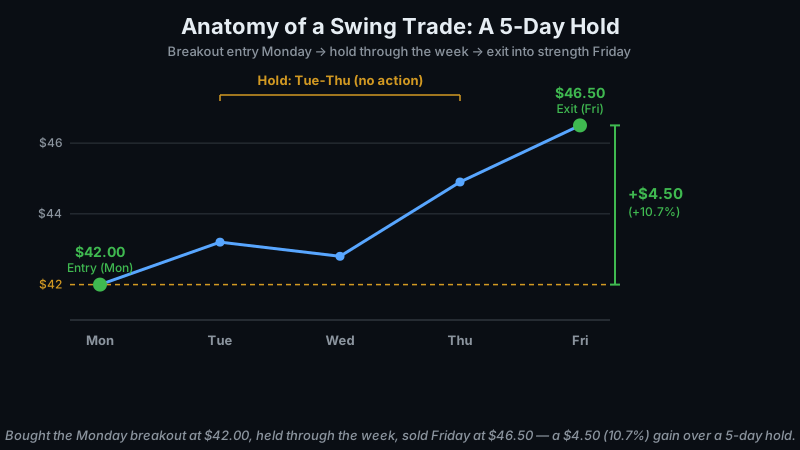
Here's what a real swing trade looks like from entry to exit, including the math.
Setup: A stock has been consolidating in a tight range for three weeks — a base — and breaks out above that range on above-average volume.
Monday: You buy at $42.00 on the breakout.
Tuesday–Thursday: The stock grinds higher, holding above your entry with no major red flags. You don't touch it.
Friday: You sell at $46.50 into strength, before the weekend.
Gain: $46.50 − $42.00 = $4.50 per share.
Return: $4.50 / $42.00 = 0.107, or 10.7%.
That 10.7% didn't happen because you caught a lucky five-minute spike — it happened because you sized up a setup, took the entry, and then let the thesis play out over five trading days instead of trying to time every tick. That's the whole appeal of the style. It's also the whole risk of it, which is the part that gets glossed over.
The real tradeoff: gap risk
Here's the part that separates swing trading from "day trading but slower and with better odds." When you day trade, you're flat by the close. Whatever happens after 4:00 PM — an earnings beat, a lawsuit headline, a Fed announcement, a CEO tweet — literally cannot touch your position, because you don't have one anymore.
When you swing trade, you're exposed to all of it. You're holding through every close, every overnight session, and every weekend where the market is shut but the news cycle isn't. If a company reports disappointing earnings after hours on Tuesday, or a competitor drops surprise news on Sunday, the stock can gap down 8%, 15%, or more the next time it opens — and there's no way to react in between. You didn't get a chance to hit the sell button at a reasonable price on the way down, because the price simply wasn't tradable while the gap was forming. Your stop-loss order, if you had one, doesn't protect you from a gap either — it fills at the next available price, not the price you set.
This is the tradeoff, full stop. In the example above, nothing went wrong between Monday and Friday. But swap in a bad earnings print on Wednesday night and that same trade could have opened Thursday morning well below your entry, with no opportunity to exit at $42.00 or anywhere close to it. That risk doesn't show up in the win, so it's easy to forget it's baked into every hold. It's the price of not watching the market all day — you get more flexibility in exchange for less control over exactly when you get out.
How GenZTrade helps you find these setups
The hard part of swing trading isn't holding for a week — it's knowing which setups are actually worth holding through the risk described above. GenZTrade's Swing Watchlist is built around exactly this holding period. Instead of scrolling for random breakout screenshots, it surfaces setups with a defined confirmation process — the kind of base-and-breakout structure in the example above — so you're working from a repeatable process rather than a gut feeling about which chart looks good. It won't remove gap risk, nothing can, but it means the setups you're choosing to hold through that risk are ones that met a consistent bar before you ever clicked buy.
Bottom line
Swing trading trades one kind of risk for another. You give up the fast, same-day feedback loop of day trading — and the ability to close everything out before the closing bell — in exchange for not needing to watch a screen all day. For people with a job, school, or a small account under the pattern day trader threshold, that tradeoff often fits real life a lot better. But be honest with yourself about what you're signing up for: holding overnight and through weekends means real news can move the stock before you get a chance to react, and that's not a hypothetical, it's the mechanism. Swing trading isn't a lower-risk version of day trading. It's a different risk, one that fits certain schedules and account sizes better — and like every other approach to markets, it doesn't remove the possibility of losing money.
Comments (0)