
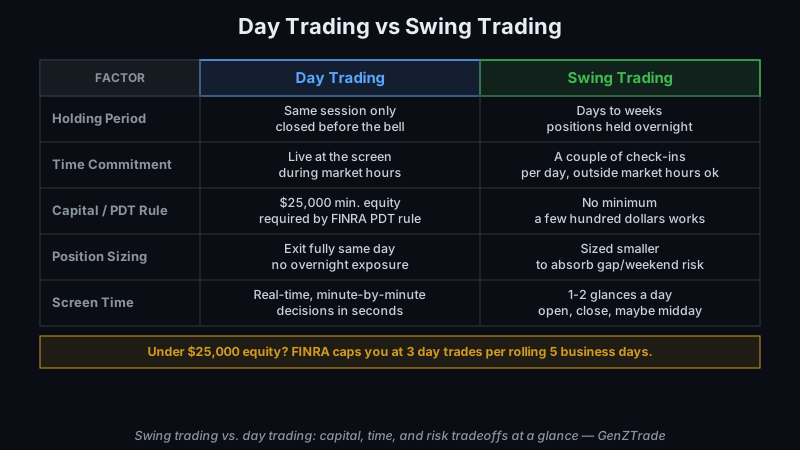
In one sentence: swing trading and day trading are both legitimate ways to trade stocks, but they demand almost opposite things from you in terms of money, time, and nerves — and the "which is better" debate misses the point, because the honest answer is whichever one you can actually execute consistently given your life right now.
Most of the content comparing these two styles is written by people trying to sell you a course on one of them. That's not what this is. This is a mechanical, no-hype breakdown of the five dimensions that actually separate day trading from swing trading, so you can figure out which one matches your reality instead of which one looks cooler on social media.
Capital required
This is the dimension beginners skip past and shouldn't. If you want to day trade actively in a margin account — meaning four or more "day trades" (buying and selling the same security in the same session) within five business days — FINRA's pattern day trader rule requires you to maintain at least $25,000 in equity in that account. Fall under $25,000 and your broker will cap you at three day trades per rolling five business day period, then restrict the account further if you exceed it. There's no way around this in a standard margin account; it's a regulatory floor, not a broker preference.
Swing trading has no equivalent minimum. You can swing trade with a few hundred dollars, though position sizing and diversification get harder the smaller the account. For most people starting out with a few thousand dollars or less, day trading isn't even legally available to them in the way it's often portrayed — swing trading is the format that's actually accessible.
Time commitment
Day trading means being at the screen, live, for some meaningful chunk of market hours — watching price action, managing entries and exits in real time, and making decisions in minutes or seconds. It's a job in the literal sense: if you're not watching, you're not day trading, you're just holding a position you opened by accident.
Swing trading is built for people who have a day job, are in school, or simply don't want to stare at a chart for six hours straight. Positions are held for days to weeks, so checking in once or twice a day — before the open, after the close, maybe a midday glance — is usually enough to manage the trade. The research and setup work still take real time, but it doesn't have to happen during market hours.
Overnight and gap risk
Day traders close every position before the bell. That's the entire point of the style — no exposure to what happens after hours, no risk of waking up to news that gapped a stock 8% against you. The tradeoff is that you're fully exposed to every second of volatility while the market is open, with no ability to just "wait it out" tomorrow.
Swing traders carry the opposite risk. Holding a position overnight, over a weekend, or through an earnings date means the price can gap well past any stop-loss order you had set, because stops don't protect you when the market simply opens somewhere else. Earnings surprises, overnight news, guidance cuts, macro headlines — all of it can move a stock before you get a chance to react. That's a real, uncompensated risk that day trading structurally avoids and swing trading structurally accepts.
Tax treatment
Here the two styles are more similar than people assume. Positions held under a year — which covers essentially all day trades and most swing trades — are taxed as short-term capital gains, meaning they're taxed at your ordinary income rate rather than the lower long-term capital gains rate. Neither style gets a tax advantage over the other by default.
What differs is volume. Day trading generates a dramatically higher number of taxable events per year — potentially hundreds or thousands of trades — which means more complex recordkeeping and a bigger volume of transactions to report, even though the tax rate treatment itself isn't more favorable. Swing trading, with far fewer round-trip trades per year, is simply lighter to track. Neither replaces actual tax advice from someone who knows your situation, but this is a good reason to keep clean records either way.
Pace and stress
Day trading is decision-dense. You're reading price action and making calls in real time, often with no opportunity to "sleep on it." That pace suits some people and burns others out — there's no way to know which camp you're in until you've actually tried it with small size.
Swing trading trades split-second pressure for a different kind of difficulty: patience. You have more time to research a setup before you enter, but once you're in, you have to sit through days of normal volatility — including moves against you — without panic-exiting a trade that was actually fine. That's a psychological skill of its own, and it trips up just as many beginners as fast-paced day trading does, just more slowly.
A practical way to decide
If you don't have $25,000 in risk capital, or you have a job, classes, or anything else that keeps you away from a screen during market hours, swing trading is the more realistic starting point — not because it's easier, but because it's the format you can actually execute without fighting your own schedule and account size. If you can dedicate real, undistracted attention to the market during trading hours, have capital you can genuinely afford to lose, and prefer being flat overnight to carrying gap risk, day trading may fit better. Neither answer is a verdict on which trader is more serious or more skilled — it's a match between the style's requirements and your actual life.
How GenZTrade helps you find these setups
Whichever style actually fits your life, GenZTrade is built to support it rather than push you toward one or the other. If swing trading is the realistic fit — because of capital, schedule, or both — the Swing Watchlist surfaces stocks showing multi-day setups worth tracking, so you're not starting your research from a blank screen every evening. If you've got the time, the account size, and the temperament for day trading, the Momentum Scanner is built for exactly that: surfacing intraday momentum and volume shifts in something closer to real time, so you're reacting to what the market is actually doing right now instead of a stale list.
Neither tool tells you which style to trade. That's a decision about your capital, your schedule, and your temperament — not something a scanner can answer for you. What GenZTrade does is make sure that once you've made that call, you've got a tool built for the pace you're actually operating at.
Bottom line
Neither swing trading nor day trading is inherently more profitable — the style itself doesn't determine your results, your execution and risk management do. What actually hurts beginners isn't picking the "wrong" style, it's switching between them every few weeks to chase whichever one looks more exciting after a good trade or a bad one. That constant switching is one of the most common ways new traders lose consistency: you never spend enough time in one format to learn its actual failure modes, so every mistake feels new instead of familiar. Pick the style that matches your capital, your schedule, and your temperament as they actually are today, then stick with it long enough — through losing trades and winning ones — to know whether it's genuinely working for you.
Comments (0)