
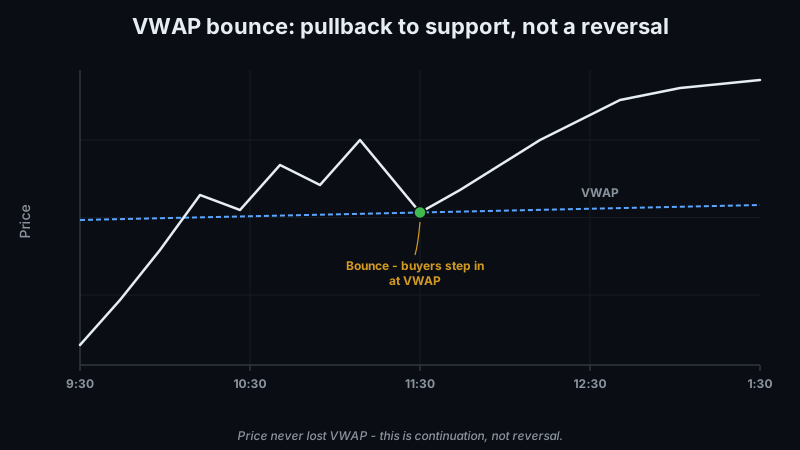
In one sentence: A VWAP bounce is price using VWAP as support from above in an established uptrend, which is a fundamentally different (and generally lower-risk) setup than a VWAP reclaim.
Bounce vs. reclaim: not the same setup
It's easy to lump every VWAP touch into one category, but a bounce and a reclaim tell you different things about who's in control.
A VWAP reclaim is a stock that was trading below VWAP - meaning the average participant so far today is underwater - and then pushes back above it, signaling a potential shift from sellers to buyers. We've covered that setup separately because it's really a reversal trade: you're betting that control of the tape is changing hands.
A VWAP bounce is different. The stock never lost VWAP in the first place. It's already in an intraday uptrend, trading above VWAP the whole session, and it simply pulls back down toward that line - touching it or slightly piercing it - before buyers step back in. There's no change of control here. The bounce is continuation, not reversal. If you mix these two setups up, you'll misjudge risk: a reclaim is inherently a lower-confidence trade because it's fighting recent selling pressure, while a clean bounce is trading with the existing trend.
What the setup looks like on a chart
The pattern has three parts, in order:
- An established uptrend. The stock has been making higher highs and higher lows intraday, staying above VWAP for a meaningful stretch - not just a couple of candles.
- A pullback to VWAP. Price retraces from a local high back down toward the VWAP line, touching it or dipping slightly below on an intrabar basis.
- A hold, not a break. A candle closes back above VWAP - ideally with some bullish structure, like a strong close near the candle's high - without any candle closing below VWAP on real volume.
The "without a close below VWAP on a meaningful candle" part matters. A one-tick wick through VWAP that immediately reverses is normal noise. A full candle body closing below VWAP is a different story - that's the market telling you sellers actually took the level, which pushes this toward reclaim territory (or worse, a breakdown) rather than a bounce holding.
Why VWAP support actually works
VWAP isn't just another line on a chart - it's the volume-weighted average price every share has traded at since the open, and it's a real benchmark that institutional execution algorithms are built around. Funds working large orders often use VWAP as a reference to judge whether they're getting a good fill, and a lot of algorithmic buying is deliberately weighted toward keeping average execution price close to VWAP.
That's why a clean touch-and-hold at VWAP in a stock that's already trending means something different than a bounce off some arbitrary support line. It suggests real buying interest is showing up at a price level that institutional participants are actually watching - not just retail traders drawing lines. That doesn't make it a sure thing, but it's a more defensible reason for a level to hold than most discretionary support/resistance calls.
Entry, stop, and target rules
The mechanics are straightforward once you've confirmed the setup: enter on the confirmation candle that holds VWAP, place your stop just below VWAP, and target the prior swing high as the first objective.
Setup: Stock XYZ in an intraday uptrend
Prior high: $63.00
Pullback low / VWAP touch: $61.50
Confirmation candle close: $61.80 (no close below $61.50)
Entry: $61.80
Stop: $61.30 (just below VWAP, with a little room)
Target: $63.00 (back to the prior high)
Risk per share: $61.80 - $61.30 = $0.50
Reward per share: $63.00 - $61.80 = $1.20
Reward-to-risk ratio: $1.20 / $0.50 = 2.4 to 1
Notice the stop isn't sitting exactly on VWAP - it's placed slightly below it. VWAP shifts throughout the session and can get tagged by a stray tick even when the underlying support is intact, so giving it a little room reduces the odds of getting stopped out by noise rather than an actual failure of the level.
When the VWAP bounce fails
No VWAP setup works every time, and this one has a few specific failure modes worth knowing in advance.
A strong-volume close below VWAP
If price closes below VWAP on real volume after the touch, that's not a bounce that's "taking a bit longer" - that's the bounce failing. At that point you're no longer looking at a continuation setup; you're looking at either a reclaim attempt from the other side or a breakdown. Treat a volume-backed close below VWAP as your signal to exit, not to average down or wait it out.
Choppy, non-trending tape
The whole logic of a VWAP bounce depends on there being real directional buying pressure behind the trend. In a stock that's chopping sideways with no clear intraday trend, a touch of VWAP doesn't carry the same meaning - there's no established buying flow for VWAP to reflect. Bounces attempted in choppy conditions fail more often simply because the premise (an active uptrend with real demand) isn't there.
Low relative volume on the pullback
Volume tells you whether a pullback is being met with actual participation or just drifting on light trading. A VWAP touch on thin relative volume is more likely to be a lack of selling pressure than a wave of buying pressure - and those are different things. Real support shows up with volume behind the hold, not silence.
Position sizing and stop discipline
Because a VWAP bounce stop is often placed less than 1% away from entry, the position size that keeps your dollar risk constant can be meaningfully larger than it would be on a wider-stop swing trade. That's the appeal of the setup - tight risk allows for size.
But that same tightness cuts both ways. A stop that close to entry will get clipped by ordinary intrabar noise more often than a wider one would, even when the broader trend and level are perfectly intact. That means your realistic win rate on VWAP bounces should account for a higher rate of small, quick stop-outs mixed in with the winners. Don't size a tight-stop setup as if it should also carry a high win rate - those two things pull in opposite directions, and treating a 2.4-to-1 reward-to-risk trade as if it should also win 70% of the time is how traders talk themselves into oversizing.
How GenZTrade helps you find these setups
Spotting a genuine VWAP bounce candidate starts with finding stocks that are actually trending with unusual participation behind them. GenZTrade's Momentum Scanner flags VWAP reclaims, opening range breakouts, and volume conditions that are unusual relative to a stock's own history - which helps you separate a stock with real intraday demand from one that's just drifting.
From there, High Volume Points overlays support and resistance levels built from where volume has actually concentrated, so you can check whether a VWAP touch is happening near a real confluence level or out in open air with nothing else backing it up. A VWAP bounce that lines up with a High Volume Point is a stronger case than one that doesn't - the tools are built to help you tell the difference before you're in the trade, not after.
Bottom line
A VWAP bounce is a continuation setup, not a reversal one - it works because it's trading with an existing trend and a real institutional reference price, not against it. The mechanics are simple: confirm the uptrend, wait for a hold at VWAP without a meaningful close below it, and size around a tight, disciplined stop. But simple isn't the same as reliable in every condition - choppy tape, thin volume, and volume-backed breaks below VWAP will all turn this setup into a loser, and no combination of rules removes that risk entirely. Treat it as one tool for reading intraday structure, confirm it with volume and level context before you act, and expect a mix of clean wins and quick, tight-stop losses along the way.
Comments (0)