
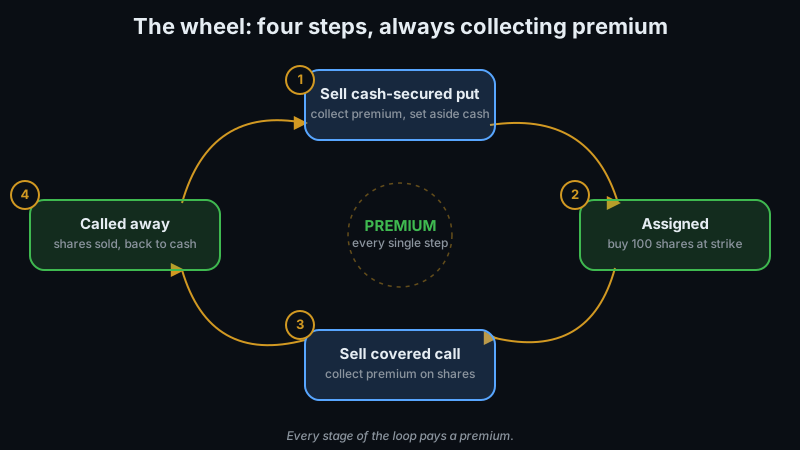
In one sentence: The wheel strategy sells cash-secured puts on a stock you would not mind owning, then sells covered calls against the shares if you get assigned - collecting a premium at every step of the loop.
The wheel is not really one strategy. It is two option-selling strategies - the cash-secured put and the covered call - stitched together into a loop. You start in cash, you might end up holding 100 shares of stock, and eventually you rotate back to cash. Every stage of the loop pays you a premium, which is the entire appeal of running it.
The four steps of the wheel
The mechanics sound more complicated the first time you read them than they actually are. The loop has four steps, and two of them are simply "wait and see what happens."
- Sell a cash-secured put on a stock you would genuinely be fine owning, at a strike below the current price. You set aside enough cash to buy 100 shares if assigned, and you collect a premium up front for taking on that obligation.
- 2a. It expires worthless: the stock stayed above your strike through expiration. You keep the full premium, free and clear, and go back to step 1 with a new cash-secured put - same stock or a different one.
- 2b. You get assigned: the stock closed below your strike, and you are obligated to buy 100 shares at that strike price. This is not a failure. It is the strategy doing exactly what it is designed to do. Your effective cost basis on the shares is the strike price minus the premium you already collected.
- Sell a covered call against the 100 shares you now own, usually at or above your cost basis so a call away still nets you a gain on the stock.
- 4a. It expires worthless: the stock stayed below your call strike. You keep that premium too, and sell another covered call against the same shares.
- 4b. Your shares get called away: the stock closed above your strike, your 100 shares are sold at that strike, and you are back in cash. The loop restarts at step 1.
Notice what never changes: you are always selling something - either the obligation to buy (the put) or the obligation to sell (the call). You are never just sitting there hoping the stock goes up with no premium coming in.
A full walk-through example
Say a stock is trading at $52. You are comfortable owning it long-term, so you decide to run the wheel.
Step 1 - sell the cash-secured put. You sell the $50 put, about a month out, for $1.50 in premium. That requires $5,000 in cash set aside ($50 strike x 100 shares), and you collect $150 the moment the trade fills.
Step 2 - assignment. The stock drifts down and closes at $49 on expiration day. Your put is in the money, so you get assigned: you buy 100 shares at $50, using the cash you had already set aside. Because you collected $1.50 in premium, your effective cost basis on the shares is $50 - $1.50 = $48.50 per share - a real discount to where the stock was trading when you opened the trade.
Step 3 - sell the covered call. With the shares now in your account, you sell the $52 call, about a month out, for $1.20 in premium. That is $120 collected, and your cost basis stays $48.50 while you wait to see what the stock does.
Step 4 - called away. The stock recovers and closes at $53 on expiration. Your $52 call is in the money, so your shares are called away: you sell 100 shares at $52. You are back in cash, and the cycle is complete.
Here is the full accounting for that cycle:
Put premium collected: $1.50 x 100 shares = $150
Call premium collected: $1.20 x 100 shares = $120
Total premium collected: $150 + $120 = $270
Capital gain on the shares: bought at $50 (the put strike), sold at $52 (the call strike) = $2.00 x 100 = $200
Total profit for the full cycle: $270 + $200 = $470
Capital committed: $5,000 (the cash secured for the put)
Return on capital: $470 / $5,000 = 9.4 percent over roughly six weeks
Stretch that 9.4 percent out to a full year and it looks like a very large number - but that is an illustrative annualization, not something you should expect to repeat cycle after cycle. Not every put you sell gets assigned at a convenient bottom, not every call gets exercised at a convenient top, and some cycles will involve a stock that just sits below your cost basis for months. Treat the math above as one clean example of how the pieces fit together, not a forecast.
How to pick wheel candidates
The wheel only works well on the right underlying stock. A few filters matter more than people expect:
- Liquid options. Look for tight bid-ask spreads on the strikes you would actually trade. Wide spreads quietly eat your premium on both the put and the call leg, twice per cycle.
- A stock you would genuinely own. The entire strategy rests on being fine with assignment. If you would panic-sell the moment you owned the shares, you should not be selling the put in the first place.
- Moderate-to-elevated implied volatility. A low-IV, sleepy stock pays you very little premium relative to the cash you have to tie up. The wheel needs enough premium to make the capital commitment worthwhile.
- Avoid wheeling into earnings unassigned. Selling a put that captures an earnings gap can spike your premium, but it also spikes your risk of assignment at a price the market reassesses violently the next morning. Many traders roll or close positions before earnings rather than let assignment happen through a surprise report.
The risk nobody mentions
The wheel gets marketed as a steady, mechanical way to generate premium, and the mechanics really are simple. What gets left out is what happens when the stock just keeps falling after you are assigned.
Picture the same $52 stock from the walk-through, but instead of recovering to $53, it drops to $38 and stays there. You still own 100 shares at a cost basis of $48.50. Selling covered calls against those shares brings in small premiums - maybe $30 to $60 a month at a strike low enough to attract buyers - but that is nowhere near enough to offset a $10.50-per-share unrealized loss. You are stuck holding a losing position, collecting premiums that shrink relative to the hole you are in, unless you are willing to sell a call at or below your cost basis and lock in the loss.
The other side of that same coin: the wheel underperforms a plain buy-and-hold position in a strong, sustained uptrend. Every time you sell a covered call, you cap your upside at that strike. If the stock rips well past your call strike, you get called away at a modest gain and miss the rest of the move - the shares you sold at $52 are irrelevant to you if the stock is at $70 two months later. The wheel trades away tail-end upside in exchange for premium income along the way. That is a deliberate trade-off, not a flaw, but it only makes sense if you go in understanding it.
Rules that keep the wheel profitable
Size positions relative to your account, not your enthusiasm
Every cash-secured put ties up real capital, and every assignment concentrates more of your account into one stock. If you are running the wheel on three or four names at once, make sure a full assignment on all of them at the same time would not leave your portfolio dangerously overweight a single sector or story.
Roll or accept assignment - do not panic-close
When a put moves against you before expiration, you generally have two reasonable options: roll it out to a later date for a fresh credit, or let assignment happen and move into the covered-call leg as planned. Closing early out of anxiety, after paying to buy back the put at a loss, tends to be the move that costs traders the most over a full year of running the wheel.
Stay away from low-liquidity and meme-volatile names
Big headline premiums on thinly traded or highly speculative stocks are usually big for a reason - the market is pricing in a real chance of a violent move. Wide spreads on those names also make rolling and adjusting expensive. The wheel works best on names with steady volume and options markets that are actually two-sided.
How GenZTrade helps you find these setups
The wheel needs two different kinds of screening - one for the put leg, one for the call leg - and doing that by hand across a watchlist gets tedious fast. That is exactly what the platform is built to speed up:
- Momentum Scanner surfaces stocks with confirmed technical structure and healthy volume, which is the starting filter for "a stock I would actually be fine owning."
- Options Plays auto-generates both cash-secured put candidates and covered call candidates on the same names, with strikes, credit, and break-even already calculated - so once you are holding shares from an assignment, finding the next covered call strike is a lookup, not a research project.
Together, those two panels cover both legs of the wheel without forcing you to switch tools or rebuild the same analysis twice.
Bottom line
The wheel strategy is straightforward once you have run the loop once: sell a cash-secured put on a stock you would own anyway, collect the premium, and either keep repeating the put or roll into a covered call if you get assigned. The example above turned a $5,000 cash commitment into $470 over about six weeks by stacking two premiums on top of a modest capital gain - but that outcome depended on the stock landing between the two strikes. A stock that falls hard after assignment, or a stock that runs far past your call strike, changes the math in ways that premium collection alone will not fix. Treat the wheel as a way to get paid for patience and stock selection, not as a substitute for either one.
Comments (0)