
In one sentence: A bull put credit spread pays you cash upfront to bet that a stock stays above a certain price for a short window - with your maximum loss capped, no matter how bad it gets.
What this strategy actually is
Think of it like collecting rent on a stock. You promise to buy the stock at a specific price - called the "short strike" - by a specific deadline. Someone pays you cash upfront for that promise. To keep your risk from spiraling if the stock crashes, you also buy an insurance policy: another put at a lower strike price. That insurance caps your maximum loss.
You keep the rent you collected if the stock stays above your short strike through the expiration date. If it falls below, you can lose money - but only up to the gap between your two strikes, minus the credit you already collected. There is no "wipe out your account" scenario like there is with naked options. That defined loss is the whole reason this strategy is beginner-safe when you follow the rules.
The bias: mildly bullish or neutral. The trade wins if the stock rallies, drifts sideways, or even sells off a little - as long as it stays above your short strike at expiration. That is a much wider profit zone than a straight bet on direction.
The payoff picture
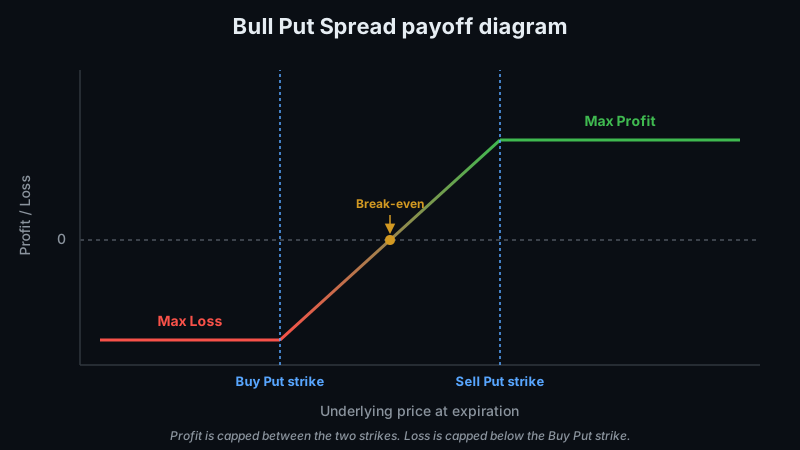
The diagram above shows exactly what happens at expiration. Read it from left to right:
- Max Loss zone (left, red): if the stock closes below your Buy Put strike, you are at maximum loss. It cannot get worse than this, no matter how far the stock crashes.
- Break-even zone (middle): between the two strikes, your profit and loss slides linearly. The line crosses zero at the break-even price.
- Max Profit zone (right, green): if the stock closes above your Sell Put strike, you keep the full credit. It does not matter whether the stock closes 5 cents or 50 dollars above your short strike - the payoff is the same.
That flat "Max Profit" ceiling is why the strategy is called a limited-reward trade. You are not going to 10x. You are going to grind out small consistent wins that add up over hundreds of trades - if you follow the discipline.
A real example: SPY at $500
Let us put real numbers on it. Assume SPY is trading at $500 today. You look at options expiring in about a month and pick two strikes:
- Sell (short) the $495 put for $2.10 in premium
- Buy (long) the $490 put for $1.30 in premium
- Net credit into your account:
$2.10 - $1.30 = $0.80, or $80 per spread (one options contract controls 100 shares)
The strikes are $5 apart, so the maximum you can lose is $500 per contract minus the $80 credit you already collected. Here is the full math:
Max profit: $80 per contract (the credit)
Max loss: $500 - $80 = $420 per contract (if SPY closes below $490 at expiration)
Break-even at expiration: $495 - $0.80 = $494.20
Return on the risk you took: $80 / $420 = 19 percent
The video above walks through this exact setup live inside GenZTrade's Options Plays panel, including the intel that confirms the entry: options flow, news sentiment, and gamma exposure at the strikes.
When this strategy works best
Three things should line up before you open any credit spread:
- The stock is going sideways or slightly up. Not crashing. Not in free-fall. The whole trade depends on the stock NOT falling below your short strike.
- Options are "expensive." When implied volatility is elevated, option premiums are richer - which means you get paid more for taking the same amount of risk. Selling cheap options is not worth the tail risk.
- There is clear support below your short strike. A meaningful technical level like the 200-day moving average, a prior swing low, or a high-volume node. Put the short strike below something that has historically held.
I avoid opening credit spreads on Fridays when they would carry weekend gap risk into Monday, through earnings announcements (unless the volatility crush is the entire play), and when the market is in a high-VIX regime (in that case, only broad indexes).
The rules that keep you profitable
The math on any single trade does not matter. The math on hundreds of trades is where the money is made or lost. These rules are the reason the strategy compounds instead of blowing up.
Close winners at 50 percent of max profit
On the SPY example, the $80 credit becomes a "take profit at $40" target. Why leave $40 on the table? Because the last half of the credit takes disproportionately long to earn, and every day closer to expiration the trade gets more sensitive to sudden moves. Bank the win, redeploy the capital, and let compounding do the work.
Stop out if the trade doubles against you
If you collected $0.80 in credit and the spread is now trading at $1.60 or worse - close it. Do not "give it a chance." Do not roll to a worse strike hoping to bail out. Take the pre-defined loss and reassess. Small losses compound just as fast as small wins.
Never hold through earnings unless that IS the plan
Selling a bull put through an earnings announcement is essentially a coin flip on which direction the stock gaps. Unless the earnings play is the entire reason you are in the trade, skip earnings weeks entirely. There will always be another setup next week.
Cap your daily losses
Set a hard dollar cap - whatever amount feels like the ceiling for a bad day in your account - and stop trading if you hit it. Log the trades, review what happened, come back tomorrow. Trying to "make it back" in one session is how a $200 loss becomes a $2,000 loss.
Common mistakes I see
Selling too close to the money for the extra credit
A more aggressive short strike would have paid maybe $1.20 in credit on that SPY example instead of $0.80. That is 50 percent more income - but the probability of finishing in-the-money nearly doubles. You have now turned an income trade into a covert directional bet. The math no longer works over hundreds of trades.
Averaging down into a losing spread
The temptation is to "add another spread lower to reduce cost basis." What you actually do is double your exposure to the same losing move at a worse entry price. Take the defined loss. Move on.
Ignoring the chart
Credit spreads look mechanical, but they are still directional trades on the underlying stock. Selling a bull put spread on a stock that just broke below its 200-day moving average is a bad trade no matter how much premium is available. The technicals still matter.
How GenZTrade helps you find these setups
The platform was built with strategies like this in mind. Here is the workflow:
- Momentum Scanner flags bullish stocks with confirmed technical structure. That gives you the universe of candidates.
- Options Plays auto-generates bull put credit spread cards for those candidates, with strikes, credit, break-even, and probability all pre-computed.
- High Volume Points overlays support levels on the chart so you can confirm your short strike sits below a meaningful level, not just an arbitrary technical.
- Cockpit tracks your open trades against their targets and stops, and pings you when a winner hits target or a loser triggers its stop.
None of this replaces the analytical work. What it does is compress the hours you would otherwise spend hunting for setups down to a few minutes, so you spend more time thinking about risk and less time hunting for candidates.
Bottom line
Bull put credit spreads are boring, in the best way. If you follow the rules - small position sizes, defined stops, no revenge trading - the math compounds over hundreds of trades. If you break the rules, you will blow up like everyone else who tried to shortcut discipline. Start with paper trades. Learn the muscle memory of how the P&L moves intraday, how theta shows up on the position, how quickly a move against you can flip an $80 credit into a $160 debit. Then trade real money when the setup fits your rules.
Frequently asked questions
What is a bull put credit spread?
A bull put credit spread is an options strategy where you sell a put at a higher strike and buy a put at a lower strike, both with the same expiration. You collect a net credit up-front and profit if the stock stays above the higher strike at expiration. Maximum loss is capped at the width between strikes minus the credit received.
How much money can you lose on a bull put spread?
Maximum loss equals the difference between the two strike prices minus the net credit received, multiplied by 100. For example, a $5-wide spread with an $80 credit has max loss of $500 - $80 = $420 per contract if the stock closes below the lower strike at expiration.
When is the best time to sell a bull put credit spread?
The best conditions are when implied volatility is elevated (rich premium), the underlying stock is trading sideways or slightly up, and there is clear technical support below your short strike. Avoid selling through earnings unless volatility crush is your entire play.
What is a good win rate for credit spreads?
Well-structured bull put spreads at 0.20-0.30 delta short strikes typically win 70-80% of the time. The math still requires discipline: cutting losses at 2x the credit received and taking profits at 50% of max are what turn a high win rate into consistent income.
Comments (0)