
In one sentence: An iron condor pays you cash upfront to bet that a stock stays inside a price range for a short window - like collecting rent on a house guest who agrees not to move.
What this strategy actually is
An iron condor is two credit spreads stapled together - a bull put spread below the current price, and a bear call spread above it. You collect a credit from both. The trade wins if the underlying stays between the two short strikes through expiration. It loses only if the underlying breaks past one of the outside protective strikes. Losses are capped by design.
Trading an iron condor is like betting on the weather being "nothing special" - you win when nothing dramatic happens, and lose only if there is a hurricane in either direction. The whole strategy is a bet on boredom. Choppy days, tight consolidation, quiet weeks, and any environment where a stock has settled into a range - that is what the iron condor is built for.
The bias: neutral. You do not need direction. You need the underlying to sit still. That is a wider profit zone than any straight directional trade because you win in three of the four possible outcomes - up a little, sideways, or down a little.
The payoff picture
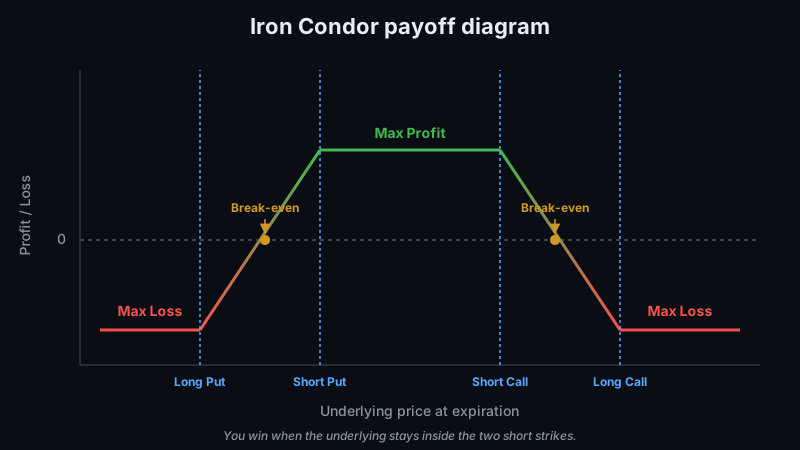
The diagram above shows what happens at expiration. Read it left to right:
- Max Loss zones (far left and far right, red): if the underlying closes past either long strike, you are at maximum loss. No worse than that, no matter how far the move.
- Transition zones (between long and short strikes): P&L slides linearly. The line crosses zero at each break-even price.
- Max Profit zone (middle, green): if the underlying closes between the two short strikes, you keep the full credit from both spreads. Flat-top payoff.
The flat-top ceiling is the whole reason iron condors are called limited-reward trades. You are not chasing a monster win. You are grinding out small consistent credits over hundreds of trades - if you follow the risk rules.
A real example: SPY at $500
Let us put real numbers on it. SPY is trading at $500. IV rank is 55 (elevated). You look at options expiring in 35 days:
- Sell the $495 put for $1.60, buy the $490 put for $0.70 - put spread credit:
$0.90 - Sell the $505 call for $1.50, buy the $510 call for $0.60 - call spread credit:
$0.90 - Total net credit into your account:
$1.80per iron condor, or $180 (one options contract controls 100 shares)
Both wings are $5 wide, so the maximum you can lose is $500 minus the $180 credit already collected. Here is the full math:
Max profit: $180 per condor (the credit)
Max loss: $500 - $180 = $320 per condor (if SPY closes past either long strike)
Lower break-even: $495 - $1.80 = $493.20
Upper break-even: $505 + $1.80 = $506.80
Return on the risk you took: $180 / $320 = 56 percent
The video above walks through the exact setup inside GenZTrade's Options Plays panel, including how the Regime chip flags this as a chop-day setup and how the platform builds the four legs from the same card.
When iron condors work best
Three conditions should line up before you open one:
- Sideways or range-bound tape. Not trending hard. Not breaking out. A stock that has settled inside a defined range for at least a couple of weeks. Iron condors die in trending markets.
- Elevated implied volatility. IV rank 40 or higher. Rich premium means you get paid more for taking the same amount of risk. Selling cheap options is not worth the tail risk.
- No earnings, Fed, or CPI inside the window. Any of those can gap the underlying outside your wings overnight. If there is a catalyst inside the trade's window, use a shorter expiration or skip the setup.
I avoid iron condors on stocks that just broke out of a multi-month base, on names with earnings inside the window, and during high-VIX regimes on individual stocks - in that last case, index condors only (SPX, SPY, QQQ).
The rules that keep you profitable
The math on any single trade does not matter. The math on hundreds of trades is where the money is made or lost.
Close winners at 50 percent of max profit
On the SPY example, the $180 credit becomes a "close at $90 profit" target. The last half takes disproportionately long to earn and every extra day the trade is on adds gamma risk. Bank the win, redeploy capital, let compounding do the work.
Roll or exit at 2x credit loss
If the total condor cost hits 2x the credit you collected - close it or roll the tested side out and away. Do not "give it a chance." Do not add on hoping to average down. Take the pre-defined loss and reassess.
Avoid earnings weeks
Never carry an iron condor through an earnings announcement unless the earnings IV crush is the entire plan (and then you use a completely different sizing rule). Standard income condors get skipped during earnings weeks.
Size for the max loss, not the credit
The credit looks like income. The max loss is the real number that matters. Size your position so a full max-loss condor is a manageable dollar hit to the account. If you cannot stomach one losing at max, you sized too big.
Common mistakes I see
Selling too narrow for the extra premium
Tightening the short strikes closer to the current price bumps up the credit fast - and looks like free money. The catch is that the win probability collapses at the same rate. A condor with a $2 credit that has a 40 percent win rate is a losing strategy over hundreds of trades. Keep the shorts at least one standard deviation out.
Holding through earnings hoping to survive
The temptation is to leave the condor on because "the credit is fine and it will probably be OK." Then earnings gap the stock 8 percent, the wing gets blown through, and one loss wipes out four wins.
No adjustment plan
Iron condors need a written playbook for what to do when one side gets tested. Roll the untested side down (or up) to collect more credit? Close the tested side and let the untested side ride? Take the loss? Decide before you enter, not while the trade is going against you.
How GenZTrade helps you find these setups
The workflow the platform was built around:
- Regime chip flags chop days and range-bound tape - the environments where iron condors thrive. Green light means the setup is on the menu.
- Options Plays auto-generates iron condor cards for candidates with elevated IV rank, showing all four strikes, total credit, both break-evens, and the max-loss number pre-computed.
- High Volume Points overlays the support and resistance levels that anchor your short strikes - put them below and above real levels, not arbitrary technicals.
- Cockpit tracks the four-leg position against the 50 percent profit target and the 2x credit stop, and pings you when either fires.
None of this replaces the analytical work. It just compresses the hours you would spend hunting for the right chop-day setup down to a few minutes.
Bottom line
Iron condors are boring, in the best way. If you follow the rules - elevated IV entries, no catalysts inside the window, 50 percent profit targets, 2x credit stops, size for max loss - the math compounds over hundreds of trades. If you break the rules, you will blow up like everyone else who tried to shortcut discipline. Start with paper condors on SPY. Learn how the P&L moves when the underlying tests one wing. Learn how quickly a $180 credit can flip to a $400 debit on a gap day. Then trade real size when the setup fits your rules.
Frequently asked questions
What is an iron condor?
An iron condor is a defined-risk options strategy that combines a bull put spread and a bear call spread on the same underlying with the same expiration. You profit when the stock stays between the two short strikes and lose only if the stock breaks out significantly in either direction.
When should I trade iron condors?
Iron condors work best in low-directional, high-implied-volatility environments where you expect the underlying to trade in a range. Avoid iron condors before earnings, during major macro events, or when the underlying has a strong recent trend.
How much can you lose on an iron condor?
Maximum loss is the width of one wing (the two strikes on either side) minus the total credit received. Loss occurs on one side only - the stock cannot exceed both wings simultaneously. Typical trades risk $400-800 to make $100-200 credit.
Comments (0)