
In one sentence: Options prices spike before Fed and CPI announcements because everyone braces for a big move, then collapse the moment the news is out - sell that inflated premium and profit from the fade.
What this strategy actually is
The Federal Reserve meets eight times a year to set interest rate policy. The Bureau of Labor Statistics releases the Consumer Price Index (CPI) once a month. Both events move the whole market - not just one stock - and both are pre-scheduled. Everyone knows the day and the hour. That certainty is exactly what makes them tradeable.
In the days leading up to a Fed decision or a CPI print, options on index ETFs (SPY, QQQ, IWM) get bid up. Traders buy protection. Hedge funds bake in wider scenarios. Retail piles into short-dated calls and puts hoping for a directional pop. All that demand pushes implied volatility higher across the whole options chain. Then the news drops. Powell reads the statement. The CPI number hits the tape. Within minutes, the uncertainty is gone. IV collapses back to its baseline. Every option that was pumped just lost 30 to 50 percent of its extrinsic value.
Trading options around the Fed is like being at a movie premiere - the anticipation is expensive, but the moment the movie starts, prices drop fast. Position on the buildup. Exit on the release. You are not betting on whether the movie is good or bad. You are betting that the anticipation fades.
The bias: neutral on direction, bearish on volatility. You do not care whether the Fed hikes, cuts, or pauses. You care that IV crashes right after the announcement - which it almost always does.
The picture of the Fed-week fade
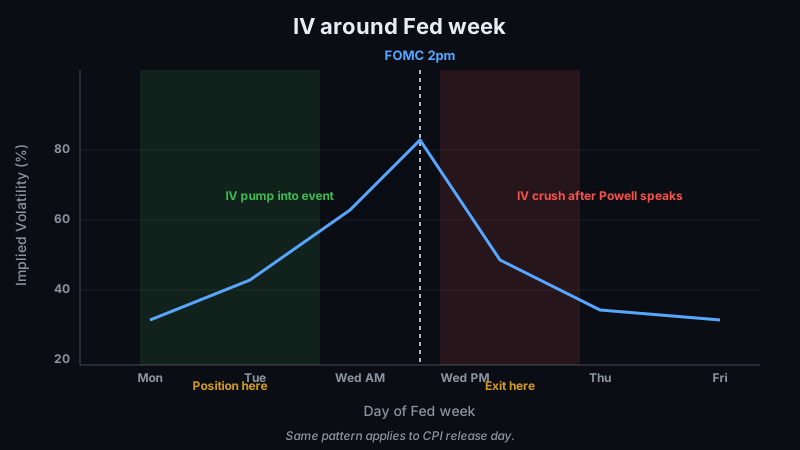
The diagram above shows implied volatility over a typical Fed week. Read it left to right:
- Monday through Wednesday morning: IV climbs steadily. Traders position and hedge. This is the pump.
- Wednesday 2pm: the FOMC decision drops. IV peaks in the minutes before Powell starts speaking.
- Wednesday 2:30pm through Thursday: IV collapses fast as the market digests the message. This is the crush.
- Friday: IV settles back to baseline.
Two shaded zones on the chart matter most. The entry window (Monday to Tuesday) is where you sell inflated premium at low gamma risk. The exit window (Wednesday afternoon) is where you close after the crush hits. Everything else is noise. CPI weeks follow the same shape, just with a Tuesday or Wednesday 8:30am release instead of a 2pm Fed statement.
A real example: FOMC decision Wednesday 2pm
It is a Fed week. Monday morning, SPY is at $500, IV rank on 30-day SPY options is 70. You look at options expiring 30 days out:
- Sell the $495 put + $505 call - both are richly priced by the Fed-week pump
- Buy the $490 put + $510 call - defined-risk wings, five points wide
- Total credit into your account:
$2.50, or $250 per iron condor
Wednesday afternoon, Powell speaks. SPY moves 1 percent during the press conference but stays inside the $495-$505 range. Within an hour, IV rank has crushed from 70 to 40. Same iron condor now trades at $1.20. You close by buying back at $1.20:
Credit collected at entry: $250
Cost to close at exit: $120
Net profit per condor: $130
Ten contracts: $1,300 profit across a two-day hold
The video above walks through this exact setup inside GenZTrade's Options Plays panel, including how the Macro Calendar flags the FOMC date and how the IV rank chip qualifies the entry.
When macro plays work best
Three things should line up before you sell into a macro event:
- Elevated IV rank in the days before. 50 or higher on the index ETFs. If IV is not pumped, there is nothing to sell. Skip Fed weeks that come in quiet.
- Historical range holding. The underlying should be inside a defined range on the daily chart, not breaking out or breaking down. Iron condors on trending tape lose regardless of the Fed.
- No wild-card catalyst overlapping. No major earnings from index-heavy names (AAPL, MSFT, NVDA) inside your window. No geopolitical event mid-air. One catalyst at a time.
I only trade macro condors on liquid index ETFs (SPY, QQQ, IWM) and occasionally SPX. Individual stocks get pushed around by too many secondary factors during Fed weeks to be reliable. Stay in the indexes.
The rules that keep you profitable
Trade defined risk only
Never sell a naked strangle into an FOMC decision. The tail risk is real - Powell has moved SPY 3 percent in an afternoon on hawkish surprises. Defined-risk iron condors cap your loss at the wing width minus the credit. Naked options can wipe out a month of profit in one press conference.
Exit right after the IV crush regardless of direction
The entire edge is the volatility fade. Once IV has crushed, the trade has done its work. Do not hold hoping the market will settle back into the middle. Close it, book the number, move on. Gamma builds up fast as you get closer to expiration - holding past the crush is uncompensated risk.
Avoid the day of the event as entry
Selling on Wednesday morning for an afternoon Fed decision leaves no cushion. IV can spike another 10-15 points in the hours before Powell speaks and drag your condor into an unrealized loss before the crush shows up. Enter Monday or Tuesday. Give the position time to breathe.
Size for the max loss, not the credit
The credit is the reward. The max loss is the number that matters for sizing. One full max-loss condor should be less than 2 percent of the account. If you run ten condors and they all lose max on the same event, that is a bad day - not a blowup.
Common mistakes I see
Guessing the direction
The most tempting trade before a Fed announcement is a straight directional bet on how Powell will pivot. It almost never works. Even if you are right about the message, the market's initial reaction routinely reverses within an hour. You would have been better off selling premium on both sides.
Trading naked because "SPY does not move that much"
SPY has moved 3.5 percent in a single Fed afternoon multiple times in the last two years. Naked options during macro events are how retail traders blow up accounts.
Holding through the event hoping to catch the spike
Traders sell the pump on Monday, then get greedy Wednesday morning and hold instead of taking a partial profit. The crush happens, but so does the initial spike, and the mark-to-market swing is brutal. Close a portion Wednesday morning, close the rest right after Powell speaks. Do not try to time the exact peak.
How GenZTrade helps you find these setups
- Macro Calendar highlights FOMC dates, CPI release times, and other market-moving events with the current IV rank pre-computed so you can spot the entries in one view.
- Options Plays auto-generates defined-risk multi-leg iron condor cards for SPY, QQQ, and IWM around each event, showing strikes, credit, break-evens, and max loss.
- Cockpit tracks the position through the IV crush and pings you when the target is hit so you can close the trade without staring at the screen through the entire press conference.
- Regime chip tells you whether the broader tape is calm enough to run macro condors or too directional to add event risk.
None of this makes macro trading risk-free. It just compresses the setup work down to a few minutes so you spend more time thinking about position size and less time hunting for entries.
Bottom line
Fed and CPI options are a volatility play, not a direction play. Sell the pumped premium before the announcement, close after the crush, size small, defined risk only, no exceptions. The math compounds over the twenty macro events you get every year if you follow the rules. It blows up in one hawkish surprise if you do not. Start with paper condors on SPY around the next FOMC. Learn how the P&L moves during the press conference. Learn what a bad print feels like on your position. Then trade real size when the setup fits your rules.
Frequently asked questions
What options strategies work best on Fed and CPI days?
Long straddles pre-event capture the realized move; iron condors post-print collect the IV crush premium; credit spreads after Fed speeches trade the confirmed directional move. Never hold naked directional plays through the announcement itself.
How much does the market move on CPI days?
SPX typically moves 30-80 handles in the first 2 minutes after an 8:30 AM ET CPI print. Options premiums inflate 20-40% into the print then collapse within minutes as IV normalizes. Positioning matters more than direction.
Should I trade Fed announcements as a beginner?
No. Fed and CPI events are the highest-volatility environment in equities. Pin risk, gap risk, and IV crush all compound. Practice on paper accounts through several event cycles before deploying real capital.
Comments (0)