
In one sentence: Options prices pump up before earnings because everyone wants protection, then collapse right after - sellers of that inflated premium collect the difference.
What the IV crush actually is
In the days before a company reports earnings, everyone with an opinion about the stock starts buying options. Bulls buy calls to bet on a beat. Bears buy puts to bet on a miss. Institutions buy protection to hedge their positions. All of that demand pushes implied volatility (IV) higher. Higher IV means every option contract - call or put, near or far - trades at a fatter premium than it would in a normal week.
Then the report drops. The uncertainty resolves. The demand for options evaporates almost overnight. IV collapses back to its baseline in a matter of hours - sometimes minutes. That collapse is the IV crush. The stock might have barely moved, but every option on the chain just lost 30 to 50 percent of its extrinsic value.
Trading earnings options is like renting umbrellas before a forecast storm - everyone wants one, so prices spike. Sell the umbrellas at peak panic, buy them back after the storm hits, pocket the difference. You are not betting on the direction of the storm. You are betting that the panic fades.
The bias: neutral on direction, bearish on volatility. You do not care whether the stock beats, misses, or trades flat. You care that IV crashes after the print - which it almost always does.
The picture of the crush
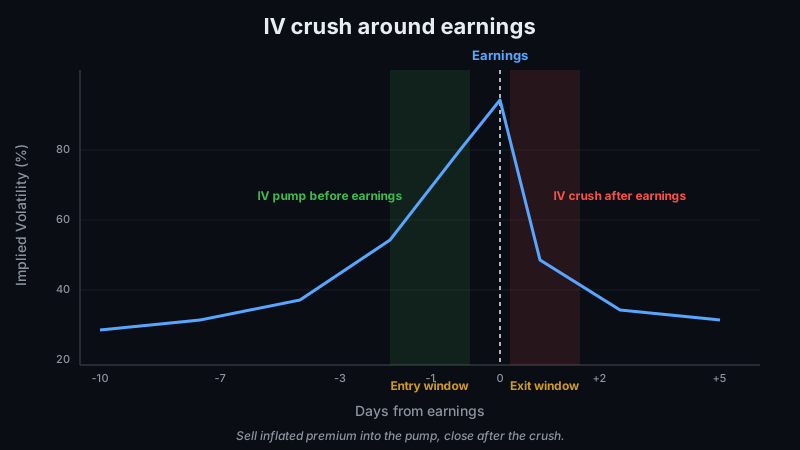
The diagram above shows implied volatility from ten days before earnings to five days after. Notice the shape:
- Days -10 to -5: IV drifts slowly higher. Nothing dramatic. The market is pricing in the coming event.
- Days -5 to 0: IV climbs steeply as the report approaches. This is the pump. The last day is often the steepest.
- Day 0 (the report): IV peaks. This is the entry window for a seller.
- Day +1: IV collapses. The crush. This is where the profit shows up.
- Days +1 onward: IV settles back to baseline.
Two shaded zones on the chart matter most. The entry window (day -2 to -1) is where you sell inflated premium. The exit window (day 0 to +1) is where you close after the crush hits. Everything else is noise.
A real example: NVDA earnings Thursday
NVDA reports Thursday after the close. Wednesday morning, the stock is at $150, IV rank is 85 (extremely elevated). You look at options expiring 30 days out:
- Sell the $145 put + $155 call - both are richly priced due to the pump
- Buy the $140 put + $160 call - defined-risk wings
- Total credit into your account:
$6.00, or $600 per iron condor
Thursday after hours, NVDA reports. The stock moves 3 percent overnight but stays inside the $145-$155 range. Friday morning, IV has crashed from 85 to 45. Same iron condor now trades at $2.00. You close by buying back at $2.00:
Credit collected at entry: $600
Cost to close at exit: $200
Net profit per condor: $400
Ten contracts: $4,000 profit across a 24-hour hold
The video above walks through this exact setup inside GenZTrade's Options Plays panel, including the earnings calendar that flags the report date and the IV rank chip that qualifies the entry.
When earnings plays work best
Three things should line up before you sell into an earnings event:
- High IV rank going in. 60 or higher, ideally 80+. If IV is not pumped, there is no crush to collect. Skip low-IV names entirely.
- Expected move priced into the credit. The options market gives you a straddle price that implies how much the stock is expected to move. Your short strikes should sit outside that expected move.
- No overlapping wild-card catalyst. No FDA decision, no Fed meeting, no litigation ruling scheduled inside your window. One catalyst at a time.
I only trade earnings on liquid tickers with tight option spreads (NVDA, AAPL, MSFT, GOOGL, META, TSLA, AMD, and a few others). Illiquid names have terrible fills that eat the whole edge.
The rules that keep you profitable
Always defined risk
Never sell a naked straddle or strangle into earnings. The overnight gap can be brutal - stocks routinely move two to three times the expected move on bad prints. Defined-risk iron condors cap your loss at the wing width minus the credit. Naked options can wipe out weeks of profit in one report.
Position sized so a wrong-way move does not blow up the account
Sizing rule: a full max-loss on one earnings condor should be less than 2 percent of the account. If you are running ten condors and they all lose max, that is a bad day. If they wipe out the account, you sized too big.
Exit after the IV crush regardless of direction
The whole edge is the volatility collapse. Once IV has crushed, the trade has done its work. Do not hold hoping the stock will drift back into the middle of the range. Close it, book the profit or the loss, move on to the next setup.
Common mistakes I see
Undefined-risk short straddles
The temptation is real - a naked straddle collects way more premium than an iron condor. The math looks incredible until one stock gaps 15 percent on a bad print and one contract wipes out three months of gains. Never do this.
Holding past the crush hoping for more
You sold at IV 85, the crush drops it to 45, and you think "I can wait for 30." Meanwhile, gamma builds up, the stock drifts, and one bad afternoon flips your winner into a loser. The crush is where the edge is. Close after it.
Sizing too big because "this one is a lock"
There are no locks. Every stock can gap 20 percent on a bad print. Size the same way on every earnings condor, whether it feels like a slam dunk or a coin flip. The one you size too big is the one that blows up.
How GenZTrade helps you find these setups
- Earnings Calendar highlights the reports coming this week with IV rank pre-computed, so you can filter to the 60+ names in one view.
- Options Plays auto-generates the multi-leg iron condor cards for earnings candidates, with strikes outside the expected move and the credit shown up front.
- Cockpit alerts you when the IV has crushed and the condor is trading at target so you can close without babysitting the screen.
- Regime chip stays on so you can see whether the broader market is calm enough to run earnings trades or too choppy to add event risk on top of macro noise.
None of this makes the strategy risk-free. It just compresses the setup work down to a few minutes so you can focus on sizing and exit discipline.
Bottom line
Earnings options trading is a volatility play, not a direction play. Sell the pumped premium before the report, close after the crush, size small, defined risk only, no exceptions. The math compounds over an earnings season if you follow the rules. It blows up in one bad print if you do not. Start with paper trades on a couple of names to feel how fast the crush hits. Learn what a max-loss print feels like. Then trade real money when the setup fits your rules.
Frequently asked questions
Should I trade options through earnings?
Only if you understand implied volatility crush. Options prices are inflated 30-60% going into earnings and drop sharply within minutes of the print regardless of direction. Long options usually lose money even on a correct directional call because IV crush overwhelms the delta gain.
What is IV crush?
Implied volatility crush is the sudden collapse in option premiums immediately after an earnings announcement or scheduled event. IV typically drops 40-70% within seconds as the uncertainty resolves, causing long options to lose 30-50% of value even if the underlying moves in your favor.
What is the safest options strategy for earnings?
Iron condors placed after the earnings print, once direction is clear and IV has crushed. You collect premium from IV normalization plus benefit from range-bound post-earnings action. Avoid long straddles and long calls/puts through the print - IV crush usually wins.
Comments (0)