
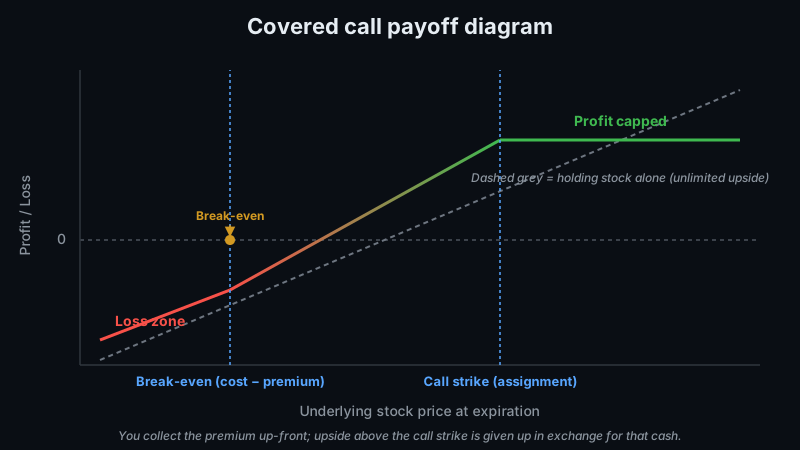
In one sentence: A covered call rents out your stock to someone else for a month or so - you keep the rent cheque no matter what, and you keep your shares unless the stock rockets past a price you already agreed you would be happy to sell at.
What this strategy actually is
You already own 100 shares of a stock. Instead of just holding them and hoping they go up, you also sell one call option against those shares. Someone pays you cash today - the "premium" - for the right to buy your shares from you at an agreed-upon price by an agreed-upon date. If the stock never reaches that price, the option expires worthless and you keep the premium plus all your shares. If it does reach that price, your shares get sold at that price. You still make money - just less than if you had held.
The "covered" part is important. Because you already own the shares, you can always deliver them if the option gets exercised. There is no scenario where you owe more money than you started with. That single feature makes this the safest income strategy in options trading and the one most brokers approve at the basic options level.
The bias: neutral to slightly bullish. The trade wins if the stock stays flat, drifts up a little, or even sells off modestly. It underperforms only if the stock rockets straight up - in which case you still made money, just not as much as you could have.
The payoff picture
The diagram above shows what happens at expiration. Read it from left to right:
- Loss zone (left, red): if the stock closes below your break-even price, you have a paper loss on the shares - but it is smaller than if you had held the stock alone, because you also collected the premium.
- Break-even point (orange dot): the price at which your total position - shares plus premium collected - is exactly flat. It sits below your original cost basis by the amount of premium you got paid.
- Rising zone (middle): between break-even and the call strike, your profit grows one-for-one with the stock. Every dollar the stock rises is a dollar in your pocket.
- Profit-capped zone (right, green): once the stock rises above the call strike, your gains stop growing. The shares get called away at the strike price. You keep the premium plus the gain from your cost basis up to the strike - but nothing above that.
The dashed grey line shows what would have happened if you had held the shares alone with no call sold. Above the strike, the grey line keeps climbing while the green line goes flat. That gap is the price you pay for the guaranteed income. It is not a "loss" - it is opportunity cost.
A real example: Apple at $180
Let us put real numbers on it. Say you own 100 shares of Apple that you bought at $170 per share. Apple is now trading at $180. You look at options expiring in about a month and pick a call strike above the current price:
- Sell one $185 call for $2.50 in premium
- Cash into your account:
$2.50 × 100 = $250deposited today
Here is what the trade looks like across three scenarios one month from now:
Scenario A - Apple stays around $180 at expiration:
The $185 call expires worthless. You keep the $250 premium AND you still own all 100 shares. Return on the month: $250 / $18,000 stock value = 1.4%. Annualized: about 17% just from the calls, on top of whatever the stock itself does.
Scenario B - Apple rises to $184 at expiration:
The $185 call still expires worthless. You keep the $250 premium AND your shares have appreciated to $18,400. Total gain: $650 (premium plus stock appreciation).
Scenario C - Apple rockets to $195 at expiration:
Your call is in-the-money. Your shares get called away at $185. You collect: $250 premium + $1,500 stock gain (bought at $170, sold at $185) = $1,750 total. You missed the extra $1,000 above the strike, but you still made $1,750 on capital of $17,000 - about 10.3% in one month.
Notice something important about Scenario C. Even in the "worst" outcome, you made money. That is the whole point of covered calls - they smooth out returns. You give up the top few percent of an explosive move in exchange for consistent income when the stock moves quietly.
The video walks through this exact Apple setup live inside the GenZTrade Options Plays panel - including the option chain, the strike selection helper, and the risk chart that shows all three scenarios side by side before you commit.
When this strategy works best
Covered calls are not a magic income machine. They work well in specific conditions and poorly in others. Three things should line up before you sell a call against your shares:
- You are neutral to mildly bullish on the stock over the next 30 to 45 days. If you think it is about to rip 20% higher on an earnings surprise, do not cap your upside. If you think it is about to crash, sell the shares instead of collecting a small premium on the way down.
- Implied volatility is elevated but not crazy. Higher IV means richer premium, which means more income per dollar of stock. On the flip side, very high IV usually signals an event risk (earnings, product launch, macro print) - you might be paid well but the stock could jump the strike easily.
- You would genuinely be happy to sell at the strike price. Ask yourself: if the stock ran to my strike and my shares got called away, would I regret it? If the answer is yes, pick a higher strike or skip the trade. The strike is a price you are agreeing to sell at - never pick one you would feel bad about hitting.
Avoid selling calls through earnings unless the volatility crush is your entire play, on stocks you plan to hold long-term for dividends only (the assignment kicks you out of the position and can trigger a taxable event), and on positions that just broke out of a base (that is exactly when the stock is most likely to run past your strike).
The rules that keep you profitable
Any single covered call is a small win. The compounding comes from doing it right dozens of times per year on stable positions. These rules are what separate a boring 12 to 18% annual income overlay from a "why did I give up all my gains" story.
Pick a strike where the probability of assignment is around 20 to 30 percent
Every options chain shows you the "delta" of each strike. A 0.20 delta call has roughly a 20% chance of finishing in-the-money at expiration. That is the sweet spot for covered calls: you get paid meaningful premium but the odds of losing the shares are low. Higher deltas pay more but you will get called away often. Lower deltas barely pay you anything.
Sell 30 to 45 days out
The premium-per-day is best in that window. Weeklies burn theta faster but they are also so cheap that a single sudden move eats the whole month of income. Long-dated calls (60+ days) pay more in dollars but the daily rate of decay is slow, and you are locked up for two months. Thirty to forty-five days is the industry-standard sweet spot for a reason.
Close for 50 percent of max profit if it happens fast
Say you sold the call for $2.50 and two weeks later it is trading at $1.20. You could hold to expiration and try to squeeze the last dollar, but the risk-reward has flipped: you are risking $1.20 to make another $1.20, and the trade only has half its time left. Close it. Redeploy the capital in a fresh call at a fresh strike. The compounding matters more than the last dollar.
Roll up and out if the stock threatens the strike
The stock ran to $184 and your $185 strike is looking shaky. Instead of watching it get called away, "roll" the position: buy back the current call for a small debit and simultaneously sell a new call at a higher strike, a later expiration. Done properly, the roll is either credit-neutral or pays you additional premium. You have effectively bought yourself another month of income at a higher ceiling.
Track your average annualized yield, not per-trade dollars
A $250 premium on $18,000 of stock is 1.4% for a month, or roughly 17% annualized. That is the number that matters. Do not compare a $250 call trade to a $80 credit spread - the capital at risk is completely different. Always think in yield per dollar of capital tied up.
The trade-off you must accept
Here is the honest part most articles skip. Covered calls will occasionally cost you a big move. If Apple runs from $180 to $220 on an earnings surprise, your $185-strike covered call caps you at a $1,750 profit while the buy-and-hold trader made $5,000. That will happen. You will feel it.
The math still works. Across a full year of monthly covered call cycles on a portfolio of stable stocks, the extra income more than makes up for the two or three times you get capped on a big move. But you have to be emotionally prepared to give up the top of a rocket in exchange for boring, consistent, monthly cheques. If you cannot accept that, this strategy is not for you and you should keep buying and holding.
Common mistakes to avoid
Selling calls on stocks you love
Never sell calls on positions you emotionally cannot let go of. If the stock runs past the strike, you will refuse to let the assignment happen, you will keep rolling for debits, and you will bleed money defending a position that the market has already priced beyond your strike. Only sell calls on stocks you would happily part with at the strike price.
Chasing the highest premium
The richest premium always belongs to the highest-risk strike or the longest-dated expiration. Both come with hidden costs: high-delta strikes get called away often (you end up rebuilding positions constantly), and long-dated calls lock up capital while the daily theta grind is slow. Stick with 20 to 30 delta at 30 to 45 days out.
Ignoring earnings dates
An earnings announcement in the middle of your call's life is not a bonus - it is a landmine. IV crushes after the print, the stock can jump 8 to 12 percent in either direction, and your position gets whipsawed. Either close before earnings or, better, pick expirations that avoid the print entirely.
Doubling the position size when you win
You made $250 on one Apple call. You feel great. Next month you sell two calls. Now one bad move costs you twice as much, and your capital concentration in Apple is higher than your risk plan allows. Grow position size slowly, in step with account growth - not in step with recent wins.
How GenZTrade helps you run this strategy
The platform was built with income strategies like covered calls in mind. Here is the workflow:
- Portfolio reads your Fidelity CSV and shows every long stock position that qualifies for covered calls (100+ shares, liquid options chain).
- Options Plays auto-generates covered call cards for each qualifying position - with strike, expiration, premium, delta, break-even, and annualized yield pre-computed.
- Intel Panel pulls the underlying stock's option flow, news sentiment, and upcoming earnings date so you can vet the call before selling it.
- Cockpit tracks the sold call intraday and pings you when the 50%-profit take-profit level hits or the stock threatens the strike.
None of this replaces judgment. What it does is compress the "which strike, which month, which stock" decisions from an hour of clicking around a brokerage into a two-minute review of pre-scored candidates. You spend more time thinking about which stocks belong in the strategy and less time hunting for the right option chain.
Bottom line
Covered calls are boring in the best way. Done consistently on a portfolio of stable stocks you are happy to hold - or happy to sell at the right price - they add 10 to 18 percent of annualized income on top of whatever the stocks themselves do. The catch is you have to accept giving up occasional explosive upside in exchange for that consistency. If that trade-off makes sense to you, start with one covered call on one position, close it for 50 percent of max profit, and repeat until the muscle memory is second nature. Then scale from there.
Frequently asked questions
What is a covered call?
A covered call is an income strategy where you own 100 shares of a stock and sell one call option against those shares. You collect the premium up-front and keep it regardless of what the stock does. Your shares get called away only if the stock rises above the strike at expiration.
How much money can I make selling covered calls?
Typical monthly returns are 1-1.5% of the underlying stock value, or roughly 12-18% annualized on top of any stock appreciation. Actual results depend on strike selection, implied volatility, and how many months per year the position gets called away.
What delta should I sell covered calls at?
The sweet spot is 0.20-0.30 delta strikes 30-45 days to expiration. This gives you meaningful premium while keeping the probability of assignment (losing the shares) around 20-30%. Higher deltas pay more but you get called away often.
Should I sell covered calls before earnings?
Generally no. Earnings announcements typically move the stock 5-10% in either direction, easily jumping through the call strike. If the volatility crush is not your entire play, either close the call before earnings or pick expirations that avoid the print entirely.
What happens if my covered call gets assigned?
Your 100 shares are sold at the strike price and you keep the premium plus any capital gain from your cost basis up to the strike. You still made money - you just gave up any additional upside above the strike. Then you either repurchase the shares or move the capital to a new position.
Comments (0)