
In one sentence: Long call gives you unlimited upside but pays a fat premium. Bull call spread caps your upside but costs a fraction as much - the right choice depends on how expensive options are today.
What this actually is
Both structures are bullish trades on the same underlying with the same directional thesis. They behave completely differently in the P and L, in the timing, and in how implied volatility affects them.
Think of a long call like buying a lottery ticket. You pay a premium and if the stock rockets, your payoff is huge. Think of a bull call spread like buying a lottery ticket AND selling one for lower odds - you finance part of your ticket cost by giving up the tail upside. Costs less. Wins less. Way better math when the ticket price is high.
The insight: the right structure is not a matter of preference. It is a matter of how expensive options are right now. Implied volatility rank decides most of the answer before you even look at the setup.
The picture
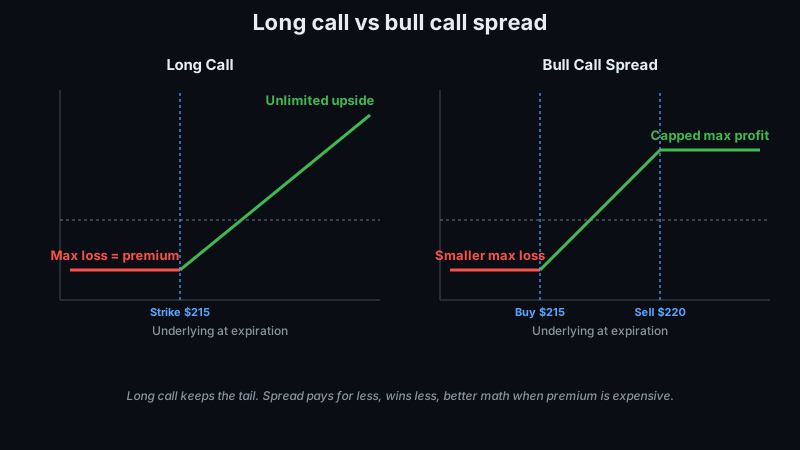
The diagram above shows both payoffs side by side. Left panel: long call. Max loss is the premium paid. Above the strike, profit runs up and to the right without a ceiling. Right panel: bull call spread. Max loss is a smaller premium. Above the sold call's strike, profit flatlines at the cap. That capped ceiling is why the spread cost less to open - you sold that upside to fund the trade.
A real example: AAPL at $210
AAPL is trading at $210 with an IV rank of 40 - elevated but not extreme. Thesis is bullish continuation over the next 2 weeks with a target of $220.
Option 1 - long $215 call. Pay $6 in premium. Risk: $600 per contract. Break-even at expiration: $221. If AAPL closes at $220 on expiration, the call is worth $5 intrinsic - $6 debit = $1 loss per share, or a $100 loss per contract. It only pays off if AAPL clears $221.
Option 2 - $215/$220 bull call spread. Buy the $215 call at $6, sell the $220 call at $4. Net debit: $2 per share, or $200 per contract. Risk: $200. Break-even: $217. Max profit at any close at or above $220: $5 width minus $2 debit = $3 per share, or $300 per contract. That is a 150 percent return on risk if the target hits.
Compare the two side by side. At $220, the outright call loses $100. The spread wins $300. Below $220, the spread breaks even faster. Above $220 the outright call would eventually catch up and pass the spread's cap, but only if AAPL blows past target. When premium is elevated (IV rank 40+), the spread almost always wins on the base case.
The video above walks through this decision live inside GenZTrade's Options Plays panel, showing how both variants are auto-generated for every bullish signal with the debit, break-even, and max profit already computed.
When it works best
- Use long call when IV rank is below 30. Premium is cheap. Do not give up the upside for a small credit. Keep the tail.
- Use bull call spread when IV rank is above 60. Premium is expensive. Selling the higher strike offsets the cost meaningfully.
- Use long call for longer timeframes (over 4 weeks). More time means more chance the stock runs past target. Do not cap that upside.
- Use bull call spread for defined-risk sizing. Smaller debit means the position fits cleanly into a per-trade risk cap.
The rules that keep you profitable
Let IV rank decide first, then the other factors
IV rank above 60: use spread. IV rank below 30: use long call. In the 30 to 60 zone, let conviction, timeframe, and sizing decide. This one rule captures most of the correct-structure decisions before any of the other analysis matters.
Never open either into an earnings report
Do not open either structure heading into a name's earnings report unless the earnings play itself is the entire thesis. Both die on the post-earnings IV crush - the long call because its extrinsic value collapses, the spread because both legs collapse together and the net position hardly moves. The move that would make the trade work has to fight the volatility drag.
Cap concurrent long calls
Long calls pay off in lumpy hits and take small losses when they do not. Too many concurrent positions means every one has to work to hit the target return, and options do not cooperate at that scale. Cap the number of concurrent long calls at a level your account and psychology can absorb. Same discipline for spreads.
Pre-define your stop for each structure
For long calls, a fixed percent of debit (typically 50 percent of premium paid) triggers the exit. For spreads, a fixed dollar or credit-multiple stop. Set it before entry so a losing trade never becomes a debate at the moment of the stop.
Common mistakes I see
Buying expensive premium because "the setup is amazing"
The setup might be amazing. The premium math on an expensive long call still does not work. If IV rank is 80 and you buy the outright call, the stock has to move meaningfully in your direction just to overcome the built-in premium decay. Use the spread. Give up the tail. Keep the math.
Selling the spread's short call too close to the money for extra credit
A tighter spread pays more credit but also caps you at a smaller max profit and gets you assigned into a losing position more often. Keep the spread wide enough that your short strike sits above your directional target.
Chasing structures in volatile regime
When VIX is above 30, both structures get whipsawed. Long calls stop out repeatedly on intraday reversals. Spreads see their short leg keep threatening to blow through. In high-VIX regimes, sit out until VIX cools or restrict to defined-risk index spreads.
Using either structure in chop
Chop kills long calls with theta. It partially kills spreads with the same. If the underlying is trapped in a range with no catalyst, neither structure earns anything. This is where credit spreads and iron condors take over.
How GenZTrade helps you find these setups
- Options Plays auto-generates both variants for every bullish signal - long call card and bull call spread card side by side, with debit, break-even, and max profit already computed.
- IV rank chip on each card shows whether premium is cheap or expensive, so the primary decision from the framework above is already made for you.
- Regime detection hides both structures on chop days so you do not fall into the theta trap.
Bottom line
The whole decision that used to take 10 minutes of options-chain analysis compresses to about 30 seconds when the platform surfaces both structures with the IV context already labeled. IV chip green: long call. IV chip red: spread. Conviction and timeframe come from the setup itself. Pick the structure that fits and skip the chain-diving.
Related reading
- Bull put credit spread setup guide (with real trade examples)
- Options plays: matching strategy to market regime
Frequently asked questions
What is the difference between a long call and a bull call spread?
A long call gives unlimited upside but requires paying the full premium. A bull call spread sells a higher-strike call against it, reducing cost by 40-60% but capping upside at the short strike. Long calls win on explosive moves; bull call spreads win on steady moves.
When should I use a long call vs a bull call spread?
Long calls fit when you expect a large one-directional move (earnings surprise, catalyst-driven breakout). Bull call spreads fit when you expect a moderate move to a specific target and want lower capital risk and better probability of profit.
Which is better for beginners: long calls or bull call spreads?
Bull call spreads. Lower absolute cost, defined maximum loss, higher probability of profit, and easier position sizing. Long calls have a lower win rate (typically 30-40%) that beginners often underestimate due to occasional big winners.
Comments (0)