
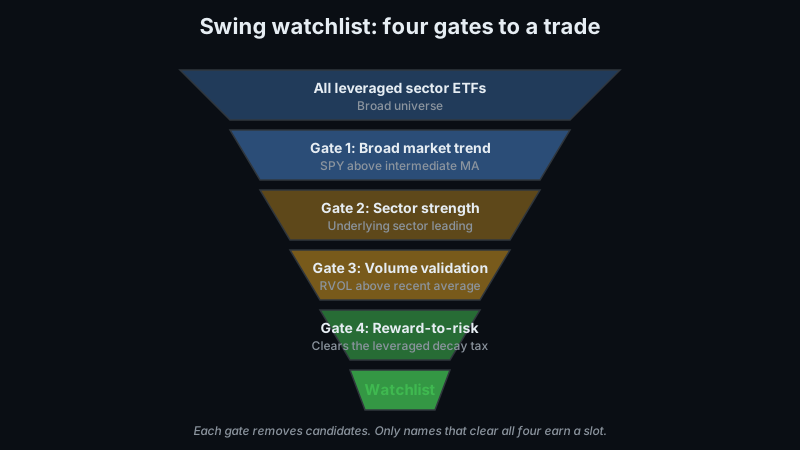
In one sentence: A leveraged ETF swing watchlist works when every candidate has to pass four filters - broad market, sector, volume, and reward-to-risk. Anything less is a coin flip.
What this actually is
Most swing traders lose money for a reason that has nothing to do with their entry timing or their stop discipline. They lose because their watchlist is broken. A random collection of tickers pulled from social media, screener defaults, and gut instinct produces random results. Whipsaw setups get taken because the trader has no framework for filtering out low-probability candidates before they get to the entry decision.
Think of building a swing watchlist like a security checkpoint at an airport. The more filters your name passes, the higher your priority for boarding. Names that clear one filter but fail the rest do not make the list. Names that clear all filters get first-class treatment. The whole point of the framework is to reduce the trade universe from "every leveraged ETF that showed up on a screener" to a handful of setups per week where the environment already favors follow-through.
The insight: the leverage that makes 2x and 3x ETFs attractive is the same leverage that punishes bad entries. Multi-factor confirmation is not paranoia. It is the difference between a strategy that compounds over 100 trades and a strategy that gets crushed by the second losing streak.
The picture
The diagram above is a funnel. The wide top is the universe of major sector leveraged ETFs - broad indices, tech, semis, financials, small caps, healthcare, and a few sector rotators. Each layer down is a gate. Gate 1: broad market trend intact. Gate 2: sector strength confirmed. Gate 3: volume validation on the entry bar. Gate 4: reward-to-risk math clears the leveraged decay tax. Only names that pass all four filters land in the narrow bottom - the actual watchlist.
A real example: TQQQ
TQQQ is 3x long QQQ. Run the checklist Sunday evening ahead of the trading week.
Gate 1: broad tape. QQQ closed above its 50-day moving average and above its 20-day. Both moving averages are sloping up. Pass.
Gate 2: sector strength. The semiconductor sub-sector - the largest single driver of QQQ - is leading the tape on the week. XLK broke above prior consolidation on volume. Pass.
Gate 3: volume validation. TQQQ's premarket relative volume is running 1.5x its 20-day average. Real capital is committing to positions ahead of the open. Pass.
Gate 4: reward-to-risk. Entry $89, stop $85 (below the recent swing low with a leverage-appropriate buffer), target $99 (the prior swing high). Risk $4, reward $10, ratio 2.5:1. That clears the required hurdle. Pass.
All four gates green - TQQQ makes the watchlist. Now compare: if the target had been $95 instead of $99 (only $6 reward for $4 risk, 1.5:1), gate 4 would have failed and the trade would not have been taken. That is the whole point. Three of four gates cleared and the trade still gets skipped because the reward-to-risk math does not compensate for the leveraged decay tax.
The video above walks through this checklist live inside GenZTrade's Workbench Scanner, showing how the multi-factor confirmation surfaces qualifying names automatically.
When it works best
- Broad market is in a durable uptrend on the intermediate horizon. Long leveraged setups have wind at their back. If the broad tape has flipped, oversold bounces do not follow through.
- Sector rotation favors your candidate's underlying. Sectors rotate faster than the broad market. Even a strong candidate gets pulled down when its sector is being sold.
- Reward-to-risk math clears the decay tax with room to spare. A 1:1 setup does not compensate for the daily rebalance drag on leveraged products.
The rules that keep you profitable
Require all four gates before size goes on
Any single factor in isolation gives you what can look like a decent setup. The problem is that partial-confirmation setups have real follow-through at rates far below fully-confirmed setups. Insisting on the joint condition is what turns a coin-flip strategy into a durable edge.
Rotate the list weekly
On Sunday evening, re-run the confirmation scan against the entire master list. Names that cleared broad-tape and sector checks last week get "primary" status - watch them Monday morning for volume and reward-to-risk entries. Names that failed get demoted. The management ritual matters because leveraged ETFs decay when you hold them without a strong tape.
Size to setup quality
Setups where every factor barely clears deserve smaller size. Setups where broad tape, sector, volume, and reward-to-risk are all decisively stacked in your favor can carry more weight. Do not use the same size on a marginal setup and an A+ setup.
Respect the stop
Leveraged ETFs magnify moves in both directions. A stop that would work fine on a 1x underlying can be blown through by a 3x product on a normal-looking day. Stops need to sit far enough from entry to survive the instrument's typical intraday noise while still respecting the amplified move on any real reversal.
Common mistakes I see
Doubling down on losers
The leverage that made the initial position attractive is the same leverage that punishes averaging down. If TQQQ is down 8 percent from your entry, doubling the position does not average the basis. It doubles the exposure to the underlying decay engine while the thesis is already invalidated by price action. Take the loss.
Ignoring the sector when SPY looks fine
SPY can be up 1 percent on the week while individual sectors are down. Buying TQQQ because "the market looks strong" without checking that the underlying sector is participating is how you end up long a leveraged product against a weak sector. The gate 2 check exists for exactly this reason.
Using leveraged ETFs on chop days
Chop days combine no directional edge with leveraged decay. Price does not move and the daily rebalance is punishing regardless. If the tape is chop, leveraged ETFs sit on the shelf. The confirmation framework naturally screens for this because the broad-tape or sector checks usually fail on chop days.
Skipping the reward-to-risk gate
Three gates clearing is not enough. The math on entry-target-stop has to compensate for the leveraged decay tax. A 1.5:1 setup on a 3x product does not clear the hurdle. Skip trades where the reward-to-risk math is thin, even if everything else is green.
How GenZTrade helps you find these setups
- Workbench Scanner runs multi-factor confirmation across the leveraged ETF universe automatically. Instead of manually checking each factor every morning, only the names where confirmation is clean surface.
- Cockpit tracks concurrent leveraged ETF positions against your predetermined cap. If a new fully-confirmed alert fires while you are at the cap, Cockpit lets you compare the incoming setup to your weakest open position.
- Regime detection throttles the entire leveraged ETF universe on chop-tagged days because the decay tax overwhelms most setups when the tape is not trending.
Bottom line
Random watchlists produce random results. The four-gate confirmation framework - broad tape, sector, volume, reward-to-risk - reduces the universe to a handful of setups per week where the environment already favors follow-through. Rotate the list weekly. Size to setup quality. Respect the stop. That discipline compounds a leveraged ETF strategy instead of grinding it down through decay and whipsaw.
Related reading
- Momentum scanner criteria: what actually predicts follow-through
- How High Volume Points identify support and resistance
- Options plays: matching strategy to market regime
Frequently asked questions
What is a 4-gate confirmation for swing trades?
A 4-gate confirmation requires four independent signals to line up before entry: (1) trend gate (200-day MA rising), (2) momentum gate (relative strength positive over 20 days), (3) volume gate (accumulation via OBV or CMF), (4) chart gate (breakout from valid base). Filters most false signals.
How long do swing trades typically last?
Swing trades on leveraged ETFs and mega-cap stocks typically hold 3-15 trading days. Exits trigger on: 4-gate breakdown, break of 20-day moving average, or trailing stop at 1.5x ATR. Longer holds transition into position trades with wider stops.
Should I use leveraged ETFs for swing trading?
Only with explicit position sizing rules. 2x and 3x leveraged ETFs compound daily rebalancing decay in choppy markets. Trade only in strong-trend regimes, size at 40-50% of what you would trade in the underlying, and set stops that respect the leverage multiplier.
Comments (0)