
In one sentence: A chop day is when the market goes sideways all session. If you spot it in the first 30 minutes, you can stop hunting breakouts and switch to strategies that get paid when nothing happens.
What this actually is
A chop day is a session where price just oscillates. Small range, no direction, every breakout fails within two candles. VWAP acts like a magnet - price keeps returning to it. On days like this, traders who try to force momentum setups usually finish the day down $400 not from one bad trade but from paying commissions and slippage on ten small losers.
Think of trading a chop day like fishing in a small pond. The fish (profit) are there, but you have to work them, not chase big moves. That means switching from strategies that need price to run to strategies that profit when price just sits there.
The insight: chop days are not something to fear or avoid. They are something to plan for. Roughly a third of trading days look like chop by any reasonable checklist. If you show up trying to force momentum every one of them, the account bleeds by attrition.
The picture
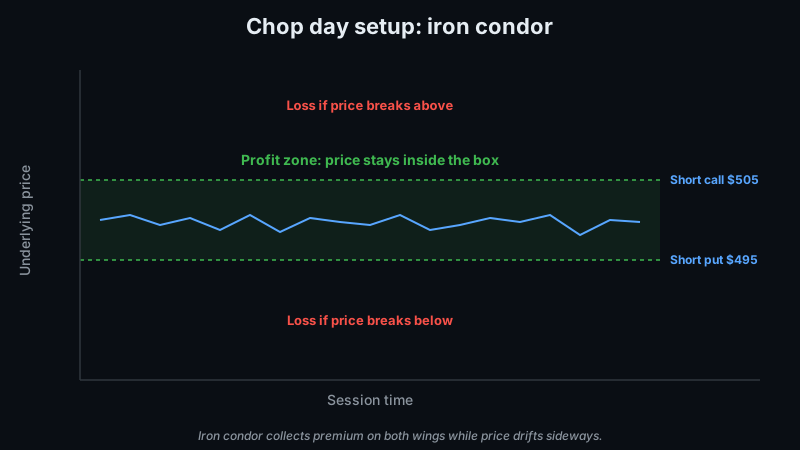
The diagram above shows exactly what a chop day looks like structurally and how an iron condor sits on top of it. Price oscillates inside a range. The iron condor sells options on both wings of that range. As long as price stays inside the box through expiration, both wings expire worthless and the trader keeps the premium collected up front.
A real example: SPY at $500
SPY opens today at $500. By 10 AM, the range is $499.20 to $500.80 - a 30 cent swing over the first 30 minutes. VWAP has been touched four times. ADX is 17 (below 20 is textbook non-trending). No clear direction from index futures. The 30-minute chop checklist is fully ticked.
Instead of trying to catch a breakout, set up an iron condor on SPY. Sell the $505 call and $495 put, buy the $506 call and $494 put as wing protection. Collect about $0.80 in credit per contract - so $80 per iron condor. Max loss is capped at $500 - $80 = $420 per contract. As long as SPY stays between $495 and $505 into expiration, both wings expire worthless and you keep the full $80.
The video above walks through this setup live inside GenZTrade's Options Plays panel, including how the regime detector auto-flips to chop and surfaces credit-spread candidates.
When it works best
- ADX(14) on the daily is below 20. That is textbook non-trending. The technical evidence for chop is on the chart itself.
- VIX between 15 and 25. Below 15 is a low-volatility crawl that can still trend slowly. Above 25 is stress that usually produces directional moves. The 15 to 25 zone is the natural home of chop.
- SPY and QQQ disagree on direction. If one is up 0.2 percent and the other is flat or down, there is no consensus. Single-name breakouts whipsaw with the index cross-currents.
The rules that keep you profitable
Run the checklist by 10 AM Eastern
Do not diagnose chop by watching one breakout fail. Diagnose it by looking at the structural conditions in the first 30 minutes and recognizing that the environment does not support directional trades - before you take any. Opening range under 0.5 percent of price, VWAP touched three or more times, ADX under 20, SPY and QQQ diverging. Three or more of those fire, treat the session as chop.
Cut position sizing across the board
Once chop is confirmed, momentum size gets halved. Long calls get skipped entirely - theta bleed dominates when the underlying is not moving. Credit spread count gets reduced from your normal max, because chop days can flip into breakdown days if a headline hits. Keep dry powder in case the regime shifts.
Close winners at 50 percent of max profit
On the SPY iron condor, the $80 credit becomes a $40 target. Why leave $40 on the table? Because the last half of the credit takes disproportionately long to earn, and every day closer to expiration the position gets more sensitive to a surprise move. Bank the win, redeploy the capital.
Stop the day if the loss cap hits
Set a hard dollar cap for a bad day. If chop days flip on you and the loss cap hits, stop trading. Log the trades, come back tomorrow. Trying to "make it back" in one session is how a small loss becomes a big loss.
Common mistakes I see
Taking every breakout candle as a real signal
A chop day can look like an early trend day for the first 20 minutes. A breakout candle prints, volume spikes, you get in. Then the follow-through never comes, price drifts back through your entry, your stop takes you out. Repeat five times and the account is down. The fix is to wait for the checklist to confirm before taking any directional trade.
Holding long calls into chop
Long calls on a chop tape lose 5 to 8 percent of extrinsic value per session from theta decay alone. Two chop days in a row and the position needs a 15 percent move to break even - which is not coming on a chop day either. Skip long calls entirely once chop is confirmed.
Averaging down into a losing spread
The temptation on any spread that goes against you is to add size to "reduce cost basis." What you actually do is double the exposure to a losing thesis. Take the defined loss. Move on.
How GenZTrade helps you find these setups
- Regime detection tags each session as "chop", "bull", "bear", or "volatile" based on the structural checklist above. When the tag flips to chop, the platform biases the alerts and the playbook accordingly.
- Options Plays auto-generates bull put credit spread and iron condor cards for qualifying underlyings, with strikes, credit, break-even, and probability pre-computed.
- High Volume Points overlays support levels on the chart so you can position your iron condor's short strikes below meaningful support and above meaningful resistance.
Bottom line
Chop days are not something to avoid. They are a specific regime with a specific playbook. Run the checklist by 10 AM. If three or more signals fire, switch strategies before you have taken a single directional trade. The discipline of doing this consistently is what separates the traders who compound through the year from the ones who grind down the account trying to force momentum onto a tape that will not cooperate.
Related reading
- Bull put credit spread setup guide (with real trade examples)
- Reading RSI(2) for oversold bounces: a systematic approach
- Momentum scanner criteria: what actually predicts follow-through
Frequently asked questions
What is a chop day in trading?
A chop day is one where price moves in a narrow range with frequent direction reversals and no sustained trend. Chop days destroy directional trading strategies because entries and exits get whipsawed. Recognizing chop early lets you shift to premium-selling strategies or stand aside.
How do I know if today will be a chop day?
Signs before 10:30 AM ET: opening range narrower than 40% of ATR, VIX above 20 with no meaningful move, price oscillating around VWAP without commitment, and low sector-rotation breadth. Two or more signals present = high chop probability.
What strategies work on chop days?
Iron condors, short strangles, and premium-selling on liquid indexes benefit from range-bound action and elevated IV. Avoid directional day trades, momentum breakouts, and long options. Better yet: reduce position count 50-70% and preserve capital for trend days.
Comments (0)